
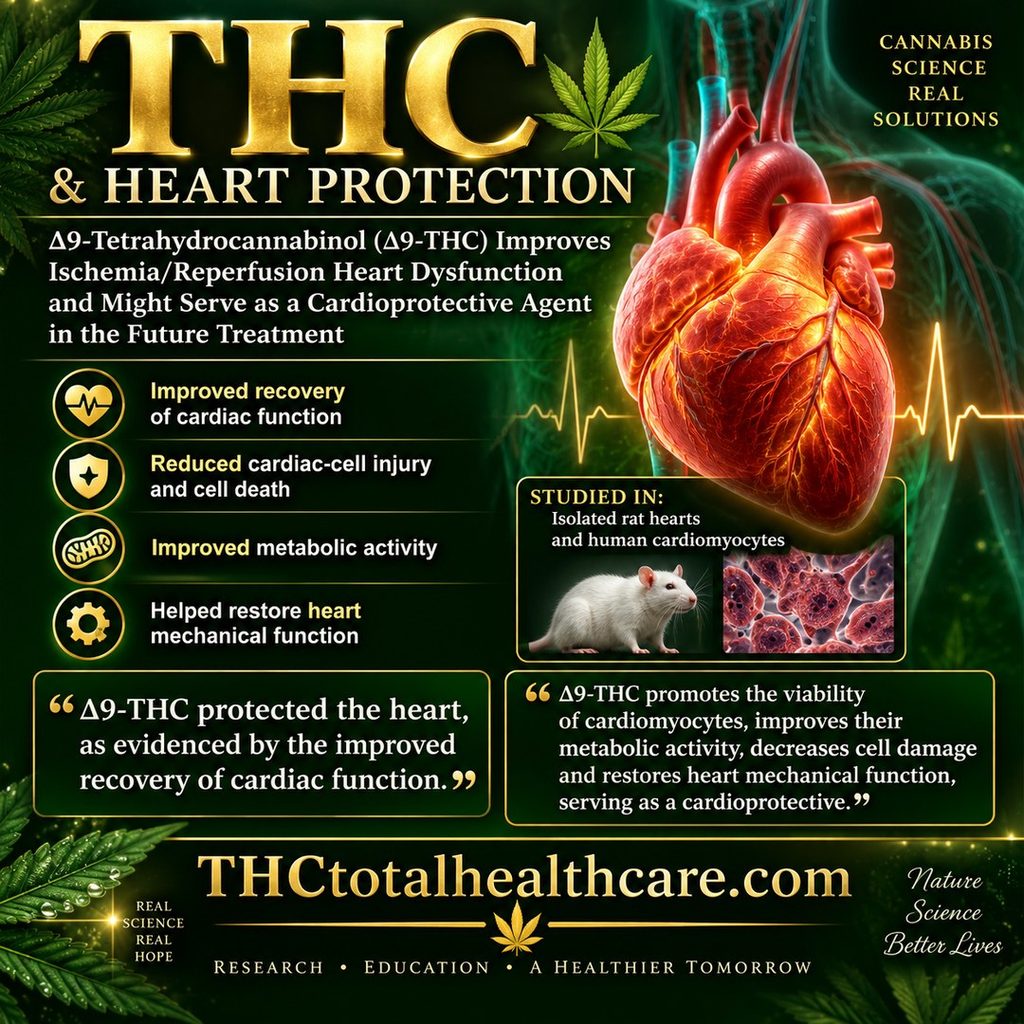
Researchers examined whether Δ9-THC could protect heart tissue from ischemia/reperfusion injury—the damage that can occur when blood flow returns after a period of oxygen deprivation. Using isolated rat hearts and human cardiac cells, the study found that THC improved recovery of heart function, reduced cellular injury and death, supported antioxidant defenses, and helped restore normal cardiac mechanical function.
“Background: Ischemia/reperfusion (I/R) is a pivotal mechanism of organ injury during clinical stetting for example for cardiopulmonary bypasses. The generation of reactive oxygen species (ROS) during I/R induces oxidative stress that promotes endothelial dysfunction, DNA dissociation and local inflammation. In turn, those processes induce cytokine release, resulting in damage to cellular structures and cell death. One of the major psychoactive compounds of Cannabis is delta-9-tetrahydrocannabinol (Δ9-THC), which is known as an anti-inflammatory mediator. Our research aimed to test if Δ9-THC may be protective in the treatment of cardiovascular system dysfunction arising from I/R heart injury.
Methods: Two experimental models were used: isolated rat hearts perfused with the Langendorff method and human cardiac myocytes (HCM) culture. Rat hearts and HCM underwent ex vivo/chemical in vitro I/R protocol with/without Δ9-THC treatment. The following parameters were measured: cell metabolic activity, morphology changes, cell damage as lactate dehydrogenase (LDH) activity, ceramide kinase (CERK) activity, ROS level, total antioxidant capacity (TAC) and heart hemodynamic parameters.
Results: Δ9-THC protected the heart, as evidenced by the improved recovery of cardiac function (p < 0.05, N = 3-6). Cells subjected to I/R showed lower cytoplasmic LDH activity, and 10 μM Δ9-THC treatment reduced cell injury and increased LDH content (p = 0.019, N = 6-9). Morphology changes of HCM-spherical shape, vacuolisation of cytoplasm and swollen mitochondria-were inhibited due to Δ9-THC treatment. I/R condition affected cell viability, but 10 μM Δ9-THC decreased the number of dead cells (p = 0.005, N = 6-9). The total level of CERK was lower in the I/R group, reflecting oxidative/nitrosative stress changes. The administration of Δ9-THC effectively increased the production of CERK to the level of aerobic control (p = 0.028, N = 6-9). ROS level was significantly decreased in I/R cells (p = 0.007, N = 6-8), confirming oxidative stress, while administration of 10 μM Δ9-THC enhanced TAC in cardiomyocytes subjected to I/R (p = 0.010, N = 6-8).
Conclusions: Δ9-THC promotes the viability of cardiomyocytes, improves their metabolic activity, decreases cell damage and restores heart mechanical function, serving as a cardioprotective. We proposed the use of Δ9-THC as a cardioprotective drug to be, administered before onset of I/R protocol.”
https://pubmed.ncbi.nlm.nih.gov/35468673/
“In conclusion, in this study we found that Δ9-THC promotes the viability and improves the metabolic activity of cardiomyocytes, as well as decreasing cell damage and restoring heart mechanical function, proving that it has a cardioprotective function at the pre-treatment level.
We propose the use of THC as a potentially cardioprotective compound to be, administered before ischemia and during the first minutes of reperfusion.
We hope that this cannabis product may be included in future clinical investigations using similar models of ischemia-reperfusion injury. We also recommend the presented data to be considered alongside clinical observations of patient outcomes with history of cannabis use.”
https://www.imrpress.com/journal/FBL/27/4/10.31083/j.fbl2704114
Need this THC study explained? thcXplained.com