Cannabis sativa extracts reduce inclusion formation in a cell model of alpha-synuclein aggregation

pubmed logo

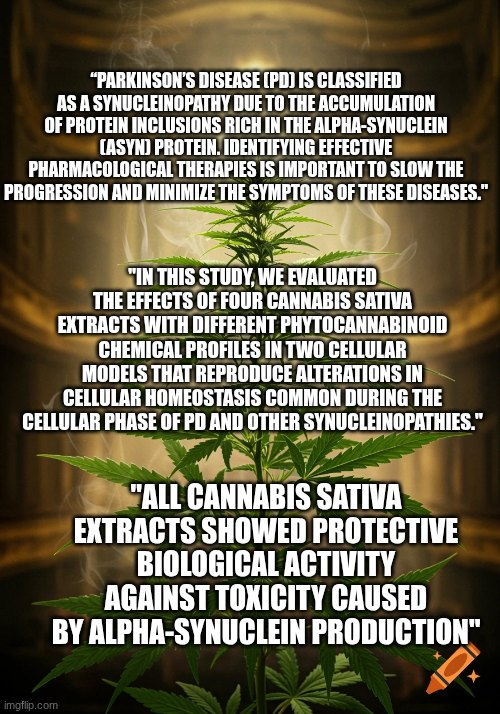
“Parkinson’s disease (PD) is classified as a synucleinopathy due to the accumulation of protein inclusions rich in the alpha-synuclein (aSyn) protein. Identifying effective pharmacological therapies is important to slow the progression and minimize the symptoms of these diseases.

Cannabis sativa has a diverse chemical profile depending on its genotype, including several classes of substances, such as cannabinoids, flavonoids, terpenes, and alkaloids.

In this study, we evaluated the effects of four C. sativa extracts with different phytocannabinoid chemical profiles in two cellular models that reproduce alterations in cellular homeostasis common during the cellular phase of PD and other synucleinopathies. We used Saccharomyces cerevisiae strains transformed with plasmid DNA and genetically modified human cells (H4), both expressing aSyn.

The results showed that all the extracts were antioxidants, decreasing intracellular oxidation levels and increasing the number of daughter cells in yeast cells, but did not prevent mitochondrial damage. Besides, the extracts reduced the number of intracellular inclusions in H4 cells and increased the number of cells without inclusions.

Phytochemical characterization revealed extracts rich in Tetrahydrocannabinol – THC (69.88 %), Cannabidiol – CBD (52.64 %), and Cannabinol – CBN (47.38 % and 58.64 %), and we concluded that, regardless of these percentages, all C. sativa extracts showed protective biological activity against toxicity caused by alpha-synuclein production, both in yeast cells and H4 cells.”

https://pubmed.ncbi.nlm.nih.gov/41187864/

“Four Cannabis sativa extracts rich in different phytocannabinoids (THC, CBD, and CBN) demonstrated antioxidant potential independent of their chemical profiles. A decrease in the intracellular oxidative environment in the Saccharomyces cerevisiae model with aSyn indicates that the extracts (E-THC, E-CBD, E-CBN and E-CBN+) may contribute to maintaining cellular redox homeostasis, minimizing potential effects related to the development of Parkinsonism.”

https://www.sciencedirect.com/science/article/abs/pii/S0367326X25005945?via%3Dihub

The Endocannabinoid System: Pharmacological Targets and Therapeutic Potential in CNS Disorders

pubmed logo

“The endocannabinoid system (ECS) influences a wide range of brain functions, including synaptic transmission, neuroplasticity, emotion, and immune regulation within the central nervous system, with CB1 and CB2 receptors mediating various neurophysiological and pathophysiological outcomes. Thus, growing interest in its therapeutic potential has prompted extensive research into how cannabinoid receptors contribute to the pathophysiology of neurological and psychiatric disorders, particularly CB1 and CB2.

This review has integrated findings from studies published between 2015 and 2025, covering conditions, like depression, anxiety, pain, multiple sclerosis, and Parkinson’s disease. We have also examined recent advances in receptor pharmacology and experimental technologies, including cryo-EM, optogenetics, and chemogenetics.

Although ECS-targeted therapeutics hold considerable promise, some key challenges remain in establishing safe and effective dosing protocols and integrating these approaches into clinical frameworks.

This review has provided an updated perspective on the system’s role in brain health and its potential to inform future therapeutic directions. Thus, ECS-targeted strategies may become increasingly important in managing and treating central nervous system disorders.”

https://pubmed.ncbi.nlm.nih.gov/41178765/

https://www.eurekaselect.com/article/151549

Cannabidiol and Parkinson’s disease: Investigating receptor interactions and their therapeutic implications

pubmed logo

“Cannabidiol (CBD) is one of the major active constituents among the several hundreds of compounds found in the cannabis plant. It is a non-psychoactive compound known for its anti-inflammatory, neuroprotective, antidepressant and anxiolytic effects.

In preclinical studies it has shown to be effective, safe, and well-tolerated in mitigating the symptoms associated with Parkinson’s disease (PD) and other neurodegenerative diseases. However, the mechanism of action is not fully characterised.

CBD is postulated to exert its therapeutic effects through its interaction with the endocannabinoid system (ECS), and via interaction with a large array of non-cannabinoid receptors, neurotransmitters, and enzymes. These interactions are complex and are influenced by cell type, concentration and exposure time.

The lack of specificity for a single receptor system makes CBD an intriguing therapeutic compound and enables it to influence multiple pathways. This broad interaction goes beyond its beneficial therapeutic effects and could lead to potential adverse effects. Detailed understanding of the versatility and complexity of how CBD exerts its effect is required so that the true potential as a therapeutic option can be realised.”

https://pubmed.ncbi.nlm.nih.gov/41161354/

“Most of the available preclinical studies investigating the effects of CBD in PD have demonstrated predominantly positive outcomes, with only a few reporting mild adverse effects such as diarrhea. The positive therapeutic effects include significant reductions in tremor and rigidity, along with improvements in sleep and overall quality of life.”

https://www.sciencedirect.com/science/article/abs/pii/S016372582500155X?via%3Dihub

Oromucosal as an Alternative Method for Administration of Cannabis Products in Rodents

pubmed logo

“Oral administration of drugs in laboratory rodents such as rats is conventionally performed using the gavage technique. Despite effectiveness, gavage can induce distress associated with restraint, especially following repeated animal handling.

To mitigate these adverse effects and reduce morbidity associated with traditional methods, we explored oromucosal/buccal administration of cannabidiol (CBD)-enriched Cannabis extract.

In this method, male rats were treated daily for 15 days with medium-chain triglycerides (TCM) derived from coconut oil or CBD-enriched Cannabis extract. Each treatment was administered individually while animals were gently immobilized using an affectionate touch technique. The administration involved the use of a micropipette to apply the oily formulation directly into the oral mucosa. The dosage was calculated based on the CBD concentration in the Cannabis extract, standardized at 3 mg/kg/day. To ensure accuracy, animals were weighed daily, allowing for dose adjustments in accordance with weight changes over the treatment period. This method offers non-invasive and stress-reducing treatment, potentially improving animal welfare in experimental settings.

The treatment with CBD-enriched Cannabis extract was safe, and the analysis of the hippocampus of these animals’ showed alterations in the expression levels of GluA1 and GFAP proteins, which are directly associated with glutamatergic receptor functionality and neuroinflammation, respectively. This suggests that Cannabis extract could be applied in pathological conditions where glutamatergic excitotoxicity and astrogliosis are observed.”

https://pubmed.ncbi.nlm.nih.gov/40920655/

https://app.jove.com/t/68104/oromucosal-as-an-alternative-method-for-administration-cannabis

Anti-Inflammatory Effects of Cannabinoids in Therapy of Neurodegenerative Disorders and Inflammatory Diseases of the CNS

pubmed logo

“Many neurodegenerative diseases are associated with immune system disorders, while neurodegenerative processes often occur in inflammatory conditions of the Central Nervous System (CNS).

Cannabinoids exhibit significant therapeutic potential due to their dual ability to modulate both neural and immune functions. These compounds have a broad spectrum of action, allowing them to target multiple pathological mechanisms underlying neurodegenerative and inflammatory CNS diseases.

The present review outlines the therapeutic potential of cannabinoids, with a focus on their anti-inflammatory properties, in the treatment of neurodegenerative conditions, including Alzheimer’s disease, Parkinson’s disease, amyotrophic lateral sclerosis, and Huntington’s disease, as well as inflammatory CNS disorders like multiple sclerosis and HIV-associated dementia.”

https://pubmed.ncbi.nlm.nih.gov/40724820/

“Cannabinoids, the active compounds derived from Cannabis sativa, are attracting increasing interest for their therapeutic potential in neurodegenerative disorders (Parkinson’s disease, Alzheimer’s disease, and Huntington’s disease) and inflammatory CNS conditions (multiple sclerosis and HIV-associated dementia).

Their multimodal mechanisms of action include the following: (1) modulating pathological protein aggregation and mitochondrial dysfunction, and (2) exerting neuroprotective and anti-inflammatory effects which are mediated through microglial regulation.

The neurodegenerative diseases and inflammatory CNS disorders discussed in this work represent a serious challenge for healthcare systems due to their complex etiology or pathophysiology, severe symptoms, and the limited effectiveness of existing treatments. Consequently, improving therapeutic strategies for these disorders remains a priority.

Many studies suggest that pharmacological modulation of the endocannabinoid system could influence neurodegenerative processes, providing a basis for further research into cannabinoid-based therapies. In particular, the inhibition of FAAH in the endocannabinoid system has emerged as a potential therapeutic approach to control neuroinflammatory processes.”

https://www.mdpi.com/1422-0067/26/14/6570

Cannabidiol Extracted from Cannabis sativa L. Plant Shows Neuroprotective Impacts Against 6-HODA-Induced Neurotoxicity via Nrf2 Signal Transduction Pathway

pubmed logo

“Background: As a prevalent neurodegenerative illness, Parkinson’s disease (PD) is associated with serious disability and reduced quality of patients’ lives. Therefore, finding new adjuvant treatment approaches that can improve patients’ quality of life is crucial.

Objectives: This study evaluated the impacts of cannabidiol (CBD) on the PC12 cell line and elucidated its mechanism of action, emphasizing the antioxidant pathway.

Methods: First, CBD was extracted from the hemp plant. Then, the cells were treated with CBD at different dosages. After treatment, the cells were exposed to 6-HODA, and cell viability and apoptosis, reactive oxygen species (ROS) content, total antioxidant capacity, lipid peroxidation, super oxide dismutase (SOD) and GSH levels, as well as the Nrf2BaxBcl-2, and Casp3 genes’ expressions were measured.

Results: Cannabidiol augmented the cell viability and decreased the apoptosis rates of 6-HODA-exposed PC12 cells. Also, pretreatment of PC12 cells with CBD was associated with decreases in ROS and malondialdehyde (MDA) contents, and an improvement in total antioxidant capacity and SOD and GSH activities were also seen. In addition, CBD overexpressed Nrf2 and Bcl-2 genes in 6-HODA-exposed PC12 cells and, on the other hand, prevented the upregulation of Bax and Casp3.

Conclusions: Overall, it was concluded that CBD has neuroprotective impacts against 6-HODA-induced neurotoxicity via the Nrf2 signal transduction pathway.”

https://pubmed.ncbi.nlm.nih.gov/40718446/

“In general, it was concluded that CBD has neuroprotective impacts against 6-OHDA-induced neurotoxicity due to its antioxidant properties that mediate via the Nrf2 signaling pathway.”

https://brieflands.com/articles/ijpr-160499

Cannabidiol improves L-DOPA-induced dyskinesia and modulates neuroinflammation and the endocannabinoid, endovanilloid and nitrergic systems

pubmed logo

“Despite the widespread use of L-3,4-dihydroxyphenylalanine (L-DOPA) as the gold standard for dopamine (DA) replacement in Parkinson’s Disease (PD), its prolonged administration frequently leads to L-DOPA-induced dyskinesia (LID), a significant therapeutic challenge.

Modulating the endocannabinoid system has emerged as a promising approach for managing LID.

This study explored whether cannabidiol (CBD), a non-psychoactive compound of Cannabis sativa, and PECS-101, a fluorinated derivative of CBD, could mitigate the onset and progression of LID.

We used unilateral 6-hydroxydopamine-lesioned rats, treated with L-DOPA (10 mg kg – 1) for three weeks to induce severe abnormal involuntary movements (AIMs). Treatments were administered during the final two weeks. CBD (30 mg kg – 1) and PECS-101 (3 and 30 mg kg – 1) significantly reduced AIMs without impairing the motor benefits of L-DOPA.

The antidyskinetic effects of CBD were associated with decreased striatal Fos-B and phospho-ERK expression and were independent of lesion severity. CBD effects were prevented by antagonists of CB1 (1 mg kg – 1) and PPARγ (4 mg kg – 1) receptors. Co-administration of TRPV-1 antagonist capsazepine (5 mg kg – 1) enhanced the antidyskinetic effects of CBD. Combining the capsazepine with the neuronal nitric oxide synthase inhibitor, 7-nitroimidazole (10 mg kg – 1) enhanced these effects. CBD did not alter striatal DA levels but significantly increased the concentrations of anandamide and 2-arachidonoylglycerol in dyskinetic animals.

The antidyskinetic effects of CBD were associated with a reduction of the enhanced striatal glia and peripheral inflammation markers. These findings suggest that CBD alleviates LID by interacting with the nitrergic neurotransmission and TRPV-1, CB1, and PPARγ receptors.”

https://pubmed.ncbi.nlm.nih.gov/40684872/

“Cannabidiol (CBD), the primary non-psychotomimetic compound in Cannabis sativa, has shown promise in PD and LID treatment (Junior et al., 2020; Fernández-Ruiz et al., 2013). Its pharmacological profile includes neuroprotective, anti-inflammatory, and antioxidant properties, as well as interaction (either directly or indirectly) with several receptors associated with LID (Ibeas Bih et al., 2015; Devinsky et al., 2014). CBD also protects neurons from toxic insults by modulating glutamatergic and dopaminergic signaling (Fogaça et al., 2012; Kim et al., 2006).”

https://www.sciencedirect.com/science/article/abs/pii/S0278584625002106?via%3Dihub

Recent Preclinical Evidence on Phytocannabinoids in Neurodegenerative Disorders: A Focus on Parkinson’s and Alzheimer’s Disease

pubmed logo

“The endocannabinoid system (ECS) is a vital biological network essential for maintaining homeostasis and supporting various physiological functions. It comprises cannabinoid receptors, endogenous lipid-based ligands, known as endocannabinoids, as well as metabolic enzymes and associated proteins responsible for regulating their levels within tissues. The ECS plays a central role in modulating processes involving the central nervous system (CNS). Recent studies have highlighted its antioxidant, anti-inflammatory, and neuroprotective properties.

The therapeutic potential of cannabinoids, particularly phytocannabinoids derived from plants, has attracted significant attention in medical and pharmaceutical research. This interest has grown in parallel with the increasing availability of cannabinoid-based food supplements on the pharmaceutical market. Given the complexity of the ECS and its broad range of interactions, the discovery of this system has spurred extensive investigations into the use of cannabinoids for various health conditions.

In this review, we examine recent preclinical evidence supporting the use of phytocannabinoids in the context of neurodegenerative diseases, particularly in Alzheimer’s disease and Parkinson’s disease. Targeting the ECS through phytocannabinoid-based pharmacological modulation offers a promising therapeutic strategy for these neurological disorders. Among these compounds, cannabidiol has emerged as a key focus of research due to its multifaceted effects and favorable safety profile. Nonetheless, continued investigation is necessary to clarify its mechanisms of action, and to develop effective, evidence-based clinical applications.”

https://pubmed.ncbi.nlm.nih.gov/40573285/

“Recent advances in cannabinoid research have shed light on the considerable therapeutic potential of phytocannabinoids, particularly CBD, in the treatment of neurodegenerative diseases.

The preclinical studies presented in this review demonstrate consistent neuroprotective, anti-inflammatory, antioxidant, and neuromodulator effects in models of AD, PD, or HD.

These effects are largely mediated through the complex interplay of phytocannabinoids with the ECS, as well as their interactions with non-cannabinoid targets, such as TRPV1, 5-HT1A receptors, and PPARs.The ECS emerges as a crucial modulator of CNS homeostasis, and its dysregulation appears to be closely linked with the pathophysiology of major neurodegenerative diseases.

Phytocannabinoid-mediated modulation of ECS activity has shown promising outcomes in various animal models, including reductions in neuroinflammation, attenuation of excitotoxicity, and preservation of cognitive and motor function.The evidence suggests that phytocannabinoids may contribute to neuronal preservation, attenuation of neuroinflammatory cascades, and improvement in motor and cognitive performance in disease models. Moreover, their favorable safety profile and ability to act on multiple molecular pathways position them as promising candidates for disease-modifying interventions.

As interest in cannabinoid pharmacotherapy continues to grow, phytocannabinoids represent a promising, multifaceted class of compounds with the potential to address unmet therapeutic needs in the field of neurodegeneration.”

https://www.mdpi.com/1424-8247/18/6/890

Cannabinol’s Modulation of Genes Involved in Oxidative Stress Response and Neuronal Plasticity: A Transcriptomic Analysis

pubmed logo

“Cannabis sativa is a remarkable source of bioactive compounds, with over 150 distinct phytocannabinoids identified to date. Among these, cannabinoids are gaining attention as potential therapeutic agents for neurodegenerative diseases.

Previous research showed that cannabinol (CBN), a minor cannabinoid derived from Δ9-tetrahydrocannabinol, exhibits antioxidant, anti-inflammatory, analgesic, and anti-bacterial effects.

The objective of this study was to assess the protective potential of 24 h CBN pre-treatment, applied at different concentrations (5 µM, 10 µM, 20 µM, 50 µM, and 100 µM), in differentiated neuroblastoma × spinal cord (NSC-34) cells. Transcriptomic analysis was performed using next-generation sequencing techniques.

Our results reveal that CBN had no negative impact on cell viability at the tested concentrations. Instead, it showed a significant effect on stress response and neuroplasticity-related processes. Specifically, based on the Reactome database, the biological pathways mainly perturbed by CBN pre-treatment were investigated.

This analysis highlighted a significant enrichment in the Reactome pathway’s cellular response to stress, cellular response to stimuli, and axon guidance.

Overall, our results suggest that CBN holds promise as an adjuvant agent for neurodegenerative diseases by modulating genes involved in neuronal cell survival and axon guidance.”

https://pubmed.ncbi.nlm.nih.gov/40563376/

“Aging and neurodegenerative diseases are characterized by a progressive decline in cellular functions, including genomic instability, epigenetic alterations, mitochondrial dysfunction, and chronic inflammation. Our study supports that CBN exerts pleiotropic effects by modulating key molecular pathways involved in oxidative stress response, DNA repair, and neuronal survival. These results suggest that CBN positively modulates the response to cellular damage, stimulating the antioxidant response through the Nrf2 pathway and reducing the sensitivity to programmed cell death, as demonstrated by the regulation of caspases and other genes related to neuronal survival. These effects indicate that CBN may be able to support neuronal health under conditions of chronic stress, a hallmark of neurodegenerative diseases. These findings pave the way for further research into CBN’s therapeutic potential, emphasizing the need for in vivo studies to validate its efficacy and safety profile in neurodegenerative disease models.”

https://www.mdpi.com/2076-3921/14/6/744

Patterns of Use and Patient-Reported Effects of Cannabinoids in People With PD: A Nationwide Survey

pubmed logo

“Background: People with Parkinson’s disease (PD) may use cannabis-based products for symptom management. In France, products containing tetrahydrocannabinol (THC) are prohibited, while cannabidiol (CBD)-products are readily available. However, data on cannabinoid use in French people with PD are lacking. 

Objectives: To identify correlates of the use of cannabis-based products and to document their patterns of use and perceived effects. Methods: A French nationwide online survey was conducted from May to July 2023. Regression analyses helped identify factors associated with current cannabis and CBD use (regardless of their form). Patterns of use and self-reported effects were also documented. 

Results: The study sample comprised 1136 participants, with a median age of 68 years. Six percent (5.9%) and 17.9% reported using cannabis and CBD, respectively. Both substances were associated with better knowledge of cannabinoids and a poor self-perceived household economic situation. The most common routes of cannabis administration were oral ingestion (44.8%) and smoking (41.4%); for CBD, they were oral ingestion (82.8%) and smoking (6.4%). Users reported that cannabis and CBD were very effective for sleep disorders, pain, and rigidity/cramps. The satisfaction level for both substances was also high. 

Conclusion: Cannabis and CBD use among people with PD was associated with better knowledge about cannabinoids and a poor self-perceived household economic situation. Furthermore, users reported high levels of satisfaction for both substances. An enhanced communication with healthcare providers and facilitated access to safe cannabis/CBD products are needed in France to enable people with PD to maximize the benefits of cannabinoids when clinically appropriate.”

https://pubmed.ncbi.nlm.nih.gov/40470397/

“Users commonly reported improvements in sleep disorders, pain, and rigidity/cramps. An enhanced communication with healthcare providers and facilitated access to safe products are needed in France so that people with PD can maximize the benefits of cannabinoids when clinically appropriate.”

https://onlinelibrary.wiley.com/doi/10.1155/padi/2979089