
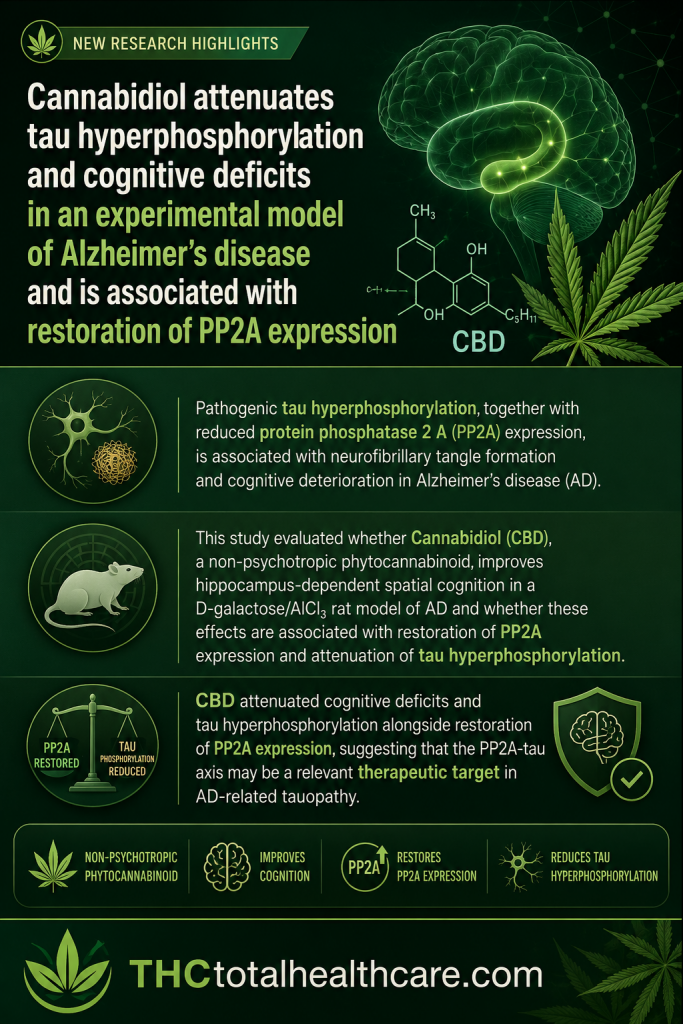
“Pathogenic tau hyperphosphorylation, together with reduced protein phosphatase 2 A (PP2A) expression, is associated with neurofibrillary tangle formation and cognitive deterioration in Alzheimer’s disease (AD).
Cannabidiol (CBD), a non-psychotropic phytocannabinoid, remains insufficiently studied for its potential to modulate the PP2A-tau axis in experimental AD.
This study evaluated whether CBD improves hippocampus-dependent spatial cognition in a D-galactose/AlCl₃ rat model of AD and whether these effects are associated with restoration of PP2A expression and attenuation of tau hyperphosphorylation.
AD-like pathology was induced in male Wistar rats by D-galactose (60 mg/kg i.p.) and AlCl₃ (200 mg/kg oral gavage) for 10 weeks, followed by CBD (20, 40 or 80 mg/kg) or donepezil (1 mg/kg) for three weeks. The Morris water maze, Jess Simple Western, and ELISA were used to assess cognition, PP2A expression, and p-tau levels, respectively.
CBD significantly improved spatial learning and memory. PP2A expression increased across all tested doses, with the highest mean level observed at 80 mg/kg. Hippocampal p-tau levels were significantly increased in the model group and significantly reduced by all CBD doses and donepezil (all p < 0.0001 vs. model). The inverse relationship between PP2A expression and p-tau levels suggests possible involvement of the PP2A-tau axis.
CBD attenuated cognitive deficits and tau hyperphosphorylation alongside restoration of PP2A expression, suggesting that the PP2A-tau axis may be a relevant therapeutic target in AD-related tauopathy.”
https://pubmed.ncbi.nlm.nih.gov/42240860
https://link.springer.com/article/10.1007/s11011-026-01894-w