
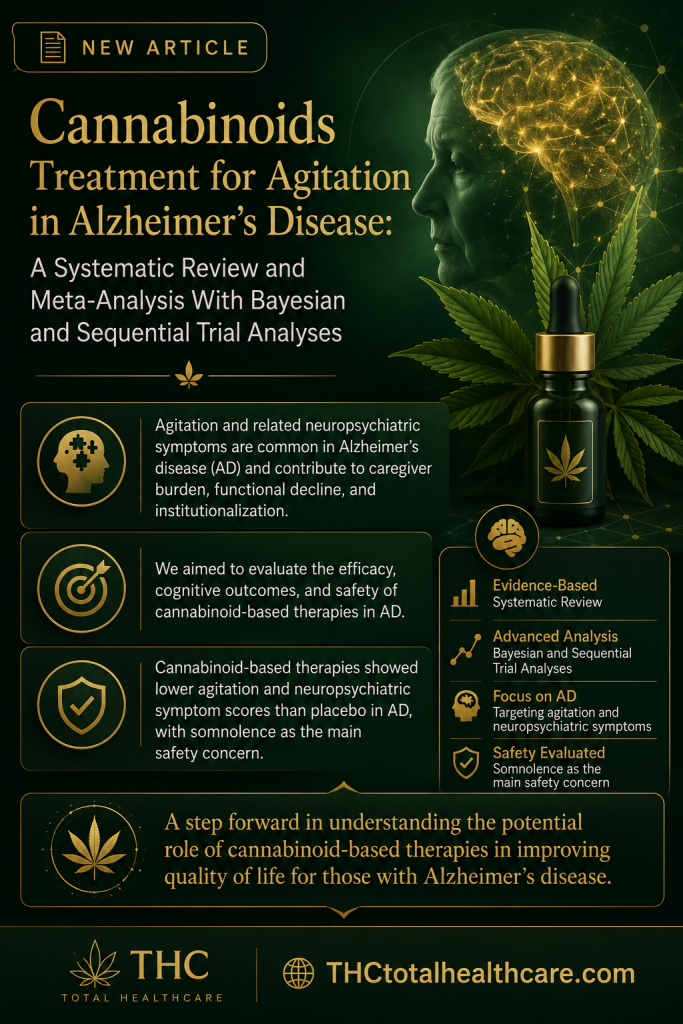
“Objective: Agitation and related neuropsychiatric symptoms are common in Alzheimer’s disease (AD) and contribute to caregiver burden, functional decline, and institutionalization. Cannabinoid-based therapies have been investigated as potential symptomatic interventions, but evidence remains limited by small trials, heterogeneous formulations, and variable outcome reporting. We aimed to evaluate the efficacy, cognitive outcomes, and safety of cannabinoid-based therapies in AD.
Methods: This systematic review and meta-analysis were prospectively registered in PROSPERO and conducted following PRISMA 2020 guidelines. PubMed, Embase, and the Cochrane Central Register of Controlled Trials were searched through April 2025 for randomized placebo-controlled trials evaluating cannabinoid-based therapies for agitation or neuropsychiatric symptoms in AD. One nonrandomized open-label study was retained as supplementary evidence for sensitivity analyses. Primary efficacy analyses were restricted to randomized between-group contrasts. Outcomes included Neuropsychiatric Inventory (NPI) total score, Cohen-Mansfield Agitation Inventory-Short Form (CMAI-SF), NPI agitation/aggression, Mini-Mental State Examination (MMSE), and safety outcomes. Random-effects meta-analyses were complemented by Bayesian models and Trial Sequential Analysis.
Results: Seven studies met the inclusion criteria, including six randomized trials and one open-label prospective cohort, with 221 participants enrolled. Cannabinoid-based therapies showed lower neuropsychiatric symptom and agitation scores than placebo in randomized between-group analyses: NPI total score (standardized mean difference [SMD], -0.31; 95% confidence intervals [CI], -0.47 to -0.15; k = 4), CMAI-SF (SMD, -0.40; 95% CI, -0.69 to -0.10; k = 3), and NPI agitation/aggression (SMD, -0.47; 95% CI, -0.69 to -0.25; k = 3). Bayesian posterior probabilities for lower symptom scores exceeded 95%. MMSE findings did not support a consistent cognitive benefit. Somnolence was the principal safety signal (risk ratios, 2.25; 95% CI, 1.43-3.54), with Trial Sequential Analysis suggesting sufficient accrued information for this outcome. Falls and fatigue were imprecisely estimated.
Conclusions: Cannabinoid-based therapies showed lower agitation and neuropsychiatric symptom scores than placebo in AD, with somnolence as the main safety concern. Interpretation remains limited by few trials, heterogeneous formulations and outcome instruments, short follow-up, and concentrated statistical weight. Larger randomized trials with formulation-specific protocols, longer follow-up, active comparators, and systematic safety monitoring are needed.”
https://pubmed.ncbi.nlm.nih.gov/42315374
https://www.ajgponline.org/article/S1064-7481(26)00400-8/abstract