
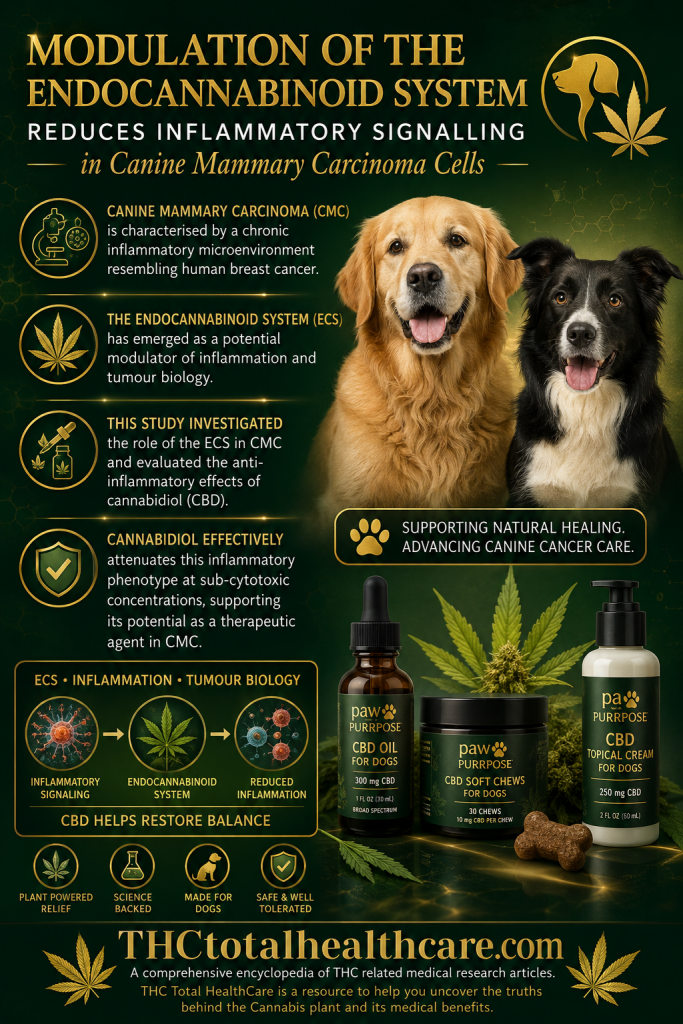
The endocannabinoid system is increasingly being studied as a regulator of inflammation within cancer cells. In this study, modulating endocannabinoid signaling in canine mammary carcinoma cells reduced inflammatory signaling pathways associated with tumor progression. The findings suggest that cannabinoid-related mechanisms may help alter the inflammatory environment that supports cancer growth, adding to evidence that the endocannabinoid system itself may represent a therapeutic target in mammary tumors.
“Background: Canine mammary carcinoma (CMC) is characterised by a chronic inflammatory microenvironment resembling human breast cancer; however, the upstream regulatory mechanisms driving this phenotype remain unclear. The endocannabinoid system (ECS) has emerged as a potential modulator of inflammation and tumour biology. This study investigated the role of the ECS in CMC and evaluated the anti-inflammatory effects of cannabidiol (CBD).
Methods: Primary cell cultures were established from surgically excised CMC tissues, with matched normal mammary epithelium used as controls. Basal mRNA expression of ECS-related receptors (CB1, CB2, transient receptor potential vanilloid 1 [TRPV1], G-protein-coupled receptor 55 [GPR55] and peroxisome proliferator-activated receptor alpha [PPAR-α]) and inflammatory mediators (COX-1, COX-2, interleukin [IL]-4, IL-6, IL-33, IL-17A, tumour necrosis factor-alpha [TNF-α] and LCN2) was assessed by reverse transcription quantitative polymerase chain reaction. Cytokine secretion (IL-6, IL-8, TNF-α and IL-17A) was quantified by enzyme-linked immunosorbent assay. Cell viability assays were performed to determine the 24-h IC50 of CBD (32 µM), and sub-cytotoxic concentrations (3, 10 and 20 µM) were subsequently applied for 24 h.
Results: Canine mammary carcinoma-derived cells exhibited significant overexpression of ECS receptors (CB1, CB2, TRPV1, GPR55 and PPAR-α) compared to normal controls. These cells also showed increased secretion of pro-inflammatory cytokines, including IL-6, IL-8, TNF-α and IL-17A. Treatment with CBD at 10-20 µM significantly downregulated key inflammatory genes, particularly COX-2, IL-6 and TNF-α, and reduced corresponding cytokine release without compromising cell viability.
Conclusion: The ECS is upregulated in CMC and appears to contribute to the inflammatory tumour microenvironment. Cannabidiol effectively attenuates this inflammatory phenotype at sub-cytotoxic concentrations, supporting its potential as a therapeutic agent in CMC.”
https://pubmed.ncbi.nlm.nih.gov/42078490
“These findings may also have relevant implications for human health, as CMC shares key molecular and pathological features with human breast cancer. Therefore, the modulation of ECS-related pathways observed in this study may reflect conserved mechanisms that could be exploited for the development of novel anti-inflammatory and anti-tumour strategies in human oncology.”
https://bvajournals.onlinelibrary.wiley.com/doi/10.1002/vro2.70034