
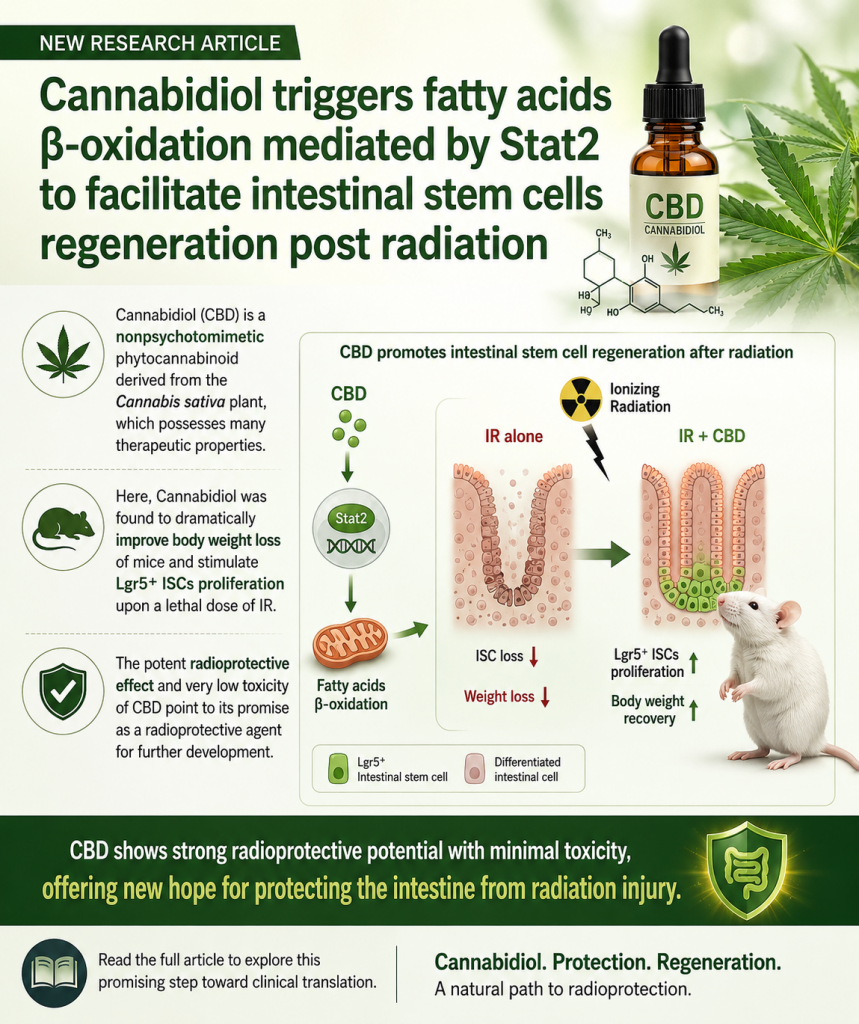
Radiation can severely damage the intestinal lining by impairing the stem cells needed for tissue repair. In this study, cannabidiol promoted intestinal stem-cell regeneration after radiation exposure by activating fatty-acid β-oxidation through STAT2 signaling. CBD improved the metabolic environment needed for stem-cell recovery and supported restoration of intestinal tissue following injury. The findings identify a specific mechanism through which CBD may enhance regeneration after radiation damage and suggest potential applications in protecting the gastrointestinal tract during cancer treatment.
“The development of compounds triggering intestinal stem cells (ISCs) proliferation represents a promising strategy to alleviate irradiation (IR)-induced gastrointestinal syndrome.
Here, cannabidiol (CBD)-a nonpsychotomimetic phytocannabinoid derived from the Cannabis sativa plant-was found to dramatically improve body weight loss of mice and stimulate Lgr5+ ISCs proliferation upon a lethal dose of IR.
Using absolute quantitative lipidomics, we found that the dysregulation of fatty acids in crypts induced by IR was rescued by CBD, which was indispensable for ISCs regeneration. Integrative analysis of transcriptome and lipidomics unveiled the critical role of PPARα in regulating fatty acid β-oxidation (FAO) by transcriptionally upregulating Slc27a2 and Acox1.
Further experiments showed that CBD could trigger the enrichment of Stat2 on the promoter region of Pparα, ultimately facilitating the FAO program and subsequent ISCs proliferation following IR exposure. In addition,THOC3 was identified as a direct target of CBD, which stabilized the THOC3 protein and substantially alleviated the IR-induced blockade of Stat2 mRNA nuclear export.
This study reveals a connection between CBD-driven ISCs proliferation and the FAO program during IR damage, providing a promising avenue for IR-induced gastrointestinal syndrome treatment. The binding of CBD to THOC3 maintains its radiation stability, which then supports the nuclear export of Stat2 mRNA for the subsequent transactivation of Pparα. The upregulation of PPARα will ultimately stimulate the FAO program, thereby facilitating ISCs regeneration during IR exposure.”
https://pubmed.ncbi.nlm.nih.gov/42120478
“Cannabidiol (CBD) is a nonpsychotomimetic phytocannabinoid derived from the Cannabis sativa plant, which possesses many therapeutic properties.”
“The potent radioprotective effect and very low toxicity of CBD point to its promise as a radioprotective agent for further development.”