
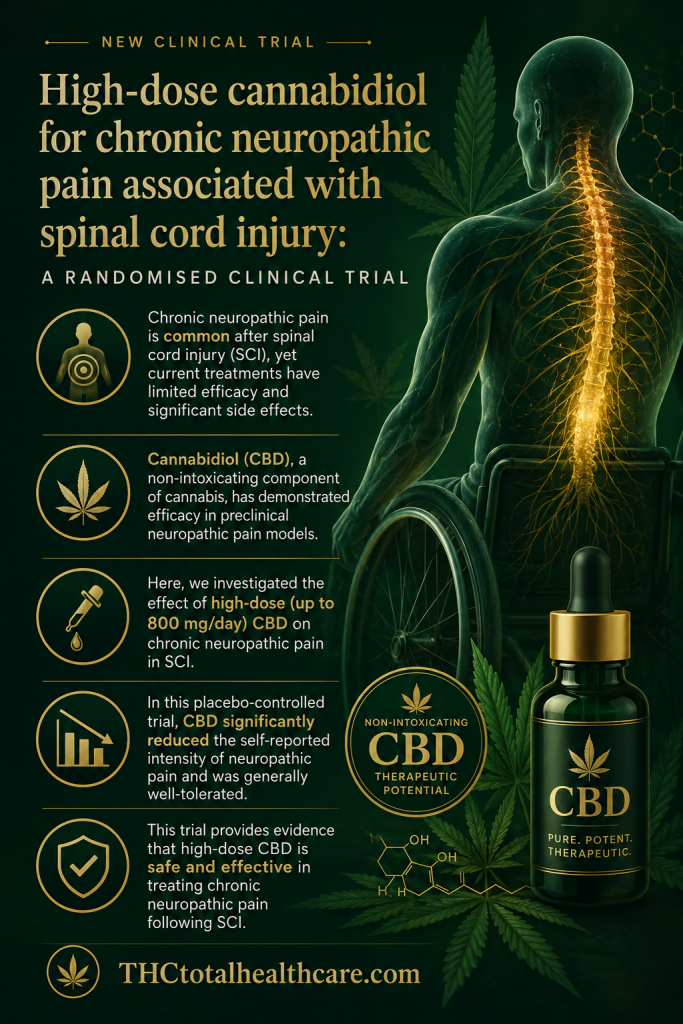
Neuropathic pain after spinal cord injury can be persistent and difficult to treat with standard medications. In this randomized clinical trial, high-dose cannabidiol produced meaningful reductions in chronic neuropathic pain among people with spinal cord injury, supporting a direct analgesic role for CBD in a particularly challenging pain condition. The findings add important clinical evidence to the growing body of cannabinoid research in neuropathic pain and suggest that higher-dose CBD may offer benefit for patients whose symptoms remain difficult to control.
“Background: Chronic neuropathic pain is common after spinal cord injury (SCI), yet current treatments have limited efficacy and significant side effects. Cannabidiol (CBD), a non-intoxicating component of cannabis, has demonstrated efficacy in preclinical neuropathic pain models. Here, we investigated the effect of high-dose (up to 800 mg/day) CBD on chronic neuropathic pain in SCI.
Methods: This randomised, double-blinded, placebo-controlled, crossover clinical trial was conducted at Neuroscience Research Australia. Adults with SCI and neuropathic pain (≥three months duration) were recruited. Participants were randomised to one of two treatment orders by an unblinded investigator who had no participant contact. Participants and all other investigators were blinded. Participants consumed oral CBD and placebo over two six-week treatment periods separated by a four-week washout. Treatment was titrated up to 800 mg/day of CBD over two-weeks. The primary outcome was change in self-reported pain intensity on a zero (no pain) to ten (worst pain imaginable) Visual Analogue Scale. Statistical comparisons included CBD versus placebo treatment, and pre-treatment (inactive phase) versus on-treatment (active phase). Outcomes were analysed by modified intention-to-treat. The study is registered with anzctr.org.au, ACTRN12622000634774 (not recruiting).
Findings: Forty participants were randomised (August 1, 2022 to December 16, 2024) and 38 included in the primary analysis (n = 6 female). A significant treatment by phase interaction effect (p < 0.001) was observed on self-reported pain. Pairwise comparison showed lower pain intensity during the active phase with CBD (mean ± SEM: 3.82 ± 0.23) compared to placebo (mean difference = -0.54, SEM = 0.15, p < 0.001), with a 95% confidence interval for the difference of -0.88 to -0.21. Treatments did not differ during the inactive phase (mean difference <0.01, SEM = 0.17, p = 1.00, 95% CI = -0.38 to 0.38). Adverse events, nearly all minor, were reported by 68.4% of participants during CBD (n = 67 events), and by 52.6% during placebo (n = 51 events) treatment.
Interpretation: In this placebo-controlled trial, CBD significantly reduced the self-reported intensity of neuropathic pain and was generally well-tolerated. While modest in magnitude, the observed effect supports further research into high-dose CBD for chronic neuropathic pain.”
https://pubmed.ncbi.nlm.nih.gov/42256679
“This trial provides evidence that high-dose CBD is safe and effective in treating chronic neuropathic pain following SCI. Additionally, the study provides initial evidence of a subgroup effect, whereby CBD is more effective in some individuals than others: this also warrants further exploration.”
https://www.thelancet.com/journals/eclinm/article/PIIS2589-5370(26)00234-8/fulltext