
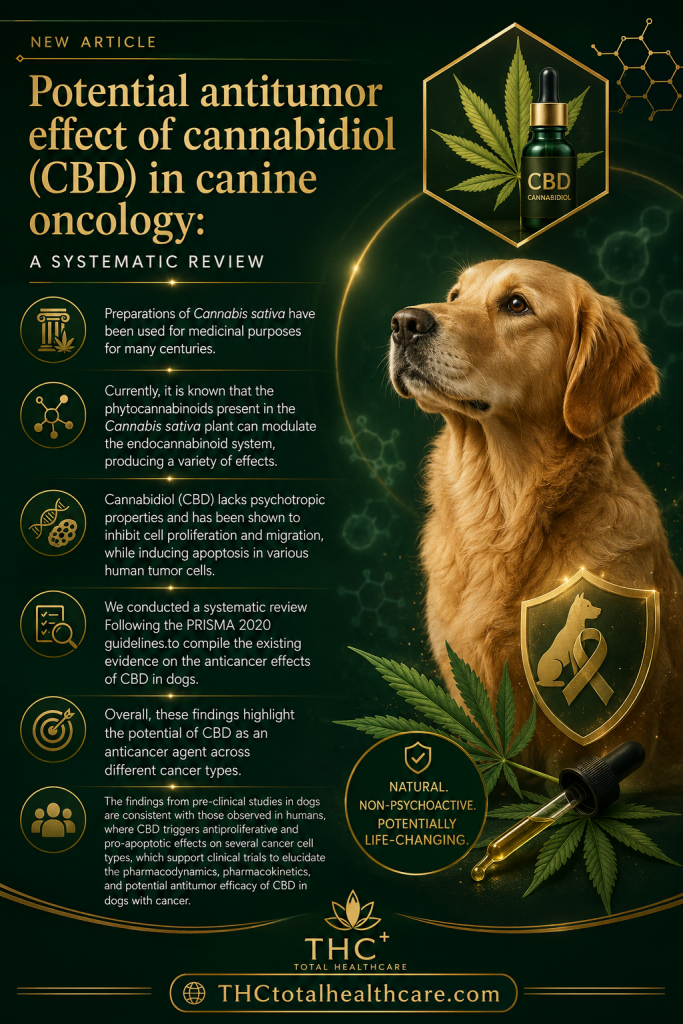
Cannabidiol is increasingly being studied in veterinary oncology for effects that may go beyond symptom relief. This systematic review examined the available evidence on CBD in canine cancer and found promising antitumor activity across several models, including reduced cancer-cell viability, induction of apoptosis, and inhibition of tumor-related signaling pathways. The review also highlights CBD’s potential to complement conventional cancer treatments, reinforcing growing interest in cannabinoid-based approaches in veterinary oncology. Together, the findings support CBD as an important area of investigation for canine cancer treatment.
“Introduction: Preparations of Cannabis sativa have been used for medicinal purposes for many centuries Currently, it is known that the phytocannabinoids present in the Cannabis sativa plant can modulate the endocannabinoid system, producing a variety of effects. Among the most abundant phytocannabinoids are delta-9-tetrahydrocannabinol (19-THC) and cannabidiol (CBD). CBD lacks psychotropic properties and has been shown to inhibit cell proliferation and migration, while inducing apoptosis in various human tumor cells. Studies evaluating CBD in dogs are more recent than those in humans, and to date, fewer publications are available. However, CBD has been shown to be safe and well-tolerated in dogs, supporting its potential clinical use. Since approximately 2015, some studies have been conducted evaluating CBD in different types of canine cancer; however, no comprehensive review of these findings has been performed.
Methods: we conducted a systematic review Following the PRISMA 2020 guidelines.to compile the existing evidence on the anticancer effects of CBD in dogs.
Results: We found that the studies conducted so far are pre-clinical, mostly based on cellular models, and that available data are primarily in lymphoma, mammary cancer, glioma, prostate cancer, osteosarcoma, and urothelial carcinoma. These studies consistently show that CBD exerts antiproliferative and proapoptotic effects, in some cases by modulating intracellular signaling pathways, including ERK, JNK, and caspases. Additionally, some studies have evaluated the combination of CBD with other drugs, reporting both synergistic and antagonistic effects.
Overall, these findings highlight the potential of CBD as an anticancer agent across different cancer types.
Discussion: Further studies are required to better elucidate the mechanisms underlying the effects of CBD and to standardize concentrations and formulations, enabling reliable, comparable results and the development of clinical studies evaluating the role of CBD in canine oncology.”
https://pubmed.ncbi.nlm.nih.gov/42254894
“The findings from pre-clinical studies in dogs are consistent with those observed in humans, where CBD triggers antiproliferative and pro-apoptotic effects on several cancer cell types, which support clinical trials to elucidate the pharmacodynamics, pharmacokinetics, and potential antitumor efficacy of CBD in dogs with cancer.”
https://www.frontiersin.org/journals/veterinary-science/articles/10.3389/fvets.2026.1800410/full