
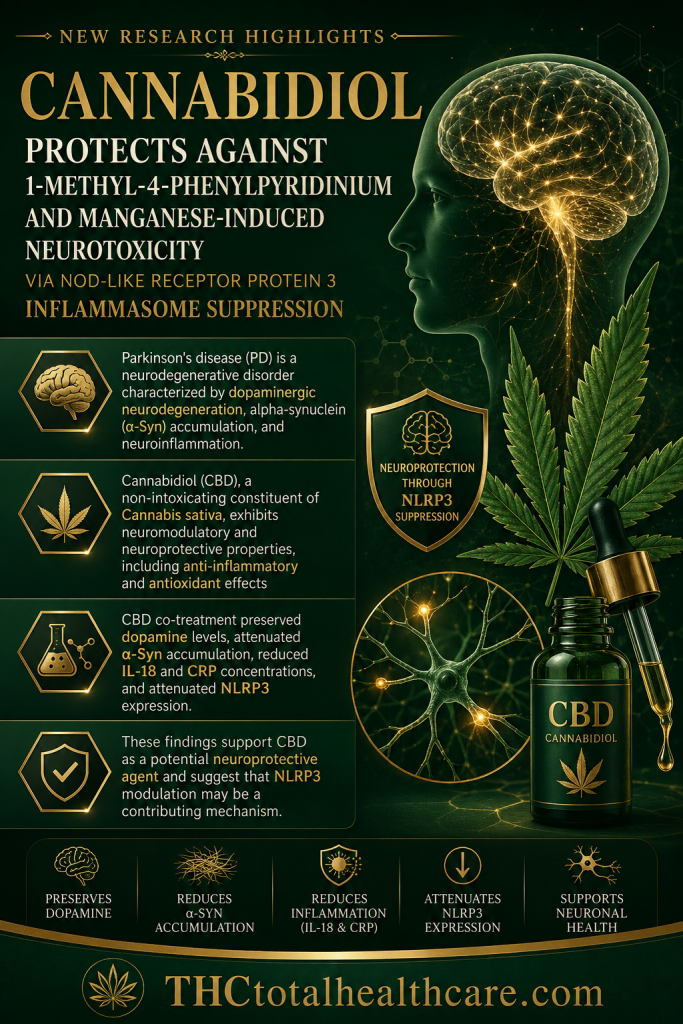
Neuroinflammation and oxidative injury play major roles in the loss of dopamine-producing neurons seen in Parkinson’s disease and related toxic exposures. In this preclinical study, cannabidiol protected neuronal cells against damage caused by 1-methyl-4-phenylpyridinium and manganese, two well-established neurotoxic insults. CBD reduced cell injury and suppressed activation of the NLRP3 inflammasome, a key inflammatory pathway involved in neurodegeneration. The findings strengthen evidence that CBD may protect vulnerable neurons by directly limiting inflammatory mechanisms associated with Parkinsonian neurotoxicity.
“Parkinson’s disease (PD) is a neurodegenerative disorder characterized by dopaminergic neurodegeneration, alpha-synuclein (α-Syn) accumulation, and neuroinflammation. The NOD-Like Receptor (NLR) family pyrin domain containing 3 NLRP3 inflammasome has recently been identified as a central mediator of PD-associated inflammatory responses.
Cannabidiol (CBD), a non-psychoactive phytocannabinoid, exhibits anti-inflammatory and neuroprotective properties; however, its effects on NLRP3 inflammasome in PD remain insufficiently understood.
This study investigated the neuroprotective effects of CBD-rich oil against 1-methyl-4-phenylpyridinium (MPP+) and manganese-induced neurotoxicity in SH-SY5Y cells.
Cells were exposed to these substances with or without CBD co-treatment, and cell viability, α-Syn, dopamine, inflammatory markers [C reactive protein (CRP) and interleukin 18 (IL-18)], and NLRP3 expressions were evaluated.
MPP+ and manganese exposures significantly decreased cell viability and dopamine levels while increasing α-Syn accumulation and inflammatory markers. Manganese induced an approximately twofold upregulation in NLRP3 mRNA and 1.5-fold increase in protein expression.
CBD co-treatment preserved dopamine levels, attenuated α-Syn accumulation, reduced IL-18 and CRP concentrations, and attenuated NLRP3 expression.
These findings demonstrate that CBD-rich oil exerts neuroprotective effects in a PD cellular model by attenuating α-Syn accumulation, preserving dopamine homeostasis, which is associated with reduced NLRP3 expression and potential modulation of inflammasome-related signaling, supporting further investigation of CBD as a potential therapeutic strategy for PD.”
https://pubmed.ncbi.nlm.nih.gov/42262723
“There is growing interest in phytocannabinoids as potential interventions for neurodegenerative disorders. Cannabidiol (CBD), a non-intoxicating constituent of Cannabis sativa, exhibits neuromodulatory and neuroprotective properties, including anti-inflammatory and antioxidant effects mediated through multiple molecular targets relevant to basal ganglia function and PD symptomatology.”
“Accordingly, the present study investigated the neuroprotective potential of CBD-rich oil in an in vitro PD model using SH-SY5Y cells exposed to MPP+ and/or manganese.”
“In conclusion, CBD-rich oil mitigated multiple PD-relevant pathological features in a neurotoxicant-based cellular model. CBD reduced α-synuclein accumulation, preserved dopamine content, attenuated inflammatory markers, and was associated with reduced NLRP3 expression at both mRNA and protein levels. These findings support CBD as a potential neuroprotective agent and suggest that NLRP3 modulation may be a contributing mechanism.”