
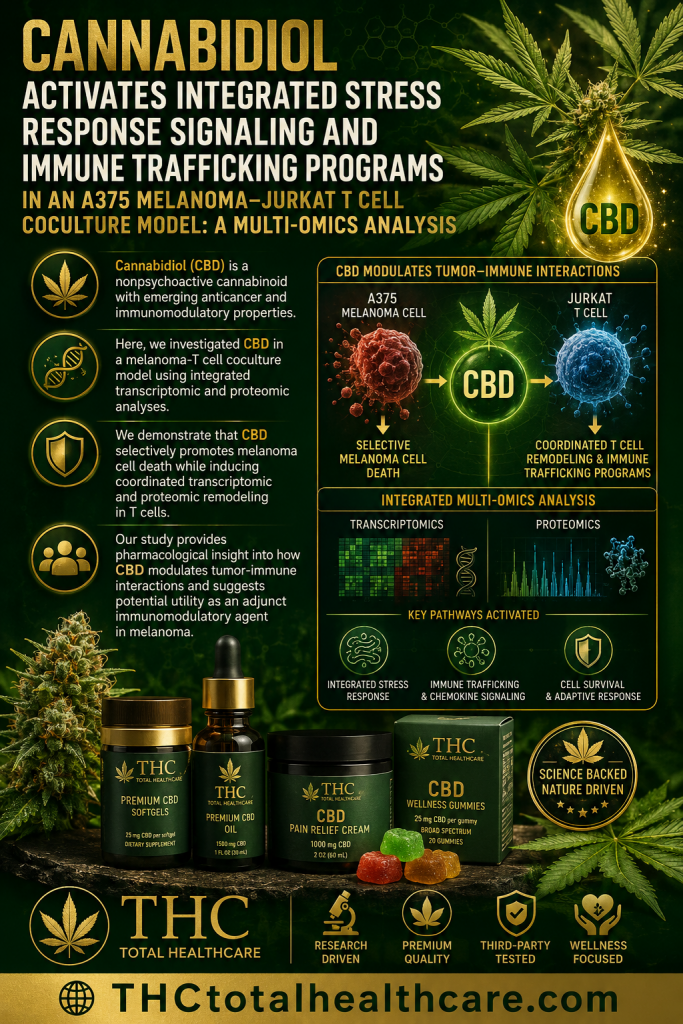
Melanoma research is increasingly focused not only on killing tumor cells, but also on understanding how cancer cells communicate with the immune system. In this multi-omics laboratory study, researchers examined CBD in a coculture model containing A375 melanoma cells and Jurkat T cells. CBD activated integrated stress-response pathways in the melanoma cells while also altering immune-trafficking and signaling programs involved in T-cell behavior. The findings suggest that CBD may influence both tumor-cell stress biology and the surrounding immune environment, adding another mechanistic layer to its potential anticancer effects. Because this was an in-vitro model, further animal and clinical research will be needed to determine whether these molecular changes translate into therapeutic benefit.
“Cannabidiol (CBD) is a nonpsychoactive cannabinoid with emerging anticancer and immunomodulatory properties; however, its systems-level mechanisms in tumor-associated immune cells remain incompletely defined.
Here, we investigated CBD in a melanoma-T cell coculture model using integrated transcriptomic and proteomic analyses.
At a subcytotoxic concentration (10 μM), CBD selectively induced apoptosis in melanoma while preserving T-cell viability and enhancing IL-2 secretion. RNA sequencing revealed coordinated activation of stress-adaptive, immune activation, and trafficking programs, including modulation of T-cell receptor signaling and cytokine networks.
Data-independent acquisition proteomics identified activation of eukaryotic initiation factor 2 (EIF2) signaling, a central node of the integrated stress response (ISR) linking redox and endoplasmic reticulum stress to translational control. Multiomics integration converged on immune cell trafficking as a consistent outcome, with upregulation of ICAM1, ITGB1, and associated adhesion-related proteins.
These findings suggest ISR-dependent translational reprogramming as a putative mechanistic axis by which CBD reshapes T-cell function in the melanoma microenvironment.
Our study provides pharmacological insight into how CBD modulates tumor-immune interactions and suggests potential utility as an adjunct immunomodulatory agent in melanoma.”
https://pubmed.ncbi.nlm.nih.gov/42396083
“Plant-derived redox-active metabolites have emerged as important modulators of these stress-adaptive pathways, acting through conserved molecular nodes that integrate oxidative stress with cellular signaling. Cannabidiol (CBD) is a nonpsychoactive phytochemical that has attracted growing attention as a redox-active compound with antioxidant, cytoprotective, and anticancer properties. Apart from its direct effects on tumor cells, CBD has been reported to modulate inflammatory signaling, oxidative stress responses, and cell death pathways, including ferroptosis.”
“In conclusion, this study provides a comprehensive multiomics characterization of CBD’s role in reshaping T-cell function within the melanoma microenvironment through redox- and stress-responsive mechanisms. Using a melanoma-T cell coculture system, we demonstrate that CBD selectively promotes melanoma cell death while inducing coordinated transcriptomic and proteomic remodeling in T cells.”