Cannabis sativa phytochemicals in cancer therapy: molecular mechanisms and therapeutic potential

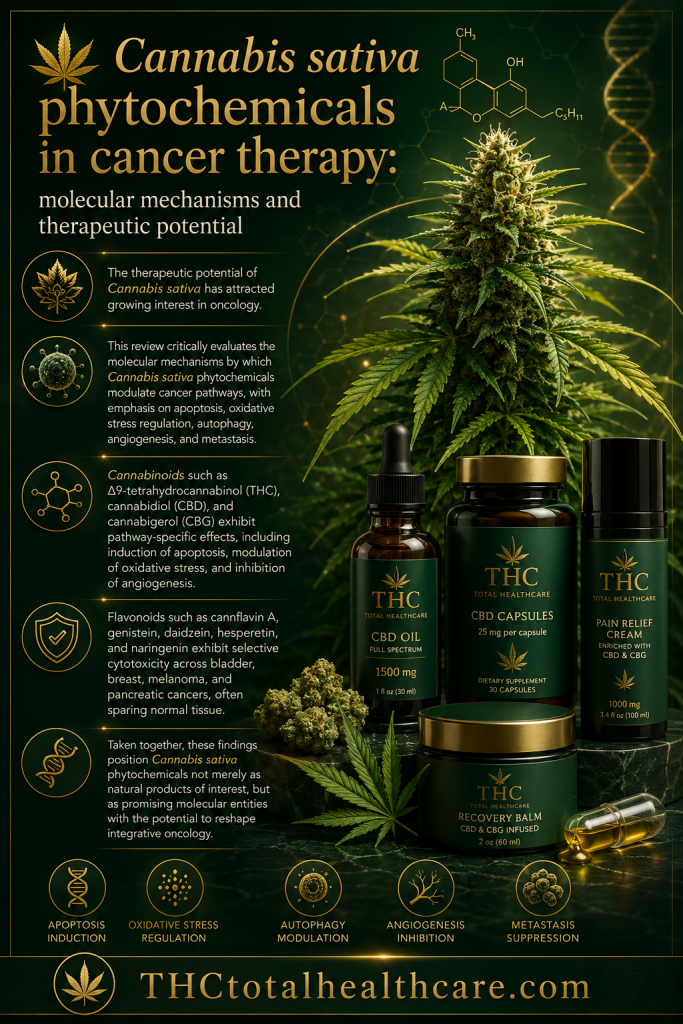
Background: The therapeutic potential of Cannabis sativa has attracted growing interest in oncology. Its diverse phytochemicals, including cannabinoids, flavonoids, and terpenes, interact with oncogenic signaling pathways and the endocannabinoid system influencing tumour progression and therapeutic responses.

Objective: This review critically evaluates the molecular mechanisms by which Cannabis sativa phytochemicals modulate cancer pathways, with emphasis on apoptosis, oxidative stress regulation, autophagy, angiogenesis, and metastasis. It also explores synergistic and additive interactions among cannabinoids and flavonoids, highlighting their translational relevance.

Key findings: Cannabinoids such as Δ9-tetrahydrocannabinol (THC), cannabidiol (CBD), and cannabigerol (CBG) exhibit pathway-specific effects, including induction of apoptosis, modulation of oxidative stress, and inhibition of angiogenesis. Flavonoids such as cannflavin A, genistein, daidzein, hesperetin, and naringenin exhibit selective cytotoxicity across bladder, breast, melanoma, and pancreatic cancers, often sparing normal tissue. Importantly, phytochemical interactions are not uniformly synergistic; while combinations such as THC and CBD amplify apoptotic signaling, others act additively or antagonistically. Clinical formulations such as Nabiximols provide translational evidence of cannabinoid synergy, although outcomes remain context-dependent.

Conclusion: The disconnect between preclinical efficacy and clinical outcomes underscores critical gaps in dosing strategies, patient selection, and combination regimens. Future research should prioritize mechanistic studies, rational phytochemical combinations, and innovative drug delivery systems. Taken together, Cannabis sativa phytochemicals emerge as promising molecular entities with the potential to reshape integrative oncology, provided their therapeutic promise is matched with rigorous, evidence-based evaluation.”

https://pubmed.ncbi.nlm.nih.gov/42416829

“Taken together, these findings position Cannabis sativa phytochemicals not merely as natural products of interest, but as promising molecular entities with the potential to reshape integrative oncology.”

https://www.frontiersin.org/journals/pharmacology/articles/10.3389/fphar.2026.1768210/full
Cannabidiol Activates Integrated Stress Response Signaling and Immune Trafficking Programs in an A375 Melanoma-Jurkat T Cell Coculture Model: A Multi-Omics Analysis

“Cannabidiol (CBD) is a nonpsychoactive cannabinoid with emerging anticancer and immunomodulatory properties; however, its systems-level mechanisms in tumor-associated immune cells remain incompletely defined.

Here, we investigated CBD in a melanoma-T cell coculture model using integrated transcriptomic and proteomic analyses.

At a subcytotoxic concentration (10 μM), CBD selectively induced apoptosis in melanoma while preserving T-cell viability and enhancing IL-2 secretion. RNA sequencing revealed coordinated activation of stress-adaptive, immune activation, and trafficking programs, including modulation of T-cell receptor signaling and cytokine networks.

Data-independent acquisition proteomics identified activation of eukaryotic initiation factor 2 (EIF2) signaling, a central node of the integrated stress response (ISR) linking redox and endoplasmic reticulum stress to translational control. Multiomics integration converged on immune cell trafficking as a consistent outcome, with upregulation of ICAM1, ITGB1, and associated adhesion-related proteins.

These findings suggest ISR-dependent translational reprogramming as a putative mechanistic axis by which CBD reshapes T-cell function in the melanoma microenvironment.

Our study provides pharmacological insight into how CBD modulates tumor-immune interactions and suggests potential utility as an adjunct immunomodulatory agent in melanoma.”

https://pubmed.ncbi.nlm.nih.gov/42396083

“Plant-derived redox-active metabolites have emerged as important modulators of these stress-adaptive pathways, acting through conserved molecular nodes that integrate oxidative stress with cellular signaling. Cannabidiol (CBD) is a nonpsychoactive phytochemical that has attracted growing attention as a redox-active compound with antioxidant, cytoprotective, and anticancer properties. Apart from its direct effects on tumor cells, CBD has been reported to modulate inflammatory signaling, oxidative stress responses, and cell death pathways, including ferroptosis.”

“In conclusion, this study provides a comprehensive multiomics characterization of CBD’s role in reshaping T-cell function within the melanoma microenvironment through redox- and stress-responsive mechanisms. Using a melanoma-T cell coculture system, we demonstrate that CBD selectively promotes melanoma cell death while inducing coordinated transcriptomic and proteomic remodeling in T cells.”

https://pubs.acs.org/doi/10.1021/acsomega.6c01965

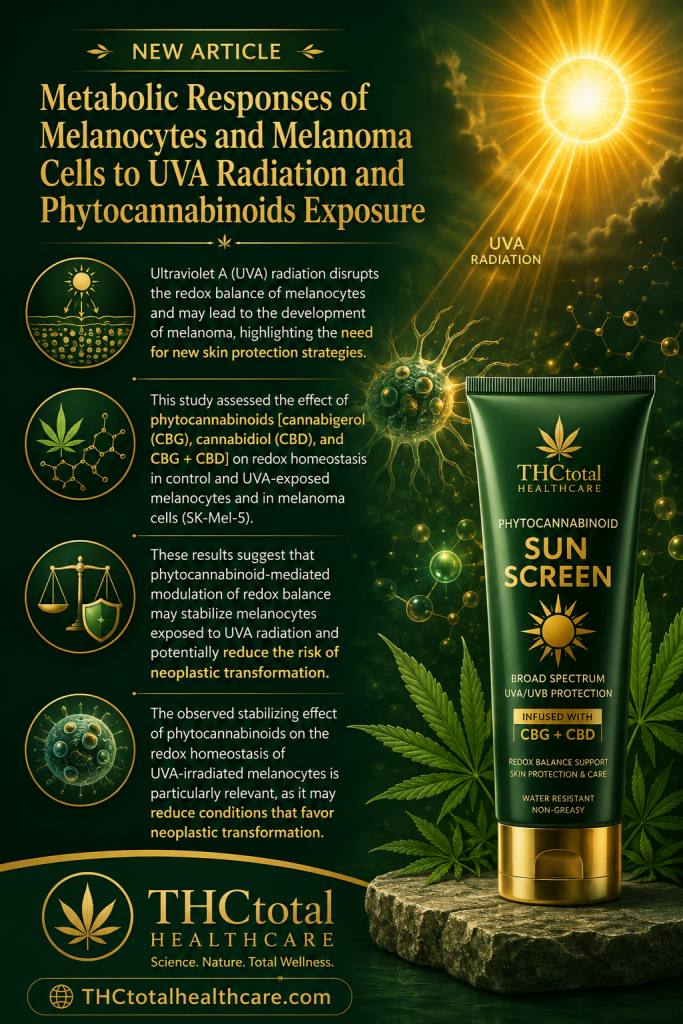
Metabolic Responses of Melanocytes and Melanoma Cells to UVA Radiation and Phytocannabinoids Exposure

“Ultraviolet A (UVA) radiation disrupts the redox balance of melanocytes and may lead to the development of melanoma, highlighting the need for new skin protection strategies.

This study assessed the effect of phytocannabinoids [cannabigerol (CBG), cannabidiol (CBD), and CBG + CBD] on redox homeostasis in control and UVA-exposed melanocytes and in melanoma cells (SK-Mel-5).

UVA radiation increased the activity of prooxidant enzymes in both melanocytes and SK-Mel-5 cells and, consequently, the level of reactive oxygen species (ROS) (approx. 2-fold). It also activated nuclear factor erythroid 2 (Nrf2), as reflected by increased expression of heme oxygenase 1 (HO-1) (melanocytes approx. 2-fold; SK-Mel-5 approx. 7-fold). Concomitantly, antioxidant mechanisms were impaired, as demonstrated by reduced superoxide dismutase (SOD1/SOD2) activity and impaired glutathione and thioredoxin function. These changes were accompanied by increased levels of oxidative damage markers (isoprostanes, 4-hydroxynonenal-4-HNE, and 4-HNE-protein adducts) (43-100%) and increased inflammatory signaling, including increased expression of nuclear factor kappa B (NF-κB) subunits (melanocytes: p52 ~2-fold, p65 ~75%; SK-Mel-5: ~4-4.5-fold) and tumor necrosis factor alpha (TNF-α; ~30%).

Phytocannabinoid treatment modulated these UVA-induced changes.

In SK-Mel-5 cells, phytocannabinoids normalized the activity of prooxidant enzymes and consequently reduced ROS levels (~30%). They also reduced Nrf2 activation and HO-1 expression; however, CBG increased HO-1 level in melanocytes (~25-40%). Furthermore, phytocannabinoids enhanced antioxidant defense by increasing SOD activity, particularly in melanocytes (~10-40%), and restoring the glutathione and thioredoxin systems. Markers of oxidative damage were reduced by approximately 23-37% after treatment. Furthermore, phytocannabinoids attenuated NF-κB activation (p52 ~18-28%, p65 ~25-29% in melanocytes; ~20% in SK-Mel-5), while TNF-α levels remained unchanged. The effects in non-irradiated cells were modest (<15%).

These results suggest that phytocannabinoid-mediated modulation of redox balance may stabilize melanocytes exposed to UVA radiation and potentially reduce the risk of neoplastic transformation. However, the observed protective effects in SK-Mel-5 cells require further investigation and detailed molecular analysis.”

https://pubmed.ncbi.nlm.nih.gov/42351996

“The observed stabilizing effect of phytocannabinoids on the redox homeostasis of UVA-irradiated melanocytes is particularly relevant, as it may reduce conditions that favor neoplastic transformation.”

https://www.mdpi.com/2076-3921/15/6/690

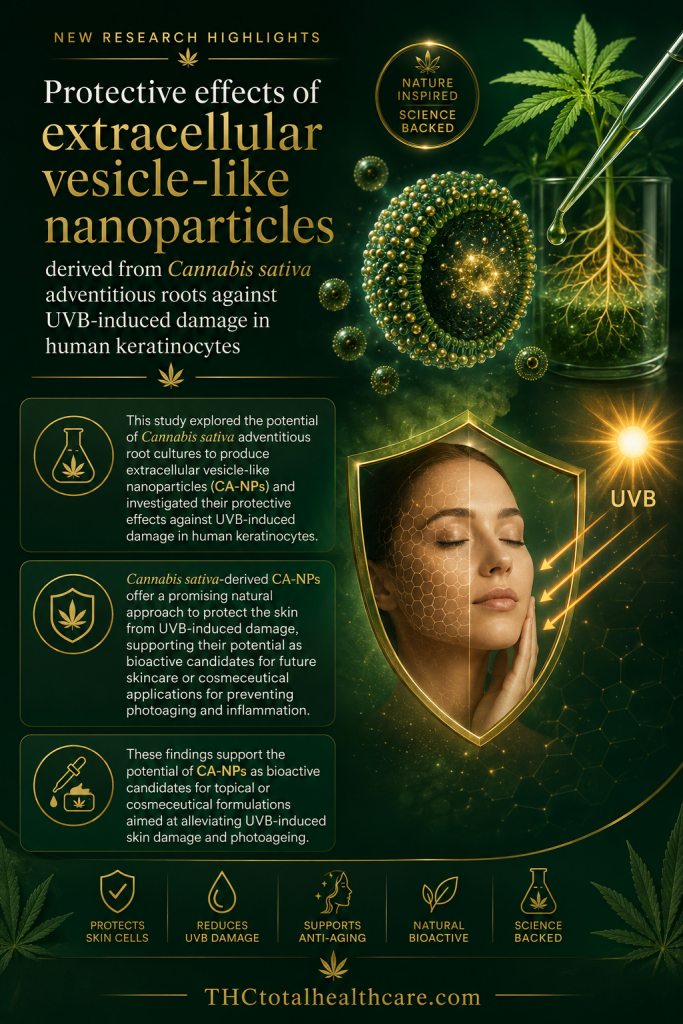
Protective effects of extracellular vesicle-like nanoparticles derived from Cannabis sativa adventitious roots against UVB-induced damage in human keratinocytes

Background: Plant-derived bioactive compounds are increasingly sought after in the cosmetics and pharmaceutical industries, prompting the development of sustainable production methods. This study explored the potential of Cannabis sativa adventitious root cultures to produce extracellular vesicle-like nanoparticles (CA-NPs) and investigated their protective effects against UVB-induced damage in human keratinocytes.

Methods: CA-NPs were isolated from Cannabis sativa root cultures and characterized for particle size, zeta potential and stability. HaCaT keratinocytes were used to assess the nanoparticles’ ability to improve cell viability, reduce apoptosis and alleviate oxidative stress after UVB exposure. Gene expression of skin barrier components and matrix metalloproteinases (MMPs) was analysed, and underlying signalling pathways (MAPK, Nrf2) were examined.

Results: CA-NPs (~128 nm, -12.9 mV) showed strong physicochemical stability and effectively protected HaCaT cells from UVB-induced damage. They suppressed MMP-1, MMP-3 and MMP-9 expression while enhancing skin barrier-related genes (HAS1, FLG, LOR, IVL). CA-NPs also modulated MAPK and Nrf2 pathways, reducing inflammation and boosting antioxidant defences.

Conclusion: Cannabis sativa-derived CA-NPs offer a promising natural approach to protect the skin from UVB-induced damage, supporting their potential as bioactive candidates for future skincare or cosmeceutical applications for preventing photoaging and inflammation.”

https://pubmed.ncbi.nlm.nih.gov/42298090

“These findings support the potential of CA-NPs as bioactive candidates for topical or cosmeceutical formulations aimed at alleviating UVB-induced skin damage and photoageing.”

https://onlinelibrary.wiley.com/doi/10.1111/ics.70108

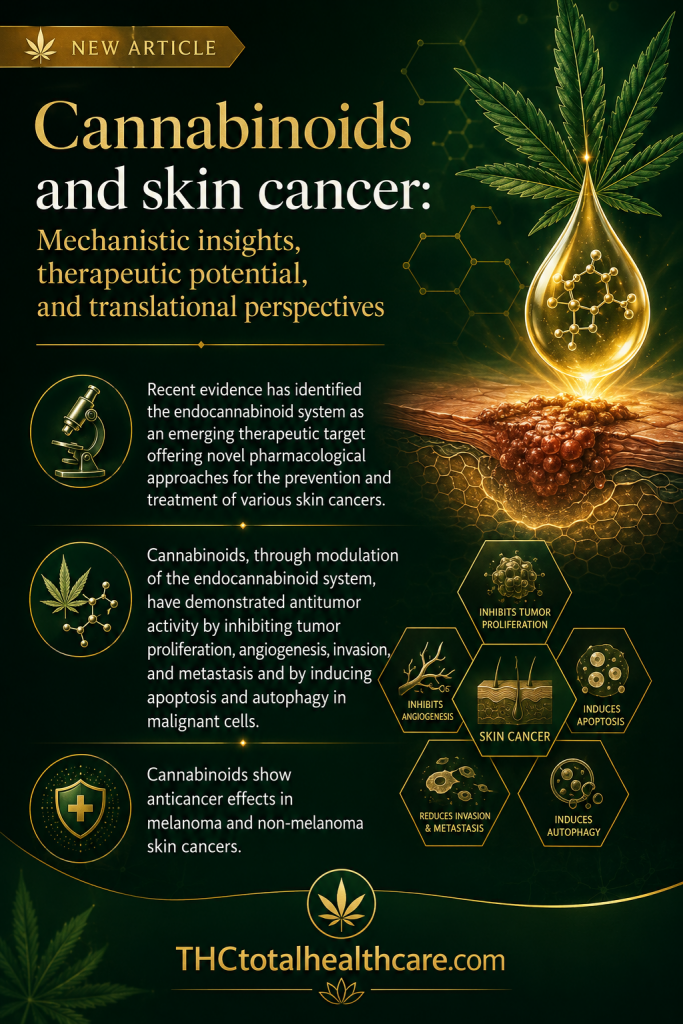
Cannabinoids and skin cancer: Mechanistic insights, therapeutic potential, and translational perspectives

“Skin cancer represents a significant global healthcare challenge, with rising incidence and persistent gaps in effective long-term management.

Recent evidence has identified the endocannabinoid system as an emerging therapeutic target offering novel pharmacological approaches for the prevention and treatment of various skin cancers.

Cannabinoids, through modulation of the endocannabinoid system, have demonstrated antitumor activity by inhibiting tumor proliferation, angiogenesis, invasion, and metastasis and by inducing apoptosis and autophagy in malignant cells.

This review synthesizes the most recent preclinical evidence on phytocannabinoids, endocannabinoids, and synthetic cannabinoids in melanoma and non-melanoma skin cancers, delineating receptor-dependent and receptor-independent mechanisms. Additionally, emerging cannabinoid-based delivery strategies, particularly cannabidiol formulations designed to enhance skin penetration and therapeutic efficacy, are critically examined. Despite encouraging preclinical findings, clinical translation remains limited by scarce skin-cancer-specific trials, variability in cannabinoid preparations, and uncertainties around dosing and safety. Consequently, robust mechanistic studies and well-designed clinical trials are required to validate cannabinoids’ therapeutic potential and guide their integration into future skin cancer treatment paradigms.”

https://pubmed.ncbi.nlm.nih.gov/41621140

“Cannabinoids show anticancer effects in melanoma and non-melanoma skin cancers.”

https://www.sciencedirect.com/science/article/pii/S0014480026000067?via%3Dihub


Cannabidiol Inhibits Melanoma Progression by Regulating PPARγ-TET1 Complex-dependent LRASM1 Demethylation

“Melanoma represents one of the most aggressive forms of skin cancers, with advanced metastatic stages largely managed through chemotherapy. However, current therapeutic strategies remain limited by drug resistance and systemic toxicity. Cannabidiol (CBD), the primary nonpsychoactive constituent of Cannabis sativa, has recently attracted attention for its anticancer properties across multiple tumor types.

OBJECTIVES

This study aimed to explore the antitumor efficacy of CBD in melanoma and elucidate its underlying molecular mechanisms, with the goal of identifying novel therapeutic strategies to overcome resistance and reduce adverse effects associated with conventional treatments.

METHODS

The antiproliferative and pro-apoptotic effects of CBD were assessed in vitro using MTS, EdU, Transwell invasion, and flow cytometry. In vivo efficacy was evaluated using a murine lung metastasis model. Potential CBD targets in melanoma were identified through network pharmacology and molecular docking, with a focus on peroxisome proliferator-activated receptor γ (PPARγ) and validation by western blotting and immunofluorescence. Integrated transcriptomic and genome-wide methylation analyses were performed to investigate epigenetic modifications induced by CBD. Co-immunoprecipitation and chromatin immunoprecipitation assays were employed to detect the interaction between PPARγ and ten-eleven translocation 1 (TET1), including their binding to promoter regions of downstream factors. Methylation-regulated target genes were further validated using qPCR and MeDIP PCR.

RESULTS

CBD significantly induced apoptosis and inhibited cell proliferation and invasion of melanoma cells in vitro, while reducing pulmonary metastasis in vivo. Pharmacological and molecular docking analyses, supported by protein-level validation, identified PPARγ as a critical mediator of CBD activity. Transcriptomic and methylation analyses revealed that CBD modulated global DNA methylation patterns, partly through the formation of a PPARγ-TET1 complex. This complex regulated the demethylation of leucine-rich repeat and sterile alpha motif-containing 1 (LRSAM1), a newly identified anticancer gene whose upregulation markedly enhanced melanoma cell apoptosis and suppressed proliferation.

CONCLUSIONS

CBD exhibited strong antitumor activity in melanoma by modulating the PPARγ–TET1 complex to induce demethylation of LRSAM1, thereby suppressing tumor progression. These findings identify CBD as a promising candidate for melanoma therapy.”

https://www.sciencedirect.com/science/article/abs/pii/S0944711326000127

“In summary, this study investigated molecular targets and mechanisms by which CBD suppresses melanoma progression, emphasizing its role in PPARγ activation and epigenetic regulation. These findings establish a mechanistic basis and provide candidate targets for future clinical application of CBD in melanoma treatment.”

“This study provides the first evidence that CBD inhibits melanoma progression by modulating gene methylation. The identification of LRSAM1 as a PPARγ-TET1-regulated tumor suppressor expands current understanding of epigenetic regulation in melanoma and highlights LRSAM1 as a viable therapeutic target.”

https://www.scilit.com/publications/50c9c0a6d08f7880cebb9c69a2c3fca7

Phytocannabinoids influence phospholipid metabolism of melanoma cells: Modulation of in vitro effects of the UVA irradiation

“The high metastatic potential of melanoma and its poor prognosis in advanced stages motivate the search for innovative therapeutic approaches. Therefore, this study aimed to assess the effects of phytocannabinoids (cannabidiol-CBD, and cannabigerol-CBG) on the structure and function of the melanoma cell membrane, phospholipid metabolism, and the respective metabolites generated in ROS- and enzyme-dependent reactions.

Biochemical and physicochemical parameters were analyzed in melanoma cells (SK-MEL-5) cultured for 24 h with CBD (5 µM), CBG (1 µM), and their combination applied either alone or after UVA irradiation (365 nm) at a dose of 18 J/cm².

Phytocannabinoids have been shown to partially counteract changes in the levels of cell membrane components, including phospholipid polyunsaturated fatty acids (PUFAs) and sialic acid, consequently affecting surface charge density and lipid rafts, which may be a potential target for anticancer therapy. Furthermore, by changing the activity of lipolytic enzymes (PLA2/COX1/2/LOX-5), phytocannabinoids partially enhanced the UVA-induced decrease in free PUFAs. Consequently, the levels of lipid mediators, including endocannabinoids and eicosanoids, were altered.

The use of phytocannabinoids led to a significant increase in 2-AG levels, while the combined action of CBD/CBG reduced the levels of pro-inflammatory eicosanoids. UVA radiation increased the expression of G-protein-coupled receptors in melanoma cells (CB1/2/TRPV1/PPARγ), while the combined use of CBD/CBG reduced their expression.

Therefore, the results have shown that CBD and CBG modulate the metabolism of phospholipids and PUFAs by altering the functions of melanoma cell membranes, potentially offering options for the use of these phytocannabinoids in the integrative biomedicine treatment of melanoma.”

https://pubmed.ncbi.nlm.nih.gov/41529510

“Phytocannabinoids modulate endocannabinoid levels, supporting antitumor activity.”

“In summary, the results of this study indicate that phytocannabinoids (CBD and/or CBG) alter the functionality of melanoma cell membranes by modeling the structure and metabolism of phospholipids and free PUFAs, which may offer potential benefits in integrated melanoma therapy.”

https://www.sciencedirect.com/science/article/pii/S0753332226000351?via%3Dihub

Current and Potential Use of Biologically Active Compounds Derived from Cannabis sativa L. in the Treatment of Selected Diseases

“Cannabis sativa L. contains numerous compounds with antioxidant and anti-inflammatory properties, including the flavonoids and the cannabinoids, particularly Δ-9-tetrahydrocannabinol (THC) and cannabidiol (CBD).

Cannabinoids have an effect on the endocannabinoid system (ECS), a cellular communication network, and are, hence, widely studied for medical applications.

Epidiolex®, a 99% pure oral CBD extract, has been approved by the FDA for the treatment of epilepsy. Nabiximols (Sativex) is an oromucosal spray containing equal volume of THC and CBD, and it is commonly used as an add-on treatment for unresponsive spasticity in multiple sclerosis (MS) patients.

Several in vitro and in vivo studies have also shown that cannabinoids can be used to treat various types of cancer, such as melanoma and brain glioblastoma; the first positive clinical trials on the anticancer effect of a THC:CBD blend with temozolomide (TMZ) in the treatment of highly invasive brain cancer are very promising.

The cannabinoids exert their anticancer properties in in vitro investigations by the induction of cell death, mainly by apoptosis and cytotoxic autophagy, and the inhibition of cell proliferation. In several studies, cannabinoids have been found to induce tumor regression and inhibit angiogenic mechanisms in vitro and in vivo, as well as in two low-numbered epidemiological studies.

They also exhibit antiviral effects by inhibiting ACE2 transcription, blocking viral replication and fusion, and acting as anti-inflammatory agents; indeed, prior CBD consumption (a study of 93,565 persons in Chicago) has also been associated with a much lower incidence of SARS-CoV-2 infections.

It is postulated that cannabis extracts can be used in the treatment of many other diseases such as systemic lupus erythematosus, type 1 diabetes, or various types of neurological disorders, e.g., Alzheimer’s disease.

The aim of this review is to outline the current state of knowledge regarding currently used medicinal preparations derived from C. sativa L. in the treatment of selected cancer and viral diseases, and to present the latest research on the potential applications of its secondary metabolites.”

https://pubmed.ncbi.nlm.nih.gov/39684447/

“C. sativa L. is an extraordinary plant that provides a valuable raw material for medical applications. Its secondary metabolites, cannabinoids, have attracted growing interest in the fight against illness, mainly due to their effect on CB1 and CB2 cannabinoid receptors.”

https://www.mdpi.com/1422-0067/25/23/12738

A new cannabigerol derivative, LE-127/2, induces autophagy mediated cell death in human cutaneous melanoma cells

pubmed logo

“Despite the targeted- and immunotherapies used in the past decade, survival rate among patients with metastatic melanoma remains low, therefore, melanoma is responsible for the majority of skin cancer-related deaths.

The ongoing investigation of natural antitumor agents, the nonpsychoactive cannabinoid, cannabigerol (CBG) found in Cannabis sativa is emerging as a promising candidate. CBG offers a potential therapeutic role in the treatment of melanoma demonstrating cell growth inhibition in some tumors. Its low water solubility and bioavailability hinder the potential effectiveness. To address these challenges, a modified CBG, namely LE-127/2 was synthesized by Mannich-type reaction.

The aim was to investigate the effect of this novel compound on cell proliferation as well as the mechanism of cell death with a particular focus on autophagy and apoptosis.

Human cutan melanoma cell lines, WM35, A2058 and WM3000 were utilized for the present study. Cell proliferation of the cells after the treatment with LE-127/2, parent CBG or vemurafenib was assessed by Cell Titer Blue Assay. Cells were treated with a 1.25-80 µM of the above-mentioned compounds, and it was found that at 20 μM of all drugs showed a comparable effective inhibition of cell proliferation, however, vemurafenib and CBG proved to be more effective than LE-127/2. In addition, clonogenic cell survival assays were performed to examine the inhibitory effect of LE-127/2 on the colony formation ability of melanoma cell lines.

Cells treated with 20 µM of LE-127/2 for 14 days showed about a 50% suppression of clonogenic cell survival. LE-127/2 exerted the most intensive inhibition on A2058 cell colonies. Furthermore, notably, LDH cytotoxicity assay performed on HaCaT cell line, proved LE-127/2 to be cytotoxic only at higher concentration, such as 80 μM, while the parent CBG was cytotoxic at concentration as low as 5 μM, suggesting that the new CBG derivative as a drug candidate may be applied in human pharmacotherapy without causing a substantial damage in intact epidermal cells. Analysis of protein expression revealed the impact of LE-127/2 on the expression of basic proteins (LC-3, Beclin-1 and p62) involved in the process of autophagy in the three different melanoma cell lines studied. Elevated expression of these proteins was detected as a result of LE-127/2 (20 µM) treatment. LE-127/2 also induced the expression of some proteins involved in apoptosis, and it is particularly noteworthy the increased level of cleaved PARP.

Based on the results obtained, it can be concluded that LE-127/2 induced autophagy could lead to the inhibition of cell proliferation and death in melanoma cells.”

https://pubmed.ncbi.nlm.nih.gov/39357769/

https://www.sciencedirect.com/science/article/pii/S0928098724002331?via%3Dihub

Cannabinol modulates the endocannabinoid system and shows TRPV1-mediated anti-inflammatory properties in human keratinocytes

pubmed logo

“Cannabinol (CBN) is a secondary metabolite of cannabis whose beneficial activity on inflammatory diseases of human skin has attracted increasing attention. Here, we sought to investigate the possible modulation by CBN of the major elements of the endocannabinoid system (ECS), in both normal and lipopolysaccharide-inflamed human keratinocytes (HaCaT cells).

CBN was found to increase the expression of cannabinoid receptor 1 (CB1) at gene level and that of vanilloid receptor 1 (TRPV1) at protein level, as well as their functional activity. In addition, CBN modulated the metabolism of anandamide (AEA) and 2-arachidonoylglicerol (2-AG), by increasing the activities of N-acyl phosphatidylethanolamines-specific phospholipase D (NAPE-PLD) and fatty acid amide hydrolase (FAAH)-the biosynthetic and degradative enzyme of AEA-and that of monoacylglycerol lipase (MAGL), the hydrolytic enzyme of 2-AG.

CBN also affected keratinocyte inflammation by reducing the release of pro-inflammatory interleukin (IL)-8, IL-12, and IL-31 and increasing the release of anti-inflammatory IL-10. Of note, the release of IL-31 was mediated by TRPV1. Finally, the mitogen-activated protein kinases (MAPK) signaling pathway was investigated in inflamed keratinocytes, demonstrating a specific modulation of glycogen synthase kinase 3β (GSK3β) upon treatment with CBN, in the presence or not of distinct ECS-directed drugs.

Overall, these results demonstrate that CBN modulates distinct ECS elements and exerts anti-inflammatory effects-remarkably via TRPV1-in human keratinocytes, thus holding potential for both therapeutic and cosmetic purposes.”

https://pubmed.ncbi.nlm.nih.gov/39275884/

“Taken together, our data suggest that CBN may hold true therapeutic potential to treat different human skin diseases. Such a biological activity of CBN occurs through engagement of selected elements of the endocannabinoid system—in particular TRPV1—a finding that paves the way to the development of distinct formulations of cannabis extracts for selected therapeutic applications.”

https://iubmb.onlinelibrary.wiley.com/doi/10.1002/biof.2122