Cannabis Use for Chronic Pain in Sickle Cell Disease: A Scoping Review

pubmed logo

“Purpose: The purposes of this scoping review were to: (1) systematically evaluate the literature on the types and effectiveness of cannabis and cannabinoids for pain management in adults with sickle cell disease (SCD), (2) assess the effect of cannabis and cannabinoids on pain outcomes, and (3) identify research gaps.

Design: Systematic scoping review.

Methods: Following the Preferred Reporting Items for Systematic Reviews and Meta-Analyses Extension for Scoping Reviews (PRISMA-ScR) guidelines, relevant studies were identified across PubMed, CINAHL, and Cannakeys databases. Inclusion criteria were studies involving medical and recreational cannabis use in adult SCD patients addressing pain management. Exclusion criteria included studies on pediatric populations, non-English publications, or case reports.

Results: Of 369 articles, 12 met inclusion criteria (one clinical trial, two reviews, seven observational, one mixed-methods, and one qualitative study), revealing mixed but generally positive evidence on cannabinoid effectiveness. While some studies indicated reduced pain scores with inhaled cannabis, results varied for other pain outcomes, such as hospitalizations for vaso-occlusive crises, and raised safety concerns, particularly with synthetic cannabinoids.

Conclusions: Cannabinoids may help manage SCD pain, though evidence remains mixed. No studies showed exacerbation of SCD symptoms, but safety concerns warrant careful use.

Clinical implications: The variability in outcomes underscores the need for personalized cannabis-based treatment plans and further research on standardized dosing and long-term safety.”

https://pubmed.ncbi.nlm.nih.gov/40713408/

https://www.painmanagementnursing.org/article/S1524-9042(25)00201-2/abstract

Modulation of the endocannabinoid system in chronic conditions: a potential therapeutic intervention yet to be explored in sickle cell disease

pubmed logo

“Introduction: Individuals living with Sickle Cell Disease (SCD) are subject to numerous chronic complications, including disabling chronic pain, often dependent on opioids and with important repercussions on quality of life. The use of Medicinal Cannabis in this scenario may be a promising strategy for mitigating this impact.

Areas covered: This work compiled current knowledge regarding the endocannabinoid system in humans and the role of this system in various organic functions. Articles were retrieved through a comprehensive search of the PubMed NCBI database, covering relevant studies up to 2024. These data bring important speculations on the potential role of the use of medicinal cannabis in modulating SCD chronic complications, and the preliminary results of clinical trials carried out in this condition are discussed.

Expert opinion: The search for understanding the role of cannabis-derived products in the management of chronic complications of sickle cell disease could add resources to the serious challenge of dealing with the multiple aspects of the disease faced by patients. They range from the management of chronic pain itself, the risks of opioid dependence, in addition to other difficult scenarios, such as leg ulcers and chronic inflammation and its consequences.”

https://pubmed.ncbi.nlm.nih.gov/39992131/

https://www.tandfonline.com/doi/full/10.1080/17474086.2025.2471864

Δ 9 -Tetrahydrocannabinol alleviates hyperalgesia in a humanized mouse model of sickle cell disease

pubmed logo

“People with sickle cell disease (SCD) often experience chronic pain as well as unpredictable episodes of acute pain, which significantly affect their quality of life and life expectancy. Current treatment strategies for SCD-associated pain primarily rely on opioid analgesics, which have limited efficacy and cause serious adverse effects.

Cannabis has emerged as a potential alternative, yet its efficacy remains uncertain. In this study, we investigated the antinociceptive effects of Δ9-tetrahydrocannabinol (THC), cannabis’ intoxicating constituent, in male HbSS mice, which express >99% human sickle hemoglobin, and male HbAA mice, which express normal human hemoglobin A, as a control.

Acute THC administration (0.1-3 mg-kg-1, intraperitoneal, i.p.) dose-dependently reduced mechanical and cold hypersensitivity in HbSS, but not HbAA mice. In the tail-flick assay, THC (1 and 3 mg-kg-1, i.p.) produced substantial antinociceptive effects in HbSS mice. By contrast, THC (1 mg-kg-1, i.p.) did not alter anxiety-like behavior (elevated plus maze) or long-term memory (24-h novel object recognition). Subchronic THC treatment (1 and 3 mg-kg-1, i.p.) provided sustained relief of mechanical hypersensitivity but led to tolerance in cold hypersensitivity in HbSS mice.

Together, the findings identify THC as a possible therapeutic option for the management of chronic pain in SCD. Further research is warranted to elucidate its mechanism of action and possible interaction with other cannabis constituents. 

Significance Statement The study explores THC’s efficacy in alleviating pain in sickle cell disease (SCD) using a humanized mouse model. Findings indicate that acute THC administration reduces mechanical and cold hypersensitivity in SCD mice without impacting emotional and cognitive dysfunction. Subchronic THC treatment offers sustained relief of mechanical hypersensitivity but leads to cold hypersensitivity tolerance. These results offer insights into THC’s potential as an alternative pain management option in SCD, highlighting both its benefits and limitations.”

https://pubmed.ncbi.nlm.nih.gov/38955494/

https://jpet.aspetjournals.org/content/early/2024/07/02/jpet.124.002285

The NLRP3 inflammasome: a vital player in inflammation and mediating the anti-inflammatory effect of CBD

pubmed logo

“Background: The NLRP3 inflammasome is a vital player in the emergence of inflammation. The priming and activation of the NLRP3 inflammasome is a major trigger for inflammation which is a defense response against adverse stimuli. However, the excessive activation of the NLRP3 inflammasome can lead to the development of various inflammatory diseases. Cannabidiol, as the second-most abundant component in cannabis, has a variety of pharmacological properties, particularly anti-inflammation. Unlike tetrahydrocannabinol, cannabidiol has a lower affinity for cannabinoid receptors, which may be the reason why it is not psychoactive. Notably, the mechanism by which cannabidiol exerts its anti-inflammatory effect is still unclear.

Methods: We have performed a literature review based on published original and review articles encompassing the NLRP3 inflammasome and cannabidiol in inflammation from central databases, including PubMed and Web of Science.

Results and conclusions: In this review, we first summarize the composition and activation process of the NLRP3 inflammasome. Then, we list possible molecular mechanisms of action of cannabidiol. Next, we explain the role of the NLRP3 inflammasome and the anti-inflammatory effect of cannabidiol in inflammatory disorders. Finally, we emphasize the capacity of cannabidiol to suppress inflammation by blocking the NLRP3 signaling pathway, which indicates that cannabidiol is a quite promising anti-inflammatory compound.”

https://pubmed.ncbi.nlm.nih.gov/38191853/

https://link.springer.com/article/10.1007/s00011-023-01831-y

Sila-CBD Derivatives as Inhibitors of Heme-Induced NLRP3 Inflammasome: Application in Hemolytic Diseases

pubmed logo

“Synthesis and biological evaluation of silicon-incorporated phytocannabinoids with improved pharmacological properties toward inflammatory diseases are described. The synthesized sila-analogues 15a15b, and 15c displayed potent inhibition of pro-inflammatory cytokines, including IL-1β, TNF-α, and IL-6 at 10 μM. Further, the release of heme during the lysis of red blood cells in hemolytic diseases is one of the major reasons for inflammation associated with the pathophysiology of these diseases. Due to scanty literature related to inhibitors of heme-mediated induction of the NLRP3 inflammasome, we decided to test these compounds against it. Compounds 15a and 15c significantly inhibited the heme-mediated induction of the NLRP3 inflammasome at a concentration of 0.1 μM. Interestingly, the sila-CBD derivatives also showed higher metabolic stability in contrast to their carbon analogues. Anti-NLRP3 inflammasome activity of compounds 15a and 15c were further validated in vivo against heme-mediated peritoneal inflammation. The anti-inflammatory activity of these compounds could be useful in treating diseases such as sickle cell anemia and thalassemia involving the hemolysis-mediated activation of the NLRP3 inflammasome.”

https://pubmed.ncbi.nlm.nih.gov/38116428/

https://pubs.acs.org/doi/10.1021/acsmedchemlett.3c00352

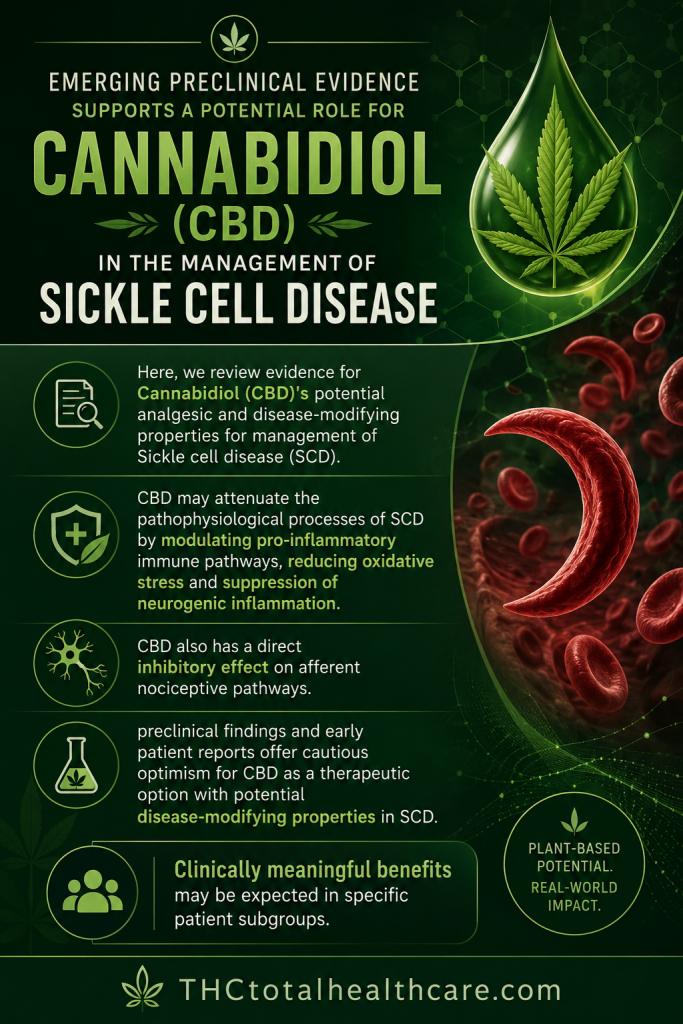
Dramatic efficacy of cannabidiol on refractory chronic pain in an adolescent with sickle cell disease

pubmed logo

“Here, we report a dramatic efficacy of cannabidiol in an adolescent with SCD suffering from chronic pain refractory to other analgesics, with complete regression of chronic pain and rapid plasma histamine level normalization after treatment.”

https://pubmed.ncbi.nlm.nih.gov/37540761/

“In conclusion, we report here for the first time a case of refractory chronic pain with dramatic improvement after CBD treatment in an adolescent with SCD. The CBD oral solution Epidiolex has been approved by the US Food and Drug Administration since June 2018 and by the European Medicine Agency since January 2023 for management of refractory epilepsy. As it seems to be a well-tolerated drug, CBD could represent a promising therapeutic perspective for patients with SCD suffering from chronic pain.”

https://onlinelibrary.wiley.com/doi/10.1002/ajh.27049

Daily Cannabis Users with Sickle Cell Disease Show Fewer Admissions than Others with Similar Pain Complaints

View details for Cannabis and Cannabinoid Research cover image “Previous studies have shown that cannabis use is common in adults with sickle cell disease (SCD), and that many patients report using cannabis to treat pain.

Methods: We performed a cross-sectional study of adults with SCD and compared daily users of cannabis with others using validated patient-reported measures of pain and quality of life as well as opioid and health care utilization.

Results: Daily cannabis users with SCD had worse pain episode severity scores than others (56.7 vs. 48.8, p=0.02) yet had 1.8 fewer annual admissions (p=0.01) and 1.2 fewer annual emergency room (ER) visits (p=0.01), and similar amounts of opioids dispensed to others after matching for age, gender, SCD genotype, hydroxyurea use, and pain impact scores.

Conclusions: We show that people with SCD with more severe pain crisis are more likely to use daily cannabis, yet have lower rates of hospital admission and ER use as compared with others with similar disease severity and pain impact. Randomized controlled trials should be performed.”

https://pubmed.ncbi.nlm.nih.gov/32923662/

“We posit that people with SCD with severe pain are more likely to use daily cannabis due to its analgesic properties. This would explain why daily users reported more severe pain crises yet had fewer admissions and ER visits after propensity matching was performed.”

https://www.liebertpub.com/doi/10.1089/can.2019.0036

Marijuana Use in Adults Living with Sickle Cell Disease.

Cannabis and Cannabinoid Research cover image “Introduction: Legal access to marijuana, most frequently as “medical marijuana,” is becoming more common in the United States, but most states do not specify sickle cell disease as a qualifying condition. We were aware that some of our patients living with sickle cell disease used illicit marijuana, and we sought more information about this. Results: Among 58 patients surveyed, 42% reported marijuana use within the past 2 years. Among users, most endorsed five medicinal indications; a minority reported recreational use. Among 57 patients who had at least one urine drug test, 18% tested positive for cannabinoids only, 12% tested positive for cocaine and/or phencyclidine only, and 5% tested positive for both cannabinoids and cocaine/phencyclidine. Subsequent to these studies, sickle cell disease became a qualifying condition for medical marijuana in our state. In the interval ∼1.5 years, 44 patients have requested certification. Conclusion: Our findings and those of others create a rationale for research into the possible therapeutic effects of marijuana or cannabinoids, the presumed active constituents of marijuana, in sickle cell disease. Explicit inclusion of sickle cell disease as a qualifying condition for medical marijuana might reduce illicit marijuana use and related risks and costs to both persons living with sickle cell disease and society.”
]]>