
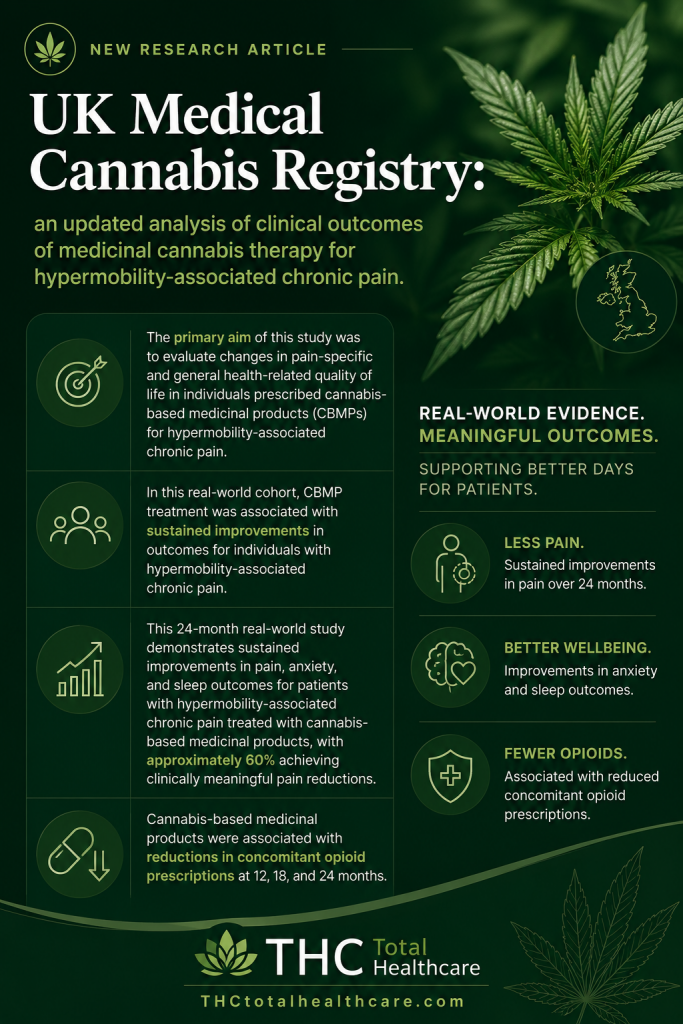
“Introduction/objective: The primary aim of this study was to evaluate changes in pain-specific and general health-related quality of life in individuals prescribed cannabis-based medicinal products (CBMPs) for hypermobility-associated chronic pain.
Methods: The case series utilised data from the UK Medical Cannabis Registry. Primary outcomes were changes in Brief Pain Inventory (BPI), Pain Visual Analogue Scale (VAS), Short-Form McGill Pain Questionnaire-2 (SF-MPQ-2), EQ-5D-5L index value, Generalised Anxiety Disorder-7 (GAD-7), and Single-item Sleep Quality Scale (SQS) over 24 months. Repeated measures analysis of variance was used to assess changes over time, with post hoc pairwise comparisons performed for significant findings.
Results: A total of 240 patients were analysed. Changes were observed across all patient-reported outcome measures (PROMs) on repeated measures analysis of variance (p < 0.001). Post hoc pairwise comparisons for the BPI subscales, SF-MPQ-2 and Pain VAS demonstrated improvement from baseline to all subsequent timepoints (p < 0.001). By 24 months, 56.67% (n = 136) and 61.25% (n = 147) of participants reported clinically significant improvements in BPI severity and interference respectively. Clinically significant improvements were also reported for SF-MPQ-2 (47.08%, n = 113) and Pain VAS scores (60.00%, n = 144).
Conclusion: In this real-world cohort, CBMP treatment was associated with sustained improvements in outcomes for individuals with hypermobility-associated chronic pain. These findings support the need for further controlled studies to determine causality.
Key Points • This 24-month real-world study demonstrates sustained improvements in pain, anxiety, and sleep outcomes for patients with hypermobility-associated chronic pain treated with cannabis-based medicinal products, with approximately 60% achieving clinically meaningful pain reductions.
• Cannabis-based medicinal products were associated with reductions in concomitant opioid prescriptions at 12, 18, and 24 months.
• This represents the largest and longest-duration observational study of medical cannabis therapy specifically in hypermobility spectrum disorders and Ehlers-Danlos syndrome, addressing a critical evidence gap in chronic pain management.
• Adverse events were predominantly mild-to-moderate in severity, with poor baseline sleep quality and current cannabis use identified as positive predictors of pain improvement, informing patient selection and treatment optimisation.”
https://pubmed.ncbi.nlm.nih.gov/42217098
“This study provides a 24-month real-world evaluation of CBMPs in patients with hypermobility-associated chronic pain. It demonstrates long-term sustained improvement in pain, anxiety and sleep-related outcomes, underpinning health-related quality of life. Despite its observational design, the study provides important insight into potentially addressing an area of significantly unmet therapeutic need.”
https://link.springer.com/article/10.1007/s10067-026-08166-z

 “The Endocannabinoid System (ECS) is primarily responsible for maintaining homeostasis, a balance in internal environment (temperature, mood, and immune system) and energy input and output in living, biological systems.
 “Ehlers-Danlos Syndromes (EDS) and related Hypermobility Spectrum Disorders (HSD) are debilitating connective tissue disorders that feature a prominent pain component for which there are limited therapeutic options for pain management.
  “We present the case of an 18-year-old woman who suffered from complications of Ehlers-Danlos syndrome (EDS). Her pain was poorly controlled despite being on a myriad of analgesic medications at the time.