The effects of chronic cannabidiol administration on brain pathology and behavioral deficits found in the tau P301s-line PS19 mouse model of Alzheimer’s disease

“Compounds derived from the plant Cannabis demonstrate many therapeutic properties suggesting that they could delay the onset and progression of Alzheimer’s disease (AD).

The goal of the present experiment was to observe the effects of chronic cannabidiol (CBD) administration on the behavior and brain pathology of an AD tauopathy mouse model, Tau P301S-Line PS19 mice.MethodsMice were orally given CBD (20 mg/kg) or vehicle, daily, beginning around 3 months of age. At 6 months old, mice were tested on a battery of tasks to assess object recognition, motor function, and spatial learning and memory. The mice were retested at 9 months old on the behavioral tasks and the fear conditioning paradigm was added. Following completion of behavioral testing, the mice were perfused for histological analysis.

Results Chronic CBD treatments did not appear to affect the behavior nor restore the reduced hippocampal volume of Tau P301S mice. However, a deeper assessment of the changes in inflammatory markers showed a treatment effect on a measure of microglia reactivity. Robust sex differences were revealed with Tau P301S males showing more severe pathology relative to females. Finally, daily treatments of CBD did not negatively impact the behavior or brain of any of the experimental groups suggesting that its chronic administration was relatively safe.

Conclusions Taken together, the results suggested that CBD can have beneficial effects on some of the pathology associated with AD, even in an aggressive model of this neurodegenerative disease, but the impacts on impaired behavior were minimal.”

https://pubmed.ncbi.nlm.nih.gov/41736228

“Cannabidiol (CBD) is a safe, readily available, and relatively inexpensive treatment option that has been shown to improve pathologies associated with AD.”

https://journals.sagepub.com/doi/10.1177/13872877261421654


Efficacy and Safety of Cannabinoids for Neuropsychiatric Symptoms of Dementia: A Systematic Review with Meta-analysis

Background and objective: Neuropsychiatric symptoms (NPS) are highly prevalent in persons with dementia and have been associated with adverse health outcomes. Neuropsychiatric symptoms can impose major physical, psychosocial, and financial burdens on caregivers while contributing to additional pressure on healthcare systems. Although atypical antipsychotics have received regulatory approval for treating specific NPS, such as agitation, their use in older adults has been linked to higher risks of mortality, cardiovascular events, and falls. Cannabinoids have emerged as promising pharmacological treatments for NPS in dementia, including agitation, anxiety, and depressive symptoms, owing to their behavior-modulating effects. The objective of this study was to provide a comprehensive assessment of the efficacy and safety of cannabinoids for NPS in dementia, which may help refine evidence-based guidelines for their use.

Methods: We systematically reviewed studies from MEDLINE, Embase, PsycINFO, CINAHL, Cochrane Library, and ClinicalTrials.gov from inception to August 2025. Search terms relevant to cannabinoids and dementia were used. Randomized controlled trials on the use of cannabinoids for treating NPS in dementia with published results were included. Participant characteristics, including age, sex, and baseline cognition, were collected. Random-effects meta-analyses were conducted to examine standardized mean differences in NPS scores between cannabinoid and placebo groups. Risk of bias was assessed using the Cochrane Risk of Bias 2 tool (RoB 2) for randomized trials. Heterogeneity between studies was analyzed through I2 statistics. Additionally, subgroup analyses and meta-regressions were performed for variables of interest. Last, risk ratios for outcomes related to adverse events were calculated to evaluate the safety of cannabinoids in this population.

Results: Of the ten included studies (328 participants), eight assessed total NPS and nine reported on agitation in persons with dementia. Our results indicated that cannabinoids did not decrease total NPS (standardized mean difference [SMD]: – 0.18, 95% confidence interval [CI] – 0.48 to 0.12; p = 0.2) compared to placebo, but reduced agitation (SMD: – 0.52, 95% CI – 1.00 to – 0.05, p = 0.03) with high heterogeneity (I2 = 77.2%). However, after removing studies rated as high risk (RoB 2) for a sensitivity analysis, the result was no longer statistically significant (SMD: – 0.35, 95% CI – 0.79 to 0.10, p = 0.1). Subgroup analyses demonstrated that cannabinoids were beneficial with doses higher than 10 mg of tetrahydrocannabinol-equivalent (SMD: – 0.63, 95% CI – 0.98 to – 0.28, p < 0.01), and in patients with severe dementia (SMD: – 0.96, 95% CI – 1.75 to – 0.16, p < 0.01). The risk of overall adverse events did not differ significantly between cannabinoid and placebo treatments, though cannabinoids were associated with an increased risk of sedation (risk ratio = 2.09, 95% CI = 1.22 to 3.57, p < 0.01).

Conclusions: This review provides up-to-date evidence that cannabinoids are efficacious for alleviating dementia-related agitation and are generally well tolerated in this population, though sedation was more commonly reported in the cannabinoid group. However, the data remained scarce for other NPS and requires further research.”

https://pubmed.ncbi.nlm.nih.gov/41748849

https://link.springer.com/article/10.1007/s40263-026-01277-w

Lifetime Cannabis Use Is Associated with Brain Volume and Cognitive Function in Middle-Aged and Older Adults

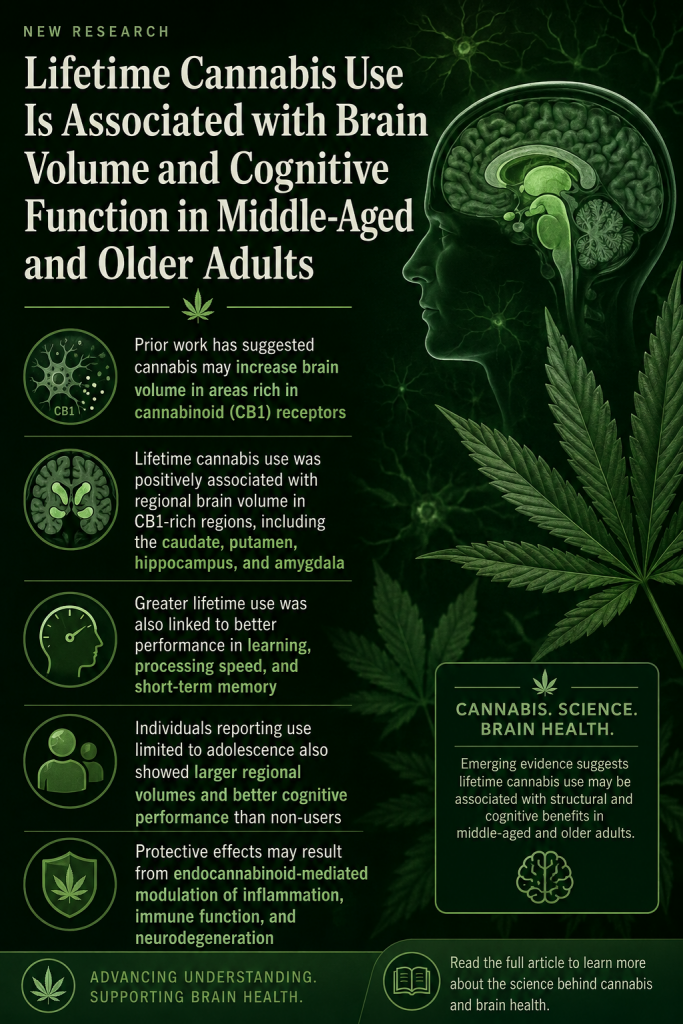
Objective: Cannabis use has increased among older adults, yet the neurocognitive effects in this demographic remain unclear. Prior work has suggested cannabis may increase brain volume in areas rich in cannabinoid (CB1) receptors, though negative effects are often reported in adolescents. This study sought to clarify the relationship between cannabis use and brain health among middle-aged and older adults.

Method: Using data from the UK Biobank, which includes health information from over 500,000 adults, associations between cannabis use, regional brain volume, and cognition in participants aged 40-70 years (mean age = 54.5) were evaluated.

Results: Lifetime cannabis use was positively associated with regional brain volume in CB1-rich regions, including the caudate, putamen, hippocampus, and amygdala. Greater lifetime use was also linked to better performance in learning, processing speed, and short-term memory. Individuals reporting use limited to adolescence also showed larger regional volumes and better cognitive performance than non-users. Sex differences in cannabis effects on brain volume and cognition were also observed.

Conclusions: Results highlight that cannabis may influence brain health differently across the lifespan, potentially offering protective effects in older age while posing risks earlier in development. Protective effects may result from endocannabinoid-mediated modulation of inflammation, immune function, and neurodegeneration. Observed sex differences likely reflect variation in the endocannabinoid system and underscore the importance of considering sex as a biological variable in studies of cannabis and brain health.”

https://pubmed.ncbi.nlm.nih.gov/41379083

https://www.jsad.com/doi/10.15288/jsad.25-00346

Evaluation of two different Cannabis sativa L. extracts as antioxidant and neuroprotective agents

Cannabis sativa L. is a plant that contains numerous chemically active compounds including cannabinoids such as trans-Δ-9-tetrahydrocannabinol (Δ9-THC) and cannabidiol (CBD), and flavone derivatives, such as luteolin-7-O-glucuronide and apigenin glucuronide.”

“These extracts could be a source of compounds with potential benefit on human health, especially related to neurodegenerative disorders.”

https://pubmed.ncbi.nlm.nih.gov/36176449

“In conclusion, this study provided new insights into the biological activities of two different extracts of C. sativa. It was revealed that these extracts constitute a valuable and interesting natural source of bioactive molecules with great antioxidant properties, potentially capable of preventing neurodegenerative diseases.”

https://www.frontiersin.org/articles/10.3389/fphar.2022.1009868/full


A Randomized Controlled Trial of the Safety and Efficacy of Dronabinol for Agitation in Alzheimer’s Disease

Importance: Agitation in Alzheimer’s disease (AD) is a great source of distress for patients and caregivers and a major public health burden. Current treatments are only modestly effective and many have safety issues including mortality risk. Novel therapeutic options are needed.

There is preliminary evidence for the safety and efficacy of dronabinol (tetrahydrocannabinol, THC) for agitation in AD.

Objective: Assess the safety and efficacy of dronabinol (THC) to decrease agitation in AD.

Design: THC-AD was a 3-week randomized parallel double-blind placebo-controlled clinical trial, conducted between 2017 and 2024.

Setting: 5 inpatient and outpatient academic clinical research centers in the Eastern U.S.

Participants: Volunteer sample of 75 participants meeting inclusion criteria for agitation of AD (International Psychogeriatric Association Provision Criteria) with Neuropsychiatric Inventory Clinician Version Agitation or Aggression (NPI-C A/A) domains total score of 4 or greater. Major exclusion criteria included seizure disorder, delirium, and non-AD dementia.

Interventions: 3 weeks dronabinol vs. placebo titrated up to target dose of 10 mg daily in divided twice-daily.

Main outcomes and measures: Prespecified co-primary agitation outcomes were the Pittsburgh Agitation Scale (PAS) and NPI-C A/A total score.

Results: The majority of participants were female and were taking concomitant psychotropic medications (antidepressants and antipsychotics) at baseline. Study participants were moderately agitated at baseline, were diverse in ethnic background (9% Black, 11% Hispanic/Latina/Latino), and had severe cognitive impairment evidenced by MMSE or SIB-8. 84% completed the 3-week trial.

Dronabinol decreased agitation on both primary outcomes greater than placebo to a clinically relevant extent. The fitted between-arm difference in PAS decline/week was -0.74 (SE 0.3, p = 0.015, effect size = 0.53) and for NPI-C A/A the decline was not significant at -1.26 (SE 0.67, p = 0.094, effect size = 0.36). No secondary outcomes differed between treatment arms including sleep, activities of daily living, Cohen-Mansfield Agitation Inventory (CMAI), cognition, intoxication, or use of ‘as-needed’ lorazepam or trazodone. Dronabinol treatment was not associated with greater intoxication nor with other adverse events (AEs) except for somnolence.

Conclusions and relevance: Adjunctive dronabinol treatment was safe and effective for treating agitation in AD.”

https://pubmed.ncbi.nlm.nih.gov/41350162

“Highlights

What is the primary question addressed by this study?

Is dronabinol (synthetic THC) a safe and effective treatment for reducing agitation in individuals with Alzheimer’s disease?

What is the main finding of this study?

In a 3-week randomized, placebo-controlled trial of 75 participants with moderate to severe Alzheimer’s disease, dronabinol significantly reduced agitation as measured by the Pittsburgh Agitation Scale (effect size = 0.53) and showed a trend toward improvement on the NPI-C Agitation/Aggression domain. The medication was well tolerated, with somnolence as the only notable side effect and no increased risk of delirium, falls, or intoxication.

What is the meaning of the finding?

These results suggest that dronabinol may be a relatively safe and effective pharmacologic option for managing agitation in Alzheimer’s disease.”

https://www.ajgponline.org/article/S1064-7481(25)00506-8/abstract

A Balanced Cannabinoids Mixture Protects Neural Stem/progenitor Cells from CoCl2 Induced Injury by Regulating Autophagy and Inflammation: An in Vitro Study

“Although tetrahydrocannabinol (THC) and cannabidiol (CBD) have been individually studied for their neuroprotective roles, few studies have addressed the effects of their balanced 1:1 formulation Satinex (STX) under pathologic conditions like hypoxia. Moreover, the effect of STX on embryonic neural stem/progenitor cells (ENS/PCs) derived from the rat embryonic brain, which are highly vulnerable during early development, remains unexplored.

Considering the pivotal role of hypoxia in numerous neuropathological situations, this study examined the impact of STX on rat ENS/PCs exposed to chemically induced hypoxia.

ENS/PCs were isolated from rat embryos and subjected to hypoxia using 100 µM cobalt (II) chloride hexahydrate (CoCl₂0.6 H₂O) for 48 h. Cytotoxic activity of STX andCoCl2was assessed using the 3-(4,5-Dimethyl-2-thiazolyl)-2,5-diphenyl-2 H-tetrazolium (MTT) assay, while stem cell identity was confirmed via flow cytometry (Nestin, SOX2). STX (0.1 and 0.5 µM) was applied under both normoxic and hypoxic conditions. Expression levels of hypoxia-inducible factor 1-alpha (Hif1α) mRNA, autophagy markers (Beclin-1, microtubule-associated protein 1 light chain 3-II [LC3-II]), and pro-inflammatory proteins nuclear factor kappa B [NF-κB], Toll-like receptor 2 [TLR2], Toll-like receptor 4 [TLR4]) were assessed using reverse transcription polymerase chain reaction (RT-PCR) and western blot techniques following STX treatment.

Based on flow cytometric assays, over 70% of cultivated cells were positive for Nestin and SOX2. Hypoxia significantly reduced cell viability and proliferation, accompanied by increased Hif1α mRNA expression. Treatment with STX (0.1 µM and 0.5 µM) significantly reversed these changes, restoring cell viability and proliferation while reducing Hif1α levels. Hypoxia also elevated autophagy markers (Beclin-1, LC3-II) and pro-inflammatory proteins (NF-κB, TLR2, TLR4), which STX suppressed in a dose-dependent manner.

This study provides novel evidence that STX mitigates hypoxia-induced neural damage by downregulating Hif1α and its downstream inflammatory and autophagic signaling pathways. The use of a clinically relevant cannabinoids mixture and a developmentally sensitive cell model underline the translational potential of balanced THC/CBD formulations in the treatment of hypoxia-related neurodegenerative and neurodevelopmental conditions.”

https://pubmed.ncbi.nlm.nih.gov/41240218

https://link.springer.com/article/10.1007/s12640-025-00770-2

History of cannabis use and cognitive function in older adults: findings from the UK biobank

“Background: Cannabis is a commonly used psychoactive drug, but its cognitive effects remain unclear, particularly in older adults. This study examined associations between past and present cannabis use and cognitive function among dementia-free older adults.

Methods: Cross-sectional and longitudinal data were drawn from the UK Biobank, including adults aged ≥60 years. Cannabis use patterns were self-reported, and cognitive function was assessed via computerized tests of attention, executive function, processing speed, visual memory and working memory. Multivariable linear regression models adjusted for demographic, health and lifestyle-related covariates.

Results: Cross-sectional analyses included 67 713 participants; longitudinal analyses included 52 002 participants with two cognitive assessments (mean age 67.2 ± 4.4 years; 46.1% male). Lifetime cannabis users (17%) performed better across all cognitive domains: attention (B = 0.071), executive function (B = 0.047), processing speed (B = 0.363), visual (B = 0.062) and working memory (B = 0.181). Current use was associated with better working memory (B = 0.169). Mixed and contradictory results were found for early onset, duration and frequency of use with cognitive outcomes. Longitudinally, past use was associated with less decline in executive function, while longer duration of use predicted steeper decline in processing speed.

Conclusions: Cannabis use is not uniformly harmful to cognition in older adults. Past use was linked to better performance and slower decline in some cognitive domains. However, specific usage patterns, such as longer duration, were associated with poorer outcomes in other domains. These findings highlight the need for further research to clarify underlying mechanisms and guide evidence-based recommendations regarding cannabis use in aging populations.”

https://pubmed.ncbi.nlm.nih.gov/41189327/

“Cannabis use in older adults is not uniformly associated with cognitive decline; former users showed better cognitive perform.”

“These results offer preliminary evidence that cannabis use may not be uniformly detrimental to cognitive health in aging.”

https://academic.oup.com/ageing/article/54/11/afaf319/8313927?login=false

Exploring multitarget molecular mechanisms of cannabidiol in Alzheimer’s disease treatment using molecular simulations and modeling

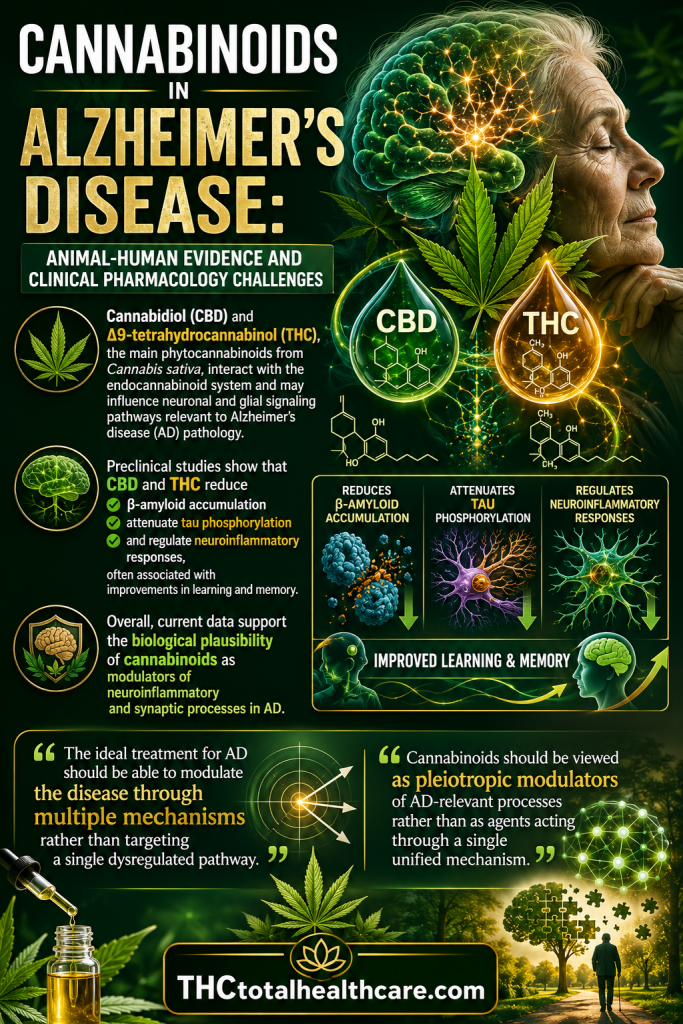
“Alzheimer’s disease is a progressive neurodegenerative disorder marked by amyloid-β (Aβ) plaque deposition and neurofibrillary tangles composed of hyperphosphorylated tau. Dysregulation of glycogen synthase kinase-3β (GSK3β) promotes tau hyperphosphorylation and amplifies Aβ-induced neurotoxicity, driving pathogenesis. Despite extensive research, current therapies targeting these core mechanisms remain largely ineffective at halting disease progression.

Based on prior clinical and preclinical evidence, we hypothesize that cannabidiol (CBD), a non-psychoactive phytocannabinoid, may exert multitarget therapeutic effects in AD by modulating Aβ aggregation, tau hyperphosphorylation, and GSK3β activity.

We investigated CBD’s interactions with Aβ-42/40, tau, and GSK3β using molecular docking, molecular dynamics simulations and ADMET predictions.

Our results show that CBD binds to Aβ with binding free energies of -7.81 kcal/mol, -7.46 kcal/mol, and -7.25 kcal/mol, disrupting aggregation by interacting with key residues (HIS6, HIS13, HIS14, GLU14, GLU22, ASP15, and ASP23). MD simulations confirm that CBD destabilizes Aβ’s β-sheet structure, preventing fibril formation. CBD binds tau with binding free energies of -9.91 kcal/mol, -9.70 kcal/mol, and -9.66 kcal/mol, disrupting tau aggregation and preventing neurofibrillary tangle formation. MD simulations show that CBD induces structural changes in tau, reducing β-sheet packing and inhibiting tau-tau interactions. CBD also binds to GSK3β with binding energies of -8.94 kcal/mol, -8.51 kcal/mol, and -8.41 kcal/mol, competing with ATP to inhibit its kinase activity and reduce tau phosphorylation. ADMET analysis indicates CBD’s favorable oral bioavailability and low toxicity.

These findings support CBD as a promising multitarget therapeutic for AD, warranting further preclinical and clinical investigations.”

https://pubmed.ncbi.nlm.nih.gov/41105605/

https://journals.sagepub.com/doi/10.1177/13872877251386440

Can cannabinoids alleviate behavioral symptoms in older adults with dementia? A systematic review

“Background: Behavioral and psychological symptoms of dementia (BPSD) affect patients’ and caregivers’ well-being. Cannabinoids may offer a promising therapeutic option for managing BPSD.

Aims: This systematic review aims to explore the strengths of using this class of substances in the context of dementia care.

Methods: We conducted a comprehensive search across Embase Ovid, PubMed, Cochrane Library, APA PsycInfo, and Web of Science, identifying 1839 studies, with 14 selected for full review. Quality was assessed using the Newcastle-Ottawa and the modified Jadad Scales.

Results/outcomes: Ten studies (278 participants) were finally included. They showed cannabinoids helped reduce agitation and nocturnal disturbances.

Conclusions/interpretation: In conclusion, cannabinoids show promise in managing BPSD in dementia, with good tolerability and safety. Further studies could solidify these findings.”

https://pubmed.ncbi.nlm.nih.gov/41035223/

https://journals.sagepub.com/doi/10.1177/02698811251375895

Oromucosal as an Alternative Method for Administration of Cannabis Products in Rodents

pubmed logo

“Oral administration of drugs in laboratory rodents such as rats is conventionally performed using the gavage technique. Despite effectiveness, gavage can induce distress associated with restraint, especially following repeated animal handling.

To mitigate these adverse effects and reduce morbidity associated with traditional methods, we explored oromucosal/buccal administration of cannabidiol (CBD)-enriched Cannabis extract.

In this method, male rats were treated daily for 15 days with medium-chain triglycerides (TCM) derived from coconut oil or CBD-enriched Cannabis extract. Each treatment was administered individually while animals were gently immobilized using an affectionate touch technique. The administration involved the use of a micropipette to apply the oily formulation directly into the oral mucosa. The dosage was calculated based on the CBD concentration in the Cannabis extract, standardized at 3 mg/kg/day. To ensure accuracy, animals were weighed daily, allowing for dose adjustments in accordance with weight changes over the treatment period. This method offers non-invasive and stress-reducing treatment, potentially improving animal welfare in experimental settings.

The treatment with CBD-enriched Cannabis extract was safe, and the analysis of the hippocampus of these animals’ showed alterations in the expression levels of GluA1 and GFAP proteins, which are directly associated with glutamatergic receptor functionality and neuroinflammation, respectively. This suggests that Cannabis extract could be applied in pathological conditions where glutamatergic excitotoxicity and astrogliosis are observed.”

https://pubmed.ncbi.nlm.nih.gov/40920655/

https://app.jove.com/t/68104/oromucosal-as-an-alternative-method-for-administration-cannabis