A single-center real-life study on the use of medical cannabis in patients with dystonia

pubmed logo

“Background: While cannabis-based medicine is being commonly used in patients with movement disorders, there is a scarcity of publications regarding the effect of cannabis on dystonia. We aimed to describe medical cannabis use in patients with dystonia and related pain.

Methods: We employed a structured interview to obtain data on the cannabis treatment regimen, perception of effectiveness and side effect profile. Eligible participants were patients diagnosed with dystonia from the movement disorders unit at the Tel-Aviv Medical Center who had used licensed medical cannabis between January 2019 and January 2021.

Results: Twenty-three subjects were interviewed (11 women, mean age 52.7). The most common way of administration was smoking (n = 11). Following an average of 2.5 ± 2.9 years of use, those with widespread dystonia (generalized, hemi and multifocal, n = 11) self-reported on a numeric rating scale an average 63% (range 0%-100%) reduction in symptoms of dystonia, while those with more focal dystonia patterns reported a significantly lower treatment effect of 32%. Participants reported a positive impact in related pain and quality of life, with an average rating of 3.8 out of 5 (SD = 1.2, median = 4) and 3.6 out of 5 (SD = 1.15, median = 4), respectively. Most common side effects were dry mouth (65%), sedation (43%), dizziness (39%) and psychiatric disorders (26%). Three patients (13%) discontinued therapy.

Conclusion: A subset of dystonia patients who use medical cannabis under clinical observation reported significant subjective improvement during 30 months of use in average. Further prospective randomized controlled trials are required to examine the effectiveness of cannabis in dystonia.”

https://pubmed.ncbi.nlm.nih.gov/37456642/

https://www.frontiersin.org/articles/10.3389/fneur.2023.1218300/full
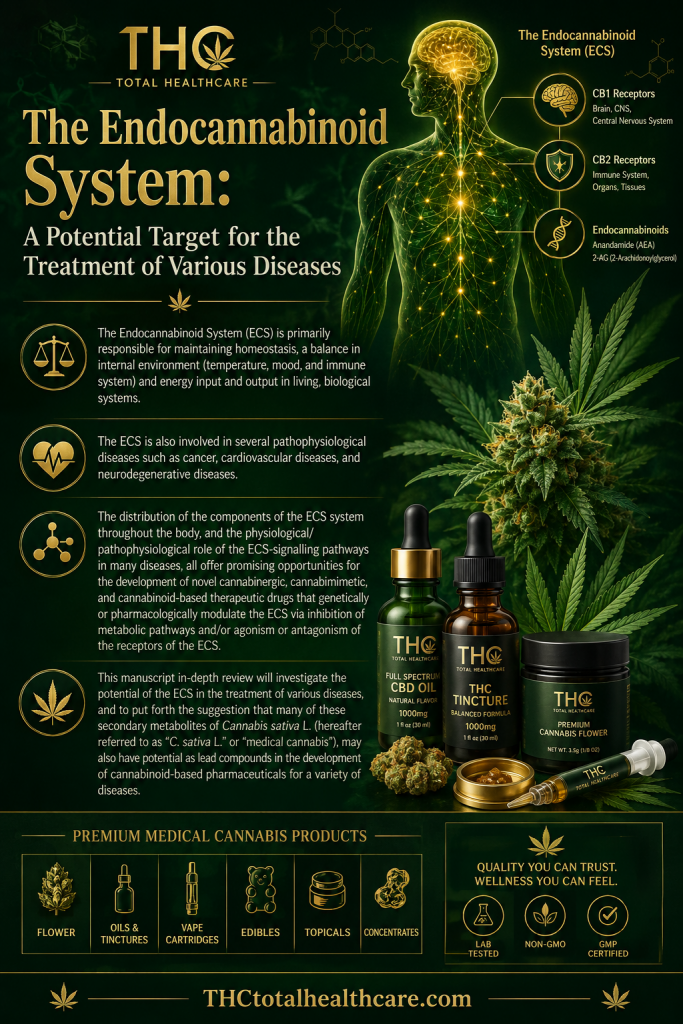
The Endocannabinoid System: A Potential Target for the Treatment of Various Diseases

ijms-logo“The Endocannabinoid System (ECS) is primarily responsible for maintaining homeostasis, a balance in internal environment (temperature, mood, and immune system) and energy input and output in living, biological systems.
In addition to regulating physiological processes, the ECS directly influences anxiety, feeding behaviour/appetite, emotional behaviour, depression, nervous functions, neurogenesis, neuroprotection, reward, cognition, learning, memory, pain sensation, fertility, pregnancy, and pre-and post-natal development.

The ECS is also involved in several pathophysiological diseases such as cancer, cardiovascular diseases, and neurodegenerative diseases. In recent years, genetic and pharmacological manipulation of the ECS has gained significant interest in medicine, research, and drug discovery and development.

The distribution of the components of the ECS system throughout the body, and the physiological/pathophysiological role of the ECS-signalling pathways in many diseases, all offer promising opportunities for the development of novel cannabinergic, cannabimimetic, and cannabinoid-based therapeutic drugs that genetically or pharmacologically modulate the ECS via inhibition of metabolic pathways and/or agonism or antagonism of the receptors of the ECS. This modulation results in the differential expression/activity of the components of the ECS that may be beneficial in the treatment of a number of diseases.

This manuscript in-depth review will investigate the potential of the ECS in the treatment of various diseases, and to put forth the suggestion that many of these secondary metabolites of Cannabis sativa L. (hereafter referred to as “C. sativa L.” or “medical cannabis”), may also have potential as lead compounds in the development of cannabinoid-based pharmaceuticals for a variety of diseases.”

https://pubmed.ncbi.nlm.nih.gov/34502379/

https://www.mdpi.com/1422-0067/22/17/9472


“Cannabis sativa L. as a Natural Drug Meeting the Criteria of a Multitarget Approach to Treatment”

https://www.ncbi.nlm.nih.gov/pmc/articles/PMC7830475/

A Brief Background on Cannabis: From Plant to Medical Indications.

 Ingenta Connect “Cannabis has been used as a medicinal plant for thousands of years. As a result of centuries of breeding and selection, there are now over 700 varieties of cannabis that contain hundreds of compounds, including cannabinoids and terpenes. Cannabinoids are fatty compounds that are the main biological active constituents of cannabis. Terpenes are volatile compounds that occur in many plants and have distinct odors. Cannabinoids exert their effect on the body by binding to receptors, specifically cannabinoid receptors types 1 and 2. These receptors, together with endogenous cannabinoids and the systems for synthesis, transport, and degradation, are called the Endocannabinoid System. The two most prevalent and commonly known cannabinoids in the cannabis plant are delta-9-tetrahydrocannabinol (THC) and cannabidiol. The speed, strength, and type of effects of cannabis vary based on the route of administration. THC is rapidly distributed through the body to fatty tissues like the brain and is metabolized by the cytochrome P450 system to 11-hydroxy-THC, which is also psychoactive. Cannabis and cannabinoids have been indicated for several medical conditions. There is evidence of efficacy in the symptomatic treatment of nausea and vomiting, pain, insomnia, post-traumatic stress disorder, anxiety, loss of appetite, Tourette’s syndrome, and epilepsy. Cannabis has also been associated with treatment for glaucoma, Huntington’s Disease, Parkinson’s Disease, and dystonia, but there is not good evidence to support its efficacy. Side effects of cannabis include psychosis and anxiety, which can be severe. Here, we provided a summary of the history of cannabis, its pharmacology, and its medical uses.” https://www.ncbi.nlm.nih.gov/pubmed/30139415
]]>