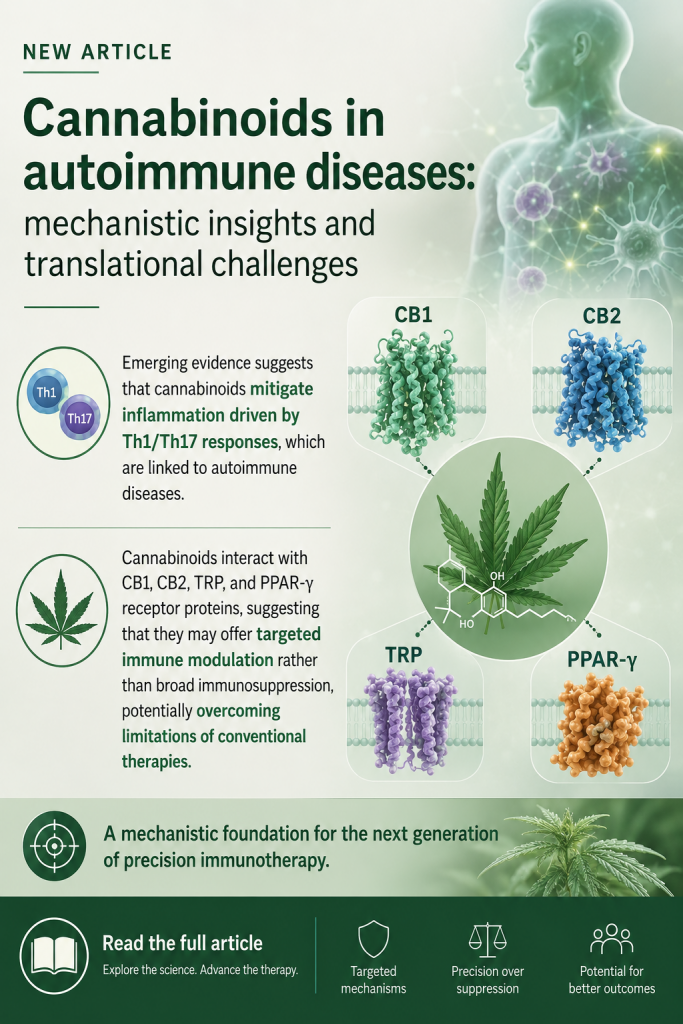
Cannabinoids in autoimmune diseases: mechanistic insights and translational challenges

“Cannabinoids are traditionally recognized for their effect on the nervous system. Emerging evidence suggests that cannabinoids mitigate inflammation driven by Th1/Th17 responses, which are linked to autoimmune diseases.

In addition to their symptomatic, and analgesic effects, cannabinoids suppress the immune response by modulating regulatory T-cell activity, reducing microglial activation, and help in maintaining the integrity of the epithelial barrier. These findings suggest that cannabinoids may be involved in immune, and metabolic regulatory pathways.

Despite the promising preclinical data, translating these findings into effective treatments for autoimmune disorders has proven challenging. Current human studies have primarily focused on symptomatic relief such as reducing spasticity, managing pain, improving sleep quality, and boosting appetite. However, few trials have included immune profiling, i.e., assessed cytokine panels, performed immune cell phenotyping, tracked relapses, or utilized inflammation-focused imaging endpoints. Consequently, documented benefits are primarily symptomatic, while potential disease-modifying effects are not yet adequately studied.

Cannabinoids interact with CB1, CB2, TRP, and PPAR-γ receptor proteins, suggesting that they may offer targeted immune modulation rather than broad immunosuppression, potentially overcoming limitations of conventional therapies.

Moreover, new compounds like cannabigerol (CBG), cannabidivarin (CBV), and CB2-selective agonists with minimal psychoactivity offer expanded therapeutic options. However, challenges persist due to variability in formulations, bioavailability issues, regulatory hurdles, and a lack of long-term safety data. Future clinical development will require standardised GMP-grade preparations, robust pharmacokinetic evaluation, and trials that include immune-related endpoints such as T-cell polarisation, inflammasome markers, oxidative stress profiles, microbiome signatures, and longitudinal imaging, to clarify their therapeutic potential in autoimmune diseases.”

https://pubmed.ncbi.nlm.nih.gov/42105814
“Cannabinoids are versatile bioactive compounds that modulate immune function, and inflammation through classical (CB1, CB2), and non-classical pathways [(TRP channels; TRPV1, TRPA1), PPAR-γ), and orphan GPCRs (GPR55, GPR18)]. They engage interconnected signalling networks rather than a single dominant mechanism, collectively influencing immune cell function.”

https://www.sciencedirect.com/science/article/abs/pii/S0006295226003655?via%3Dihub

“List of Autoimmune Diseases”

https://www.ncbi.nlm.nih.gov/books/NBK605867


Cannabinoids in immune system-related diseases: From bench to clinic

pubmed logo

“As a psychoactive drug, marijuana is used for recreational purposes. Given its addictive nature and the serious damage it causes to both individual health and social stability, marijuana has been banned in most countries worldwide. In recent years, with the continuous improvement of basic research, researchers have discovered the vital role of cannabinoids, the primary active ingredient in marijuana, in multiple human systems.

Research found that cannabinoids play roles in regulating immune system function and have therapeutic potential in immune system-related diseases.

However, the use of cannabinoids still poses certain hazards. For instance, the abuse of cannabinoids by pregnant women can exert certain impacts on fetal nervous system development; cannabinoids use can lead to adverse reactions such as dizziness, nausea, and dry mouth. Moreover, there are still numerous contradictions in current research on the effects of cannabinoids, and the mechanisms by which cannabinoids exert protective effects in certain diseases remain unelucidated.

In this review, we systematically discuss the endocannabinoid system and summarize the molecular and cellular bases of cannabinoid function in the immune system, and elucidate the effects of cannabinoids on immune system-related diseases.”

https://pubmed.ncbi.nlm.nih.gov/41146433/

“These findings collectively demonstrate the protective roles of CB1 agonists in immune system-related diseases.”

“These findings underscore the broad therapeutic efficacy of CB2 agonists in immune system-related diseases.”

“Cannabinoids exert immunoregulatory effects by inducing the apoptosis of immune cells, inhibiting immune cell proliferation, suppressing the production of proinflammatory cytokines, and regulating the functions of immune cells such as B cells, NK cells, and Treg cells.”

https://journals.lww.com/cmj/fulltext/9900/cannabinoids_in_immune_system_related_diseases_.1774.aspx

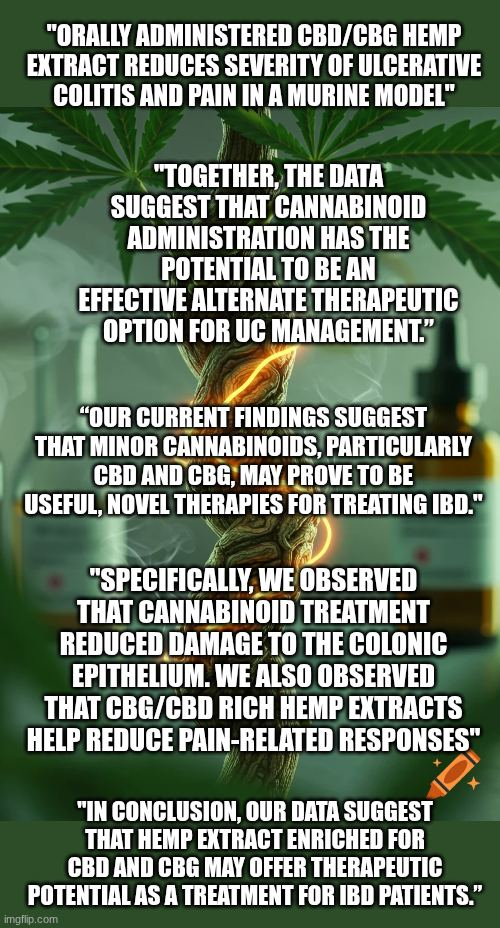
Orally Administered CBD/CBG Hemp Extract Reduces Severity of Ulcerative Colitis and Pain in a Murine Model

“Background: Ulcerative colitis (UC) is an autoimmune disorder characterized by inflammation of the mucosa that gives rise to a disrupted epithelial morphology. Persistent or recurrent inflammation and the debilitating nature of the associated symptoms make treatment of UC challenging. Cannabinoids derived from Cannabis sativa L. have been used for treatment of gastrointestinal disorders due to the wide-ranging therapeutic benefits of these compounds. 

Methods: We evaluated a commercial hemp extract, high in cannabigerol (CBG) and cannabidiol (CBD), as a novel treatment for UC symptoms using the dextran sodium sulfate (DSS) model in mice. Hemp extract was administered via two different routes of administration, intraperitoneal (i.p) and oral (p.o). 

Results: Specifically, we observed that cannabinoid treatment reduced damage to the colonic epithelium. We also observed that CBG/CBD rich hemp extracts help reduce pain-related responses in these animals. 

Conclusions: Together, the data suggest that cannabinoid administration has the potential to be an effective alternate therapeutic option for UC management.”

https://pubmed.ncbi.nlm.nih.gov/40943856/

“Our current findings suggest that minor cannabinoids, particularly CBD and CBG, may prove to be useful, novel therapies for treating IBD. These findings are important because patients already report using cannabis and cannabinoid-based products for managing their symptoms, despite little clinical data to support the use of high-THC products for treating IBD.

In conclusion, our data suggest that HE enriched for CBD and CBG may offer therapeutic potential as a treatment for IBD patients.”

https://www.mdpi.com/2077-0383/14/17/6095

Exploring therapeutic potential of Cannabis based therapy in autoimmune and rheumatic disorders

pubmed logo

“The medical use of cannabis is expanding across many countries, with some legalizing its use outright and others implementing medical licensure systems to approve treatment for eligible patients.

Despite this growing interest and utilization, there remains a lack of solid scientific evidence supporting its medical use, even though cannabis has been used therapeutically for thousands of years.

The goal of the following communication is to present updated data on the potential roles of cannabis-based treatments in various autoimmune and rheumatic conditions.

The information highlights that incorporating cannabis into the therapeutic armamentarium may offer benefits.

However, in many cases, despite encouraging perspectives and outcomes, the supporting evidence remains insufficient and requires further validation.

Due to social and legal barriers, the conduct of such rigorous clinical trials has been hindered, limiting the availability of high-quality evidence to guide medical practice.”

https://pubmed.ncbi.nlm.nih.gov/40907777/

https://www.sciencedirect.com/science/article/abs/pii/S1568997225001867?via%3Dihub

Cannabinoid receptor ligands with potential therapeutic applications and mechanisms of action: a versatile natural therapeutic agent

pubmed logo

“The endocannabinoid system (ECS) is a complex signaling network essential for regulating various physiological processes in the body. Selective cannabinoid receptor ligands have been developed to modulate specific ECS signaling pathways, offering potential therapeutic benefits. These ligands, with high selectivity and affinity for cannabinoid receptors, demonstrate potential in managing diverse medical conditions. Standardizing dosing is crucial to ensure reliable therapeutic effects, as cannabinoids may exhibit biphasic effects. Combination strategies involving both CB1 and CB2 receptor modulation show promise in managing complex conditions, including chronic pain, autoimmune disorders, and neurodegenerative diseases.”

https://pubmed.ncbi.nlm.nih.gov/40600897/

https://www.tandfonline.com/doi/full/10.1080/10286020.2025.2522396

Cannabidiol as an immune modulator: A comprehensive review

pubmed logo

“Cannabidiol (CBD), a non-psychoactive phytocannabinoid derived from Cannabis sativa, has emerged as a promising therapeutic agent due to its diverse pharmacological properties, including potent anti-inflammatory, neuroprotective, and immunomodulatory effects.

CBD modulates immune responses, including the regulation of T cell activity, induction of macrophage apoptosis, suppression of pro-inflammatory cytokines, and modulation of signaling pathways involved in inflammation and immune homeostasis. A comprehensive literature search was conducted using PubMed, Scopus, and Web of Science databases to identify relevant preclinical and clinical studies on CBD’s immunomodulatory effects.

Preclinical and clinical studies demonstrate its efficacy in treating autoimmune diseases such as Type 1 diabetes, multiple sclerosis, rheumatoid arthritis, and inflammatory bowel disease, along with its potential in neuropathic pain and cancer therapy.

Recent advancements in nanotechnology-based delivery systems have further enhanced CBD’s therapeutic potential by improving its solubility, bioavailability, and targeted delivery, enabling innovative approaches for wound healing, inflammation management, and cancer treatment. However, challenges such as variability in immune responses, limited long-term safety data, and potential drug-drug interactions persist.

This review comprehensively examines CBD’s pharmacokinetics, pharmacodynamics, and immunomodulatory mechanisms, highlighting its clinical potential, existing limitations, and future directions in advancing its integration into precision medicine and immune regulation.”

https://pubmed.ncbi.nlm.nih.gov/40407987/

“Given the multifaceted pharmacological properties of CBD, it holds significant promise as a therapeutic agent.”

https://link.springer.com/article/10.1007/s44446-025-00005-7

Efficacy of a Neuroimmune Therapy Including Pineal Methoxyindoles, Angiotensin 1-7, and Endocannabinoids in Cancer, Autoimmune, and Neurodegenerative Diseases

pubmed logo

“Purpose: Recent advancements in psycho-neuro-endocrine-immunology indicate that numerous noncommunicable diseases (NCDs) originate from disruptions in the cytokine immune network, resulting in chronic inflammatory responses. This persistent low-degree inflammation is attributed to deficiencies in crucial endogenous anti-inflammatory neuroendocrine systems, including the pineal gland, the endocannabinoid system, and the angiotensin-converting enzyme 2 / angiotensin 1-7 axis.

The administration of pineal methoxyindoles (melatonin, 5-methoxytryptamine), cannabinoids, and angiotensin 1-7 may entail potential therapeutic benefits for NCDs, particularly for patients who do not respond to conventional treatments.

Patients and methods: This study evaluates the safety and efficacy of a neuroimmune regimen comprising melatonin (100 mg/day at night), 5-methoxytryptamine (30 mg in the early afternoon), angiotensin 1-7 (0.5 mg twice daily), and cannabidiol (20 mg twice daily) in 306 patients with NCDs, including advanced cancer, autoimmune diseases, neurodegenerative disorders, depression, and cardiovascular disease.

Results: The neuroimmune regimen successfully halted cancer progression in 68% of cancer patients, who also reported improvements in mood, sleep, and relief from anxiety, pain, and fatigue. In patients with autoimmune diseases, the treatment effectively controlled the disease process, remarkable in cases of multiple sclerosis. Additionally, positive outcomes were observed in patients with Parkinson’s disease, Alzheimer’s disease, and depression.

Conclusion: Randomized controlled trials are required to assess this therapeutic approach for NCDs that includes endogenous neuroendocrine molecules regulating immune responses in an anti-inflammatory manner.”

https://pubmed.ncbi.nlm.nih.gov/40330271/

“This study highlights the potential of leveraging endogenous molecules to treat NCDs by modulating cell proliferation, inflammation, immune responses, metabolism, and neurological functions. The findings suggest that a neuroimmune regimen incorporating melatonin, angiotensin 1–7, and other bioactive compounds could offer a low-cost, minimally toxic therapeutic approach.”

https://www.dovepress.com/efficacy-of-a-neuroimmune-therapy-including-pineal-methoxyindoles-angi-peer-reviewed-fulltext-article-CIA

Cannabinoids as Multitarget Drugs for the Treatment of Autoimmunity in Glaucoma

pubmed logo

“Diseases of multifactorial origin like neurodegenerative and autoimmune diseases require a multitargeted approach.

The discovery of the role of autoimmunity in glaucoma and retinal ganglionic cell (RGC) death has led to a paradigm shift in our understanding of the etiopathology of glaucoma. Glaucoma can cause irreversible vision loss that affects up to an estimated 3% of the population over 40 years of age. The current pharmacotherapy primarily aims to manage only intraocular pressure (IOP), a modifiable risk factor in the glaucomatous neurodegeneration of RGCs. However, neurodegeneration continues to happen in normotensive patients (where the IOP is below a reference value), and the silent nature of the disease can cause significant visual impairment and take a massive toll on the healthcare system.

Cannabinoids, although known to reduce IOP since the 1970s, have received renewed interest due to their neuroprotective, anti-inflammatory, and immunosuppressive effects on autoimmunity. Additionally, the role of the gut-retina axis and abnormal Wnt signaling in glaucoma makes cannabinoids even more relevant because of their action on multiple targets, all converging in the pathogenesis of glaucomatous neurodegeneration. Cannabinoids also cause epigenetic changes in immune cells associated with autoimmunity.

In this Review, we are proposing the use of cannabinoids as a multitargeted approach for treating autoimmunity associated with glaucomatous neurodegeneration, especially for the silent nature of glaucomatous neurodegeneration in normotensive patients.”

https://pubmed.ncbi.nlm.nih.gov/40242585/

https://pubs.acs.org/doi/10.1021/acsptsci.4c00583

Patient-Reported Outcomes of Pain, Stiffness, and Fatigue Reduction in Rheumatoid and Psoriatic Arthritis With Cannabinoid Use

pubmed logo

“Rheumatoid arthritis (RA) and psoriatic arthritis (PsA) are autoimmune conditions that can progressively destroy joints, causing chronic, often debilitating pain, and drastically affecting the quality of life. Novel pharmaceutical remedies have recently been developed, which allow for better symptom management. However, the complex pain experienced is challenging to control fully, leading this patient population to seek alternative treatments.

Though cannabis has been legalized for medical use in most states in the United States, the safety and efficacy of its use in inflammatory arthritis have still not been satisfactorily established. We conducted a cross-sectional study on patients with RA and PsA who visited a rheumatology outpatient clinic from October 2019 to March 2020.

We conducted a brief, voluntary, and anonymous Qualtrics survey of specific questions regarding their use of cannabinoids and their forms, sources, methods, side effects, and perceived efficacy. The survey initially involved 302 eligible candidates, but only 290 patients completed it. Among them, 84.9% (n, 247) reported a diagnosis of RA, while 15.1% (n, 44) reported PsA. Demographically, 82.3% (n, 238) were female, and 17.7% (n, 52) were male, with mean ages of 57.1 years for RA and 56.2 years for PsA.

Around 16.95% (n=40) of RA and 11.63% (n=5) of PsA patients reported cannabinoid use, primarily inhaled for RA and topical/liquid for PsA.

Post-cannabis use, a significant decrease in pain scale was noted (mean difference: 2.267, p < 0.001), with improvements in stiffness, fatigue, and swelling reported. Side effects were minimal, and most patients were willing to discuss cannabinoid treatment with their physician (80.9% RA [n=199], 86.4% PsA [n=38]).

In conclusion, our study indicates that a notable portion of the patients with inflammatory arthritis including RA and PsA reported a history of use or ongoing cannabinoid use. Furthermore, the patients reported a short-term reduction of pain, fatigue, and swelling, though it is unclear if these findings are related to a placebo effect.”

https://pubmed.ncbi.nlm.nih.gov/39583459/

“In summary, our study sheds light on the self-utilization and the reported effectiveness of cannabinoids in managing symptoms associated with RA and PsA. Our data indicate that the reduction in pain was statistically significant, suggesting cannabinoids may help alleviate the pain associated with these conditions.”

https://www.cureus.com/articles/204984-patient-reported-outcomes-of-pain-stiffness-and-fatigue-reduction-in-rheumatoid-and-psoriatic-arthritis-with-cannabinoid-use#!/

The Perspective of Cannabidiol in Psoriasis Therapy

pubmed logo

“Psoriasis is a chronic skin condition that can significantly impact the quality of life of those affected. As an autoimmune disease, it can lead to itchy, painful, and scaly patches on the skin. Although various treatments, including topical creams, phototherapy, and systemic medications, are currently available, they may not always offer effective relief and can have side effects. Researchers have thus been exploring the potential benefits of non-psychoactive compounds such as CBD, found in Cannabis sativa plants, for treating psoriasis. CBD treatment may reduce inflammation, oxidative stress, itching, abnormal proliferation of keratinocytes, and may increase hydration. This review aims to provide an overview of the existing literature on the potential uses of CBD for psoriasis treatment.”

https://pubmed.ncbi.nlm.nih.gov/38911997/

https://www.dovepress.com/the-perspective-of-cannabidiol-in-psoriasis-therapy-peer-reviewed-fulltext-article-PTT