
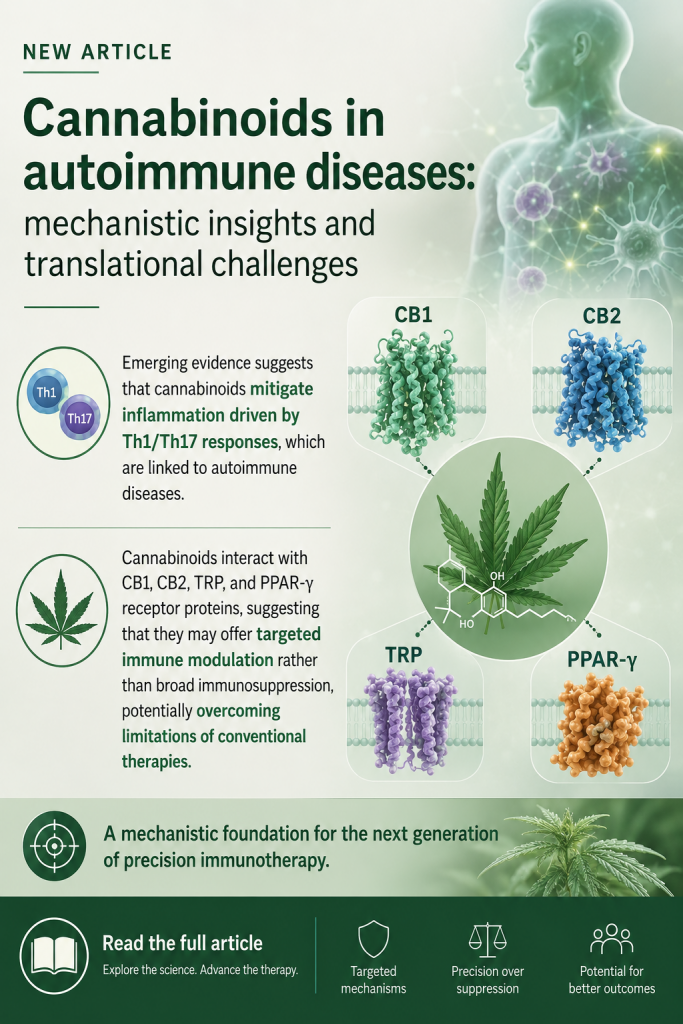
“Cannabinoids are traditionally recognized for their effect on the nervous system. Emerging evidence suggests that cannabinoids mitigate inflammation driven by Th1/Th17 responses, which are linked to autoimmune diseases.
In addition to their symptomatic, and analgesic effects, cannabinoids suppress the immune response by modulating regulatory T-cell activity, reducing microglial activation, and help in maintaining the integrity of the epithelial barrier. These findings suggest that cannabinoids may be involved in immune, and metabolic regulatory pathways.
Despite the promising preclinical data, translating these findings into effective treatments for autoimmune disorders has proven challenging. Current human studies have primarily focused on symptomatic relief such as reducing spasticity, managing pain, improving sleep quality, and boosting appetite. However, few trials have included immune profiling, i.e., assessed cytokine panels, performed immune cell phenotyping, tracked relapses, or utilized inflammation-focused imaging endpoints. Consequently, documented benefits are primarily symptomatic, while potential disease-modifying effects are not yet adequately studied.
Cannabinoids interact with CB1, CB2, TRP, and PPAR-γ receptor proteins, suggesting that they may offer targeted immune modulation rather than broad immunosuppression, potentially overcoming limitations of conventional therapies.
Moreover, new compounds like cannabigerol (CBG), cannabidivarin (CBV), and CB2-selective agonists with minimal psychoactivity offer expanded therapeutic options. However, challenges persist due to variability in formulations, bioavailability issues, regulatory hurdles, and a lack of long-term safety data. Future clinical development will require standardised GMP-grade preparations, robust pharmacokinetic evaluation, and trials that include immune-related endpoints such as T-cell polarisation, inflammasome markers, oxidative stress profiles, microbiome signatures, and longitudinal imaging, to clarify their therapeutic potential in autoimmune diseases.”
https://pubmed.ncbi.nlm.nih.gov/42105814
“Cannabinoids are versatile bioactive compounds that modulate immune function, and inflammation through classical (CB1, CB2), and non-classical pathways [(TRP channels; TRPV1, TRPA1), PPAR-γ), and orphan GPCRs (GPR55, GPR18)]. They engage interconnected signalling networks rather than a single dominant mechanism, collectively influencing immune cell function.”
https://www.sciencedirect.com/science/article/abs/pii/S0006295226003655?via%3Dihub
“List of Autoimmune Diseases”
https://www.ncbi.nlm.nih.gov/books/NBK605867