CBD-Containing Hemp Extracts and Isolated CBD for Acne: A Systematic Review of Anti-Inflammatory Mechanisms, Clinical Signals and Sustainability

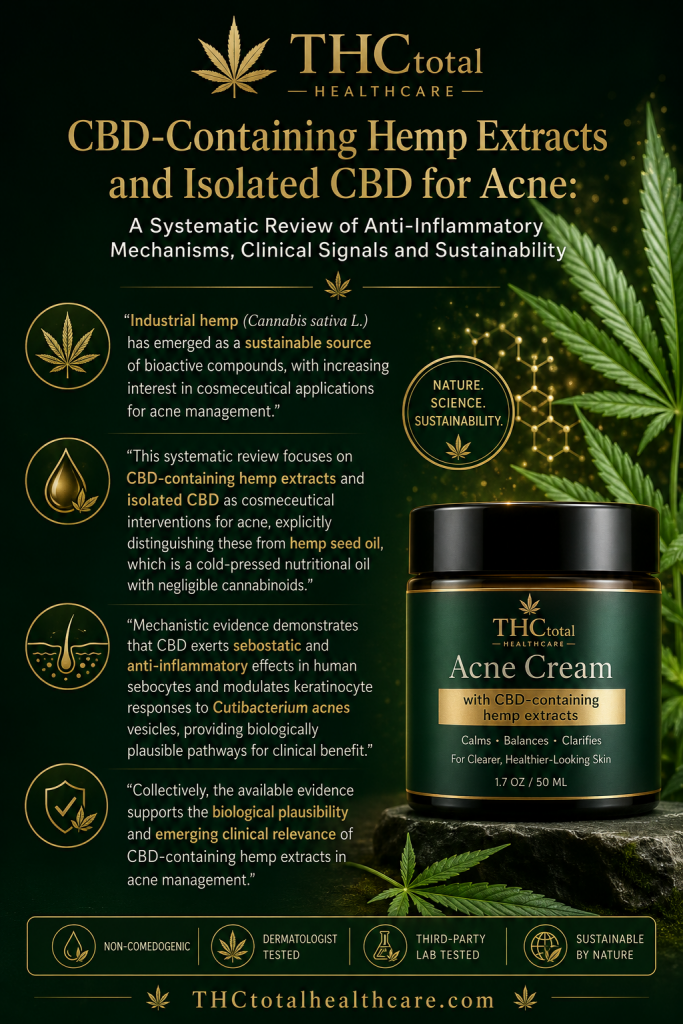
“Industrial hemp (Cannabis sativa L.) has emerged as a sustainable source of bioactive compounds, with increasing interest in cosmeceutical applications for acne management.

This systematic review synthesises evidence on cannabinoid-containing hemp extracts, particularly cannabidiol (CBD), with emphasis on anti-inflammatory and sebostatic mechanisms, alongside formulation considerations and supply-chain sustainability.

Reporting followed PRISMA 2020 guidelines and encompassed preclinical and clinical evidence relevant to acne-associated outcomes. The review protocol was registered prospectively with PROSPERO (CRD420251272093).

Across cell-based, ex vivo and early clinical studies, CBD modulated key inflammatory mediators, including TNF-α, IL-1β, IL-6 and IL-8; normalised sebocyte activity and attenuated Cutibacterium acnes (Propionibacterium acnes)-induced inflammatory signalling.

Preliminary clinical observations indicate reductions in lesion counts and erythema, with generally favourable short-term tolerability; however, interpretation is limited by small sample sizes, predominantly non-randomised designs, heterogeneous formulations and frequent co-formulation with additional active ingredients. Evidence supporting direct antimicrobial efficacy and durable clinical benefit remains limited.

Lipid-rich hemp seed-derived products were considered only in a contextual capacity for barrier-supportive and nutritional properties and were excluded from efficacy synthesis unless cannabinoid content was verified. Sustainability analyses highlight hemp’s low water requirements, carbon sequestration potential and relevance to Sustainable Development Goal 3 (SDG 3: Good Health and Well-Being) and Sustainable Development Goal 12 (SDG 12: Responsible Consumption and Production), supporting its role in environmentally responsible cosmeceutical development.

Overall, CBD-containing hemp extracts show biologically plausible and clinically promising adjunctive potential for mild-to-moderate inflammatory acne, but current evidence remains preliminary. This review highlights the need for methodologically rigorous and transparent clinical studies, standardised formulations, validated outcome measures and the integration of sustainability metrics to strengthen evidence synthesis, clarify clinical relevance and guide responsible cosmeceutical development.”

https://pubmed.ncbi.nlm.nih.gov/42357416

“This systematic review focuses on CBD-containing hemp extracts and isolated CBD as cosmeceutical interventions for acne, explicitly distinguishing these from hemp seed oil, which is a cold-pressed nutritional oil with negligible cannabinoids.”

“Mechanistic evidence demonstrates that CBD exerts sebostatic and anti-inflammatory effects in human sebocytes and modulates keratinocyte responses to Cutibacterium acnes vesicles, providing biologically plausible pathways for clinical benefit.”

“Collectively, the available evidence supports the biological plausibility and emerging clinical relevance of CBD-containing hemp extracts in acne management”
https://www.mdpi.com/1420-3049/31/12/2017

Cannabinoids for Dermatological Applications: Mechanistic Insights, Clinical Evidence, and Emerging Nanotechnology-Enabled Delivery Strategies

“Cannabinoids (CBs) derived from Cannabis sativa have attracted growing interest for dermatological applications due to their anti-inflammatory, antiproliferative, antimicrobial, antifibrotic, and antipruritic properties. However, their clinical translation is significantly limited by physicochemical and pharmacokinetic challenges, including poor aqueous solubility, lipophilicity, instability, variable skin penetration, and inconsistent bioavailability.

At the molecular level, CBs modulate keratinocyte proliferation, sebocyte activity, fibroblast function, melanocyte balance, and immune signalling through CB1/CB2 receptors, TRP channels, and PPARγ pathways.

Evidence supports their potential in the treatment of psoriasis, atopic dermatitis, acne, allergic contact dermatitis, pruritus, scleroderma, and skin cancers. Clinical evidence remains preliminary: topical and oral formulations have demonstrated anti-inflammatory, antiproliferative, antibacterial, and antifibrotic effects, with improvements in pruritus, lesion severity, and quality of life in early-phase studies. However, most trials are small, uncontrolled, and lack placebo comparators, limiting generalisability.

To overcome formulation barriers and enhance dermal delivery, advanced pharmaceutical strategies such as liposomes, nanoemulsions, polymeric nanoparticles, micelles, and transdermal systems have been investigated to improve stability, controlled release, and targeted skin deposition while minimising systemic exposure.

This review integrates mechanistic insights, clinical evidence, and emerging nanotechnology-enabled delivery approaches, emphasising rational formulation design and translational considerations necessary for advancing CBs toward standardised and clinically reliable dermatological therapeutics.”

https://pubmed.ncbi.nlm.nih.gov/42076122

“In summary, cannabinoids represent a biologically plausible yet clinically evolving therapeutic class in dermatology. Advancing their role in patient care will depend on coordinated progress in mechanistic understanding, pharmaceutical design, and structured clinical validation.”

https://www.mdpi.com/1999-4923/18/4/469

The Therapeutic Potential of Cannabidiol in Skin Conditions

pubmed logo

“Background: Dermatological disorders can have a negative impact on quality of life. Cannabidiol (CBD) is a phytocannabinoid found in the Cannabis sativa L. plant. It has multiple molecular targets, many of which are expressed in the skin, and may have therapeutic potential in several skin conditions.

Aims: This review aims to provide an overview of preclinical and clinical studies of CBD in dermatological disorders.

Methods: Literature searches were conducted using databases including PubMed and Google Scholar using the search terms: (‘cannabidiol’ OR ‘CBD’) AND ‘skin’, ‘acne’, ‘psoriasis’, ‘dermatitis’, and ‘wound healing’. Studies were included if they were original research articles focused on CBD and skin conditions.

Results: Preclinical evidence suggests that CBD may have therapeutic potential for the treatment of a variety of skin conditions, while evidence for skin moisturizing properties suggests possible cosmetic benefits. To date, there is limited clinical evidence that CBD may be beneficial in the treatment of acne, dermatitis, and psoriasis, as well as for cosmetic purposes including improving skin hydration, elasticity, and protection against skin aging.

Conclusions: There is some evidence indicating the therapeutic potential of CBD for a variety of skin conditions, including acne, dermatitis, and psoriasis, and possible utility for cosmetic purposes. Several clinical trials involving the topical application of CBD for skin conditions are currently ongoing, and the results of these trials will be important in determining the therapeutic potential of CBD.”

https://pubmed.ncbi.nlm.nih.gov/41178006/

“CBD may have therapeutic potential for the treatment of a variety of skin conditions such as acne, psoriasis, and dermatitis, with its anti-inflammatory, antimicrobial and potential anti-pruritic effects.”

https://onlinelibrary.wiley.com/doi/10.1111/jocd.70527

Cannabizetol, a Novel Cannabinoid: Chemical Synthesis, Anti-inflammatory Activity and Extraction from Cannabis sativa L

“We report the first isolation of a previously unknown cannabinoid, cannabizetol (CBGD, 7), from Cannabis sativa extracts, representing the third member of the rare class of methylene-bridged dimeric cannabinoids. The availability of a chemically synthesized standard was crucial for its unequivocal identification, thus confirming the natural occurrence of this new compound.

In addition to this structural discovery, we demonstrate that cannabizetol exhibits remarkable antioxidant and skin anti-inflammatory activity, significantly higher than that observed for the known dimeric cannabinoid cannabitwinol (CBDD, 6).

These results highlight cannabizetol as a promising bioactive metabolite with potential dermatological applications. To further enable its study, we developed a continuous flow approach to optimize the preparation of these dimers, achieving a substantial reduction in reaction times.”

https://pubmed.ncbi.nlm.nih.gov/40994228/

“Several cannabinoids have demonstrated biological activities, making Cannabis sativa particularly attractive as a source of potential medicinal active principles.”

https://pubs.acs.org/doi/10.1021/acs.jnatprod.5c00826

Cannabidiol as a therapeutic agent for rosacea through simultaneous inhibition of multiple inflammatory pathways

pubmed logo

“Rosacea is a chronic inflammatory skin disorder characterized by facial erythema, papules, pustules, and telangiectasia, affecting approximately 5.5% of the global population. Current treatments, primarily topical and oral antibiotics and anti-inflammatories, often show limited efficacy and may cause undesirable side effects, prompting the need for alternative therapies.

Cannabidiol (CBD), a non-psychoactive component of Cannabis sativa, has shown promise as a therapeutic agent for rosacea due to its anti-inflammatory, antioxidant, and anti-apoptotic properties. CBD interacts with the endocannabinoid system, which plays a crucial role in cutaneous homeostasis.

This study evaluated the efficacy of CBD, both alone and in combination with metronidazole (MET), in reducing inflammation and modulating immune responses in a rosacea-like mouse model.

Our results demonstrated that both CBD and MET significantly inhibited redness, epidermal thickness, and mast cell infiltration, with their combination being more effective. Mechanistic analyses revealed that the therapeutic effect of CBD is associated with the suppression of key inflammatory regulators in the MAPK signaling pathway, particularly the ERK, JNK, and p38 pathways. CBD treatment also led to a significant reduction in proinflammatory cytokines and chemokines, indicating immune modulation.

These findings suggest that CBD, especially in combination with MET, may represent a novel therapeutic option for rosacea and offer a scientific basis for its clinical application in managing inflammatory skin conditions.”

https://pubmed.ncbi.nlm.nih.gov/40754776/

Targeting Vascular and Inflammatory Crosstalk: Cannabigerol as a Dual-Pathway Modulator in Rosacea

pubmed logo

“Rosacea is a chronic inflammatory skin condition characterized by persistent erythema and abnormal vascular response. Although current treatments focus on symptomatic relief, they often provide only temporary improvement and may be associated with side effects or recurrence.

Cannabigerol (CBG), a non-psychoactive cannabinoid, has recently garnered attention for its pharmacological activities, including anti-inflammatory, antioxidant, neuroprotective, and skin barrier-supportive effects. However, its role in modulating pathological responses in rosacea remains unclear.

In this study, we investigated the therapeutic potential of topically applied CBG in an LL-37-induced rosacea-like mouse model.

Clinical and histological assessments revealed that CBG markedly reduced erythema, epidermal hyperplasia, and mast cell infiltration. Quantitative reverse transcription polymerase chain reaction (qRT-PCR) showed downregulation of Il1bIl4Il6Il13Il22Il31Tlr2Vegfa, and Mmp9. Immunohistochemistry and Western blot analyses further demonstrated suppression of CD31, vascular endothelial growth factor (VEGF), and Yes-associated protein (YAP) and transcriptional coactivator with PDZ-binding motif (TAZ), along with reduced activation of the Janus kinase/signal transducer and activator of transcription (JAK/STAT) pathway, including decreased levels of JAK1, STAT3, and phosphorylated STAT3.

These findings suggest that topical CBG alleviates rosacea-like skin inflammation by targeting inflammatory and vascular pathways, including JAK/STAT and YAP/TAZ signaling.”

https://pubmed.ncbi.nlm.nih.gov/40725084/

“In conclusion, our study demonstrated the therapeutic potential of CBG in an LL-37-induced mouse model of rosacea. Topical CBG treatment significantly reduced clinical erythema, epidermal hyperplasia, and mast cell infiltration, and suppressed key inflammatory and vascular mediators at both the mRNA and protein levels. Mechanistically, CBG inhibited the expression of cytokines, Vegfa, and Tlr2, as well as the activation of YAP/TAZ and JAK/STAT signaling pathways, which are known to be involved in rosacea pathogenesis.

These findings highlight CBG as a promising non-psychoactive cannabinoid with therapeutic relevance for the treatment of rosacea.”

https://www.mdpi.com/1422-0067/26/14/6840

Beyond Cannabidiol: The Contribution of Cannabis sativa Phytocomplex to Skin Anti-Inflammatory Activity in Human Skin Keratinocytes

pubmed logo

“Background:Cannabis sativa L. (C. sativa) has a long history of medicinal use. Its inflorescences contain bioactive compounds like non-psychotropic cannabidiol (CBD), which is well known for its anti-inflammatory potential in skin conditions such as psoriasis, and psychotropic Δ-9-tetrahydrocannabinol (THC). Keratinocytes, the main cells in the epidermis, are crucial for regulating skin inflammation by producing mediators like IL-8 when stimulated by agents like TNFα. 

Methods: This study explores the anti-inflammatory effects of a standardized C. sativa extract (CSE) with 5% CBD and less than 0.2% THC in human keratinocytes challenged by TNFα. The aim of this study is to analyze the specific contributions of the main constituents of CSE to inflammatory responses in human keratinocytes by fractionating the extract and examining the effects of its individual components. 

Results: MTT assays showed that CSE was non-toxic to HaCaT cells up to 50 μg/mL. CSE inhibited NF-κB activity and reduced IL-8 secretion in a concentration-dependent manner, with mean IC50 values of 28.94 ± 10.40 μg/mL and 20.06 ± 2.78 μg/mL (mean ± SEM), respectively. Fractionation of CSE into four subfractions revealed that the more lipophilic fractions (A and B) were the most effective in inhibiting NF-κB, indicating that cannabinoids and cannflavins are key contributors. Pure CBD is one of the most active cannabinoids in reducing NF-κB-driven transcription (together with THC and cannabigerol), and due to its abundance in CSE, it is primarily responsible for the anti-inflammatory activity. 

Conclusions: This study highlights CBD’s significant role in reducing inflammation in human keratinocytes and underscores the need to consider the synergistic interactions of several molecules within C. sativa extracts for maximum efficacy. Standardized extracts are essential for reproducible results due to the variability in responses.”

https://pubmed.ncbi.nlm.nih.gov/40430467/

“In conclusion, the results of this study on CSE underscore the significant role of CBD in exerting anti-inflammatory effects in human keratinocytes.”

https://www.mdpi.com/1424-8247/18/5/647

Evaluation of Cannabis sativa L. Callus Extract as a Novel Cosmetic Ingredient with Dual Anti-Inflammatory and Antioxidant Effects

pubmed logo

“The plant callus culture technique is an emerging source of bioactive compounds with potential applications in cosmetics and pharmaceuticals. Callus-derived extracts contain high concentrations of secondary metabolites with significant antioxidant and anti-inflammatory properties when elicited.

Cannabis sativa L. has been used for its medicinal effects; however, the potential of its C. sativa callus extract (CCE) for cosmetic applications remains unexplored.

Callus from C. sativa was induced in vitro using a Murashige and Skoog (MS) medium supplemented with Thidiazuron (TDZ) and naphthalene acetic acid (NAA). The extract was analyzed for its bioactive composition using high-performance liquid chromatography (HPLC). The antioxidant activity was assessed using the DPPH radical scavenging assay. The anti-inflammatory effects were evaluated in lipopolysaccharides (LPS)-stimulated RAW264.7 macrophages by measuring nitric oxide (NO) production, DAF-2 fluorescence intensity, released cytokine levels, and protein expression of inflammatory mediators via ELISA, Western blot, and immunofluorescence assays.

CCE demonstrated significant radical scavenging activity. CCE effectively suppressed LPS-induced NO production and reduced pro-inflammatory cytokine levels. Western blot analysis revealed that CCE inhibited NF-κB nuclear translocation while upregulating NRF2-mediated antioxidant responses. Furthermore, HPLC analysis confirmed the presence of cannabinoids, which could potentially be associated with the modulation of inflammatory pathways through the endocannabinoid system.

This study provides evidence that CCE possesses notable antioxidant and anti-inflammatory properties, making it a promising ingredient for cosmetic formulations targeting oxidative stress and inflammatory skin conditions.”

https://pubmed.ncbi.nlm.nih.gov/40219215/

Cannabichromene as a Novel Inhibitor of Th2 Cytokine and JAK/STAT Pathway Activation in Atopic Dermatitis Models

pubmed logo

“Cannabichromene (CBC) is one of the main cannabinoids found in the cannabis plant, and although less well known than tetrahydrocannabinol (THC) and cannabidiol (CBD), it is gaining attention for its potential therapeutic benefits.

To date, CBC’s known mechanisms of action include anti-inflammatory, analgesic, antidepressant, antimicrobial, neuroprotective, and anti-acne effects through TRP channel activation and the inhibition of inflammatory pathways, suggesting that it may have therapeutic potential in the treatment of inflammatory skin diseases, such as atopic dermatitis (AD), but its exact mechanism of action remains unclear. Therefore, in this study, we investigated the effects of CBC on Th2 cytokines along with the Janus kinase (JAK)/signal transducer and activator of transcription (STAT) pathways involved in AD pathogenesis. We used a 2,4-Dinitrochlorobenzene (DNCB)-induced BALB/c mouse model to topically administer CBC (0.1 mg/kg or 1 mg/kg).

The results showed that skin lesion severity, ear thickness, epithelial thickness of dorsal and ear skin, and mast cell infiltration were significantly reduced in the 0.1 mg/kg CBC-treated group compared with the DNCB-treated group (p < 0.001). In addition, real-time quantitative reverse transcription polymerase chain reaction (qRT-PCR) analysis showed a significant decrease in the mRNA expression of Th2 cytokines (TSLPIL-4IL-13) and inflammatory mediators (IFN-γIL-1βIL-6IL-17IL-18, and IL-33) (p < 0.05). Western blot analysis also revealed a significant decrease in JAK1, JAK2, STAT1, STAT2, STAT3, and STAT6 protein expression (p < 0.05).

These results suggest that CBC is a promising candidate for the treatment of AD and demonstrates the potential to alleviate AD symptoms by suppressing the Th2 immune response.”

https://pubmed.ncbi.nlm.nih.gov/39769302/

https://www.mdpi.com/1422-0067/25/24/13539

Exploring the Biological Activity of Phytocannabinoid Formulations for Skin Health Care: A Special Focus on Molecular Pathways

pubmed logo

“Recent advancements have highlighted the potential of cannabis and its phytocannabinoids (pCBs) in skin health applications.

These compounds, through their interaction with the endocannabinoid system (ECS), show promise for skin health products. Their ability to regulate inflammation, oxidative stress and cell proliferation makes them useful in addressing skin problems such as inflammation, scarring, healing, acne and aging, positioning them as valuable tools for innovative skincare solutions.

In the present work, the cellular and molecular effects of proprietary pCB-based formulations on ECS modulation, inflammation and skin regeneration were investigated.

Using human dermal fibroblasts (HDF) and keratinocytes (HaCaT), the effect of formulations in both pre-treatment and treatment scenarios following exposure to stress-inducing agents was assessed. Key molecular markers were analyzed to tackle their efficacy in mitigating inflammation and promoting structural integrity and regeneration.

In vitro results showed that these formulations significantly reduced inflammation, promoted skin regeneration and improved structural functions. In vivo studies confirmed that the formulations were well-tolerated and led to noticeable improvements in skin health, including enhanced barrier function.

This study demonstrates the safety and efficacy of pCB-based formulations for cosmeceutical applications. By combining molecular analysis with in vivo testing, this research provides new insights into the therapeutic potential of pCBs for managing various skin conditions.”

https://pubmed.ncbi.nlm.nih.gov/39684852/

“This study confirms the safety and efficacy of pCB-based formulations for skin applications, highlighting their potential to enhance regeneration and structural processes. The findings underscore the promise of cannabis-based products in cosmetics and dermatology, meeting the rising demand for natural, effective skincare solutions and shaping the future of modern skincare and therapeutic approaches.”

https://www.mdpi.com/1422-0067/25/23/13142