Safety and Tolerability of Low-Dose Full-Spectrum Cannabidiol in Long-Term Virally Suppressed Adults with HIV: A Randomized Double-Blind Placebo-Controlled Trial

Introduction: People with long-term virologically suppressed HIV (PWH) experience chronic inflammation. Beneficial effects such as lower levels of inflammation were reported for cannabis-based medicine, but data on the safety of standardized low-dose full-spectrum cannabidiol (CBD) are limited.

Methods: This double-blind randomized placebo-controlled trial (NCT05306249) included 80 ART-treated PWH with undetectable viremia (median time on efficient ART 14 years, median age 54 years), encompassing 30% women. Participants received 1 mg/kg CBD oil twice daily (full-spectrum, tetrahydrocannabinol < 0.3%) or placebo for 12 weeks plus a 4-week follow-up. Primary trial end-point (autophagy gene expression) will be described elsewhere; here we evaluate the treatment impact on prespecified safety outcomes such as hemodynamic with electrocardiograms, HIV immunovirological parameters, and comprehensive assessments of liver and kidney functions, performed using standard blood tests. Mixed-effects models adjusted for baseline age, sex, body mass index, CD4 count and duration of viral suppression assessed longitudinal changes.

Results: Of 80 randomized participants, 35 PWH in CBD and 37 in placebo groups completed week 12. No clinically meaningful differences emerged in creatinine, aminotransferases (alanine aminotransferase, aspartate aminotransferase), or conjugated bilirubin. Total bilirubin decreased in the CBD arm vs placebo (mixed effect model considering time, group and time*group, adjusted for covariates, p = 0.046). In exploratory sex-stratified analysis, a significant difference starting at week 12 (-8.0 bpm [95% CI: -15.6; -0.4], p = 0.0425) and persisting at week 16 (-7.9 bpm [95% CI: -14.6; -1.3], p = 0.0191) evidences a lower heart rate in men belonging to the CBD group compared with the placebo group; no change in females. There was no change in plasma viral load, cell-associated HIV-DNA levels, and CD4/CD8 ratio.

Discussion: Low-dose full-spectrum GMP-certified CBD was well tolerated over 12 weeks in virally suppressed people with HIV. Observed reductions in total bilirubin and male heart rate are exploratory and warrant confirmation in adequately powered trials incorporating inflammatory biomarkers and pharmacokinetics.”

https://pubmed.ncbi.nlm.nih.gov/41934259

https://journals.sagepub.com/doi/10.1177/25785125261439014

Cannabis Use by People with HIV is Associated with an Anti-Inflammatory Immunometabolic Phenotype in Monocyte-Derived Macrophages

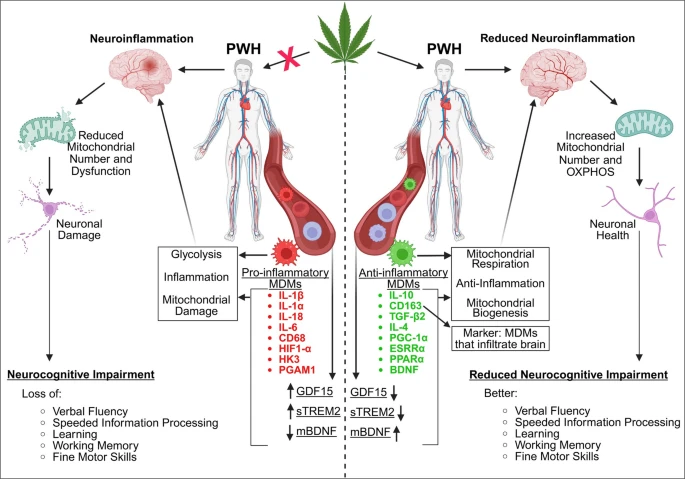
“Chronic neuroinflammation is associated with comorbidities in people with HIV (PWH) on antiretroviral therapy (ART). While cannabis use is associated with reduced neuroinflammation and neurocognitive impairment (NCI) in PWH, the underlying mechanisms are unknown.

To address this gap in knowledge, we analyzed monocyte-derived macrophages (MDMs) from a cohort of 50 PWH and 33 people without HIV (mean age: 61.9 years), categorized by frequency of cannabis use (naïve/low, moderate, daily). We performed immunocytochemistry, RNA sequencing, and qPCR on MDMs and quantified related biomarkers in donor plasma.

In this cohort study, daily cannabis use in PWH was associated with less global neurocognitive deficits, and with an anti-inflammatory immunometabolic-phenotype in MDMs characterized by (1) a metabolic shift from glycolysis to oxidative phosphorylation, (2) higher mitochondrial numbers, (3) altered cytokine profiles (pro-inflammatory downregulation, anti-inflammatory upregulation), and (4) higher brain-derived neurotrophic factor (BDNF) expression.

These cellular changes were corroborated by a plasma biomarker profile in PWH including (1) lower levels of growth differentiation factor 15 and soluble triggering receptor expressed on myeloid cells 2, and (2) higher mature BDNF/precursor BDNF ratios that correlated with better cognition.

Thus, cannabis use may mitigate NCI in PWH by immunometabolically reprogramming MDM function towards an anti-inflammatory and neuroprotective state.”

https://pubmed.ncbi.nlm.nih.gov/41867844

https://www.biorxiv.org/content/10.64898/2026.03.04.709579v1

Motor-Related Neural Dynamics are Modulated by Regular Cannabis Use Among People with HIV

“Recent work has shown that people with HIV (PWH) exhibit deficits in cognitive control and altered brain responses in the underlying cortical networks, and that regular cannabis use has a normalizing effect on these neural responses.

However, the impact of regular cannabis use on the neural oscillatory dynamics underlying motor control deficits in PWH remains less understood. Herein, 102 control cannabis users, control nonusers, PWH who regularly use cannabis, and PWH who do not use cannabis performed a motor control task with and without interference during high-density magnetoencephalography.

The resulting neural dynamics were examined using whole-brain, voxel-wise statistical analyses that examined the impact of HIV status, cannabis use, and their interaction on the neural oscillations serving motor control, spontaneous activity during the baseline period, and neurobehavioral relationships.

Our key findings revealed cannabis-by-HIV group interactions in oscillatory gamma within the prefrontal cortices, higher-order motor areas, and other regions, with the non-using PWH typically exhibiting the strongest gamma interference responses. Cannabis-by-HIV interactions were also found for oscillatory beta in the dorsal premotor cortex. Spontaneous gamma during the baseline was elevated in PWH and suppressed in cannabis users in all regions exhibiting interaction effects and the left primary motor cortex, with spontaneous levels being correlated with behavioral performance.

These findings suggest that regular cannabis use has a normalizing effect on the neural oscillations serving motor control and the abnormally elevated spontaneous gamma activity that has been widely replicated in PWH, which may suggest that cannabis has at least some therapeutic utility in PWH.”

https://pubmed.ncbi.nlm.nih.gov/40473990

“The current study found evidence of multiple novel interactions between cannabis use and HIV status in beta and gamma interference responses across a broad network of brain regions. Further, these findings corroborate multiple recent studies showing elevated spontaneous gamma activity in PWH, and that regular cannabis use is associated with a marked suppression in such spontaneous activity.”

https://link.springer.com/article/10.1007/s11481-025-10219-0

Cannabinoids shift the basal ganglia microRNA m6A methylation profile towards an anti-inflammatory phenotype in SIV-infected rhesus macaques

pubmed logo

“Epitranscriptomic modifications [N6-methyladenosine (m6A)] regulate various diseases, including cancer and inflammation. Despite their functional relevance in neural development and differentiation, the role of m6A modifications in HIV neuropathogenesis is unknown. Using anti-N6-methyladenosine (m6A) antibody-immunoprecipitation and microarray profiling, we identified m6A modifications in miRNAs in basal ganglia (BG) of uninfected (VEH) and SIV-infected Rhesus macaques (RMs) on combination anti-retroviral therapy (ART) and either VEH-treated (VEH/SIV/ART) or THC:CBD-treated (THC:CBD/SIV/ART).

HIV/SIV infection promoted an overall hypomethylated miRNA m6A profile. While THC:CBD did not significantly impact the overall hypomethylated m6A profile, specific miRNAs predicted to target proinflammatory genes showed marked m6A hypomethylation compared to VEH-treated RMs. Additionally, specific BG m6A-modified miRNAs were detected in BG-derived extracellular vesicles. Mechanistically, the DRACH motif in the miR-194-5p seed region was significantly m6A hypomethylated in THC:CBD/SIV/ART RMs. Unlike wild-type, in-vitro transfected m6A-modified miR-194-5p mimics failed to downregulate STAT1 protein expression. Further, compared to VEH/SIV/ART RMs, THC:CBD significantly reduced m6A methylation of 44 miRNAs directly involved in regulating CNS network genes.

Our findings indicate that m6A epi-transcriptomic marks in the seed nucleotides can impair miRNA function and that cannabinoids may preserve it by reducing m6A methylation levels, thus providing a mechanistic explanation underlying their anti-neuroinflammatory effects in HIV/SIV infection.”

https://pubmed.ncbi.nlm.nih.gov/41286161

https://www.nature.com/articles/s42003-025-09049-w

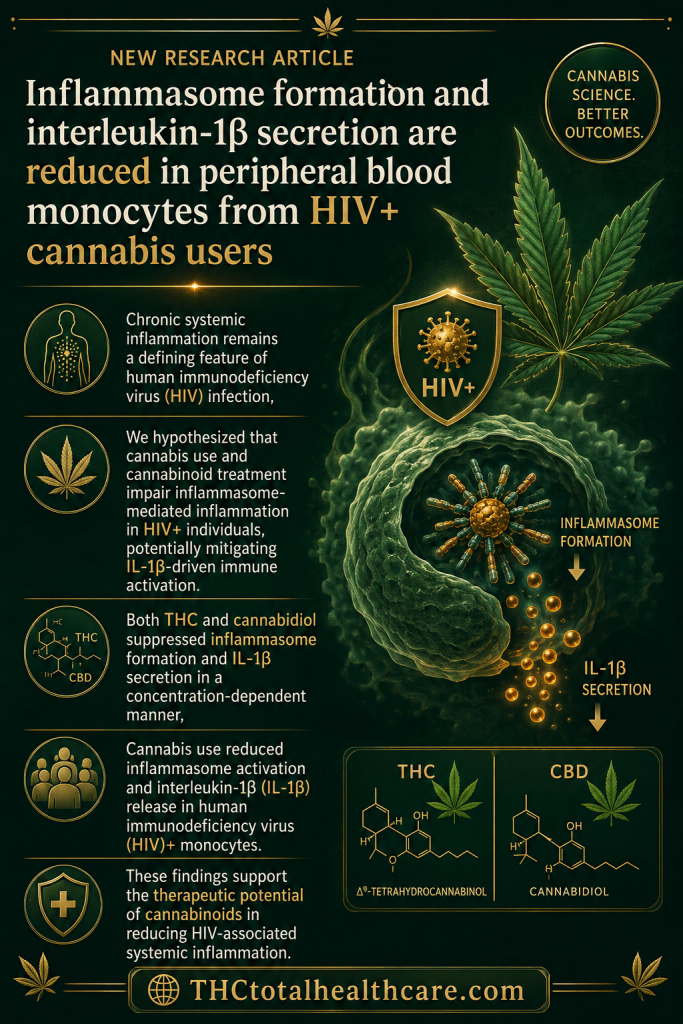
Cannabis use is associated with alterations in NLRP3 inflammasome related gene expression in monocyte-derived macrophages from people living with HIV

Introduction: Human immunodeficiency virus (HIV) infection is often associated with chronic inflammation and cognitive dysfunction in people living with HIV (PWH). The nucleotide-binding oligomerization domain-like receptor containing pyrin domain 3 (NLRP3) inflammasome plays a crucial role in the secretion of pro-inflammatory cytokines, specifically interleukin (IL)-18 and IL-1β.

Cannabis use and certain phytocannabinoids, such as cannabidiol (CBD), may provide therapeutic benefits in conditions associated with chronic inflammation.

Methods: In this cross-sectional study, we investigated the relationship between cannabis use and NLRP3-related gene expression in monocyte-derived macrophages (MDMs) from PWH (n = 43) and people without HIV (PWoH; n = 22). Participants were categorized as naïve, moderate, or daily cannabis users. Donor-derived MDMs were treated with CBD (30 μM), IL-1β (20 ng/mL), or CBD + IL-1β for 24 hours to examine effects on NLRP3-related gene expression. Gene expression data were analyzed using one-way and two-way ANOVA with Holm-Sidak’s multiple comparisons tests. Correlations between gene expression and clinical parameters were assessed using Pearson’s correlation coefficient. Statistical significance was determined at p < 0.05.

Results: MDMs without treatment from PWH exhibited 83% higher NLRP3 mRNA expression compared to MDMs from PWoH. Furthermore, MDMs without treatment from moderate cannabis users expressed 61% less IL1β mRNA compared to naïve users, and MDMs from daily users expressed a 64% increase in IL18 expression compared to moderate users. Additionally, MDMs treated with CBD and IL-1β showed a 22% decrease in NLRP3 mRNA expression compared to IL-1β treated MDMs. When treated with CBD and IL-1β, we observed a significant increase in both IL1β (3-fold, p < 0.01) and IL18 (2-fold, p < 0.01) expression compared to vehicle. The relationship between NLRP3 mRNA expression in MDMs and global deficit scores in PWH not using cannabis was inverse to that relationship in PWH using cannabis.

Discussion: Overall, these findings suggest that CBD, as consumed through cannabis use, may mitigate NLRP3 activation in PWH, potentially offering therapeutic benefits for chronic inflammation. However, the unexpected effects on downstream cytokine mRNA expression, combined with product heterogeneity, underscore the need for future mechanistic studies to fully delineate cannabinoid-inflammasome interactions in the context of HIV.”

https://pubmed.ncbi.nlm.nih.gov/41280902

“Given the need for effective strategies to address neuroinflammation in PWH, these findings support further exploration of NLRP3 inhibitors, including cannabinoids like CBD, to mitigate chronic inflammation and improve cognitive outcomes.”

https://www.frontiersin.org/journals/immunology/articles/10.3389/fimmu.2025.1634203/full

Liposomal-Cannabidiol Nanoformulation to Suppress HIV Replication and Reduce Oxidative Stress in Infected Microglia

pubmed logo

“The advent of antiretroviral therapy has significantly reduced HIV-related morbidity and mortality. However, persistent HIV infection in the central nervous system continues to drive HIV-associated neurocognitive disorders (HAND).

Cannabidiol (CBD), a nonpsychoactive cannabinoid with antioxidant and anti-inflammatory properties, has shown promise in clinical trials as a candidate to address cognitive impairments.

Despite this potential, further research is required to elucidate CBD’s molecular mechanisms in HIV infection and to improve its brain bioavailability. To overcome these challenges, we investigated CBD’s effects on oxidative stress pathways and developed a liposomal nanoformulation (NF) to enhance its delivery and efficacy in brain cells.

CBD treatment significantly upregulated APOE3 gene and protein expression while reducing HIV long terminal repeat (LTR) gene expression in infected microglia. The NF was characterized by hydrodynamic size, polydispersity index, zeta potential, encapsulation efficiency, cellular uptake, HIV infection levels, and APOE3 secretion. Successful CBD encapsulation was confirmed by liquid chromatography-mass/mass spectrometry.

Importantly, the CBD-loaded NF reduced p24 antigen levels and LTR expression, increased APOE secretion, and attenuated mitochondrial reactive oxygen species production more rapidly than free CBD.

This liposomal CBD NF enhances the pharmacological profile of CBD, offering a promising nanotherapeutic strategy to suppress HIV replication, reduce oxidative stress, and mitigate neurocognitive dysfunction associated with HAND.”

https://pubmed.ncbi.nlm.nih.gov/41222925/

https://pubs.acs.org/doi/10.1021/acsbiomaterials.5c01218

Sex differences in the capacity of minor phytocannabinoids to attenuate nociceptive insults in HIV-1 Tat-expressing mice

pubmed logo

“Objecives: Approximately 80 % of people living with HIV (PLWH) develop chronic pain and preclinical studies support the involvement of the HIV-1 regulatory protein, trans-activator of transcription (Tat). Phytocannabinoids may attenuate pain in PLWH; however, these data are controversial, and the biological mechanisms are difficult to untangle from psychosocial factors in people.

Methods: We have examined the therapeutic capacity of minor phytocannabinoids to attenuate Tat-promoted visceral hyperalgesia (acetic acid writhing assay) and reflexive nociception (warm water tail flick assay) in transgenic mice. We hypothesized that conditional expression of Tat1-86 in male and female mice [Tat(+) mice] would amplify pain responses compared to controls [Tat(-) mice], and that phytocannabinoids could ameliorate these effects.

Results: Irrespective of sex, Tat(+) mice demonstrated greater visceral pain responses than did Tat(-) controls. The phytocannabinoids, cannabigerolic acid (CBGA), cannabidiol (CBD), and cannabinol (CBN), attenuated Tat-induced visceral pain in both males and females. However, the effectiveness of these cannabinoids varied by sex with CBN being more efficacious in males, while cannabigerol (CBG) alleviated visceral pain only in Tat(+) females. Cannabidiolic acid (CBDA) and cannabidivarin (CBDV) were not effective in either sex. CBGA and CBG were also efficacious in the tail flick test among Tat(-) males and females, but demonstrated only small, sex-dependent effects to reverse Tat-induced nociception. CBD and CBN exerted little-to-no efficacy in this test.

Conclusions: These data suggest that phytocannabinoids exert analgesia for HIV-related pain, potentially aiding in the development of personalized pain management strategies.”

https://pubmed.ncbi.nlm.nih.gov/41221301/

“Overall, PLWH are more vulnerable to the development of chronic pain, resulting in physical disability and a reduced quality of life. The current pharmacological treatments for managing HIV-related pain lack efficacy and are associated with the risk of substance abuse. The medicinal use of non-psychoactive cannabis constituents for pain management might greatly benefit this population which is at a greater risk for opioid addiction and substance abuse.”

https://www.degruyterbrill.com/document/doi/10.1515/nipt-2024-0025/html

The association between cannabis use and electrocardiographic abnormalities in people living with HIV

pubmed logo

“Cardiovascular disease is a leading cause of morbidity and mortality among people with and without HIV. Among PWoH, cannabis has been associated with cardiovascular outcomes, including coronary artery disease, myocardial infarction (MI), and stroke. However, data on subclinical changes and other cardiovascular outcomes are limited among PWH.

In this study, we examined the association of cannabis use and HIV with electrocardiogram (ECG) findings -evidence of MI, other abnormalities, and normal findings. Data from study visits between 2007 and 2017 from the MACS/WIHS Combined Cohort Study (N=3,610) were used. Descriptive statistics were derived, and unadjusted and adjusted odds ratios were estimated via baseline logistic regression.

Most participants were PWH (n = 2272, 63%), and 28% reported cannabis use, with no significant difference in prevalence between PWH (27%) and PWoH (28%). Overall, 59% of participants had normal ECG findings.

Cannabis use was not significantly associated with evidence of ECG abnormalities in unadjusted or adjusted analyses (aOR for MI: 1.02, 95% CI: 0.82-1.26, p = 0.85; aOR for other abnormalities: 1.02, 95% CI: 0.80-1.32, p = 0.86). Abnormal findings were more common in females than males (41% vs. 35%, p = 0.0002). Among males, PWH had higher odds of evidence of non-MI abnormalities compared to PWoH (aOR = 1.35, 95% CI: 1.01 – 1.81, p = 0.0464).

While cannabis use was not independently associated with evidence of ECG abnormalities, sex and HIV status are important determinants. Future studies should explore the role of cannabis metabolites and usage patterns in cardiovascular outcomes among PWH.”

https://pubmed.ncbi.nlm.nih.gov/41129190/

https://journals.lww.com/jaids/abstract/9900/the_association_between_cannabis_use_and.735.aspx

Antiviral and Anti-inflammatory Effects of Cannabidiol in HIV/SIV Infection

“Persistent reservoirs and chronic immune activation are hallmarks of HIV, despite the effectiveness of antiretroviral therapy (ART) in suppressing viral replication. Here, we use rhesus macaques and primary and induced pluripotent stem cell (iPSC)-derived human immune cells to evaluate the virologic and immunologic consequences of cannabidiol (CBD) exposure during HIV/SIV infection.

We show that CBD, in the absence of ART, suppresses viral replication and establishment of the viral reservoir to levels comparable with first-line therapies during acute SIV infection of rhesus macaques.

This antiviral effect of CBD extended to in vitro HIV infection of human macrophages, T cells, and microglia. Immunologically, we observe CBD slowed CD4+ T cell decline and polarization, decreased CD14+CD16+ monocyte expansion, and reduced interferon-inducible cytokine release in rhesus macaques. We identify comparable effects on cytokine production with in vitro CBD treatment of human macrophages, T cells, and microglia.

Importantly, we find CBD inhibits cytokines only when an immune response is elicited by HIV, suggesting it is not broadly immunosuppressive. Finally, we determine CBD regulates endocannabinoid receptors, modulators, and transporters and inhibits NF-κb and STAT1 activation when mediating its antiviral and anti-inflammatory effects.

These findings show beneficial effects of CBD in laboratory models of untreated HIV, thus placebo-controlled clinical trials to evaluate the safety and effectiveness of adjunctive CBD use with ART is warranted.”

https://pubmed.ncbi.nlm.nih.gov/41040324/

https://www.biorxiv.org/content/10.1101/2025.09.25.678534v1

Assessing Inflammatory Biomarkers at the Intersection of Marijuana and PrEP Use: Preliminary findings from the NCHAT-BIO study

pubmed logo

“Introduction: Past research has shown that inflammation is reduced among marijuana-using HIV-negative people but not those living with HIV. We take this work a step further by assessing differences based on pre-exposure prophylaxis (PrEP) use among HIV-negative individuals.

Methods: NCHAT is a nationally-representative cohort study of 3,642 adult respondents who are married or cohabiting. Their ages range from 20 to 60 years with 45% self-identifying as non-heterosexual. Biological data (n=573; CRP, IL-6, and EBV antibody levels) were collected via finger stick dried blood spots as part of NCHAT-BIO, a sub-study. Participants self-reported demographic characteristics, PrEP use, and marijuana use. Multivariable regression analyses were used to assess the relationship between these variables and each of the measured biomarkers, adjusting for known confounders.

Results: In adjusted models, neither lifetime or current PrEP use were associated with CRP, IL-6, or EBV antibody levels. Moreover, marijuana use did not differ among those who used PrEP versus those who did not. Among PrEP users, those who reported marijuana use had lower CRP than those who did not (B=-2.31; 95% CI:-4.23, -0.40). Among non-PrEP users, no association was observed between marijuana use and CRP.

Conclusion: The current preliminary data suggest inflammation is reduced among PrEP users who also use marijuana, but the same is not true among non-PrEP users. These findings may suggest that PrEP increases inflammation which is then partially mitigated by the individual cannabinoids or cannabidiols found in marijuana, although more research is needed to confirm this hypothesis.”

https://pubmed.ncbi.nlm.nih.gov/40905335/

https://journals.lww.com/jaids/abstract/9900/assessing_inflammatory_biomarkers_at_the.709.aspx