
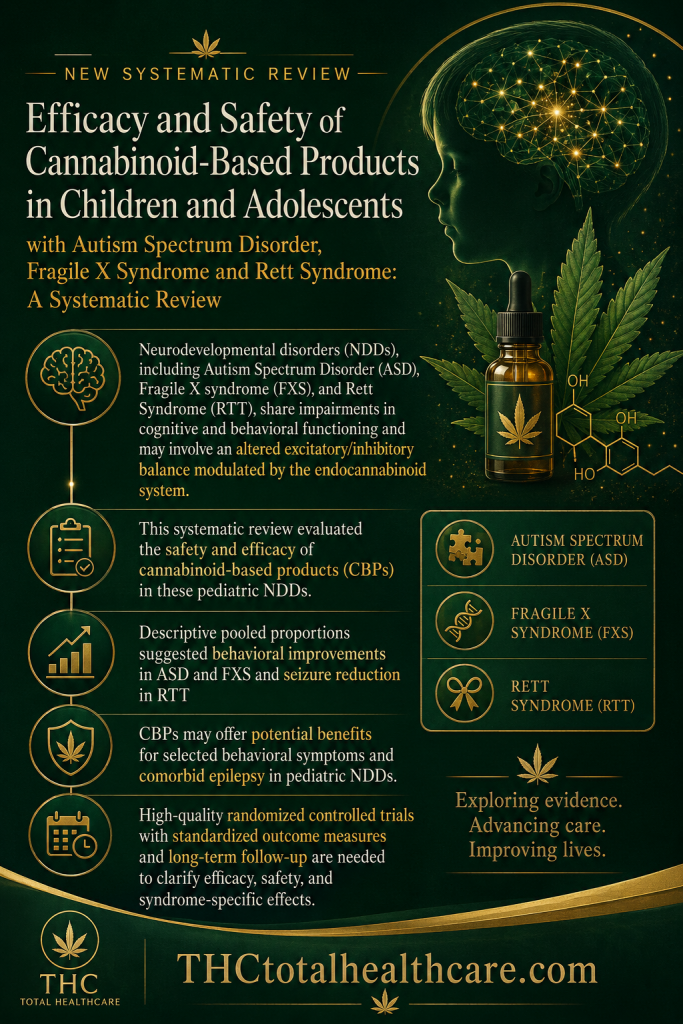
“Introduction: Neurodevelopmental disorders (NDDs), including Autism Spectrum Disorder (ASD), Fragile X syndrome (FXS), and Rett Syndrome (RTT), share impairments in cognitive and behavioral functioning and may involve an altered excitatory/inhibitory balance modulated by the endocannabinoid system. This systematic review evaluated the safety and efficacy of cannabinoid-based products (CBPs) in these pediatric NDDs.
Methods: We conducted a systematic review according to Preferred Reporting Items of Systematic Reviews and Meta-Analyses (PRISMA) 2020, including randomized and nonrandomized studies of patients under 18 years treated with cannabidiol (CBD), cannabidivarin (CBDV), tetrahydrocannabinol (THC), or their combinations. Outcomes were adverse events (AEs) and treatment discontinuation, seizure reduction, and behavioral and cognitive changes. Study quality and certainty of evidence were assessed using design-specific risk-of-bias tools and the GRADE approach.
Results: Seventeen studies (two randomized controlled trials, observational studies, and case series) met the inclusion criteria. Across diagnoses, CBPs were generally associated with mild-to-moderate AEs and low discontinuation rates. Descriptive pooled proportions suggested behavioral improvements in ASD and FXS and seizure reduction in RTT, with exploratory analyses indicating differential effects of CBD versus CBD + THC on behavioral and cognitive outcomes in ASD.
Conclusion: CBPs may offer potential benefits for selected behavioral symptoms and comorbid epilepsy in pediatric NDDs, but current evidence is insufficient to support routine clinical use. High-quality randomized controlled trials with standardized outcome measures and long-term follow-up are needed to clarify efficacy, safety, and syndrome-specific effects.”





 “Rett syndrome (RTT) is a rare neurologic disorder, characterized by severe behavioural and physiological symptoms. RTT is caused by mutations in the MECP2 gene in about 95% of cases and to date no cure is available.
 “Rett syndrome (RTT) is an X-linked neurodevelopmental disorder caused mainly by mutations in the MECP2 gene, being one of the leading causes of mental disability in females.
 “Rett syndrome (RTT) is a rare neurodevelopmental disorder, characterized by severe behavioural and physiological symptoms. RTT is caused by mutations in the MECP2 gene in about 95% of cases and to date no cure is available.
The endocannabinoid system modulates several physiological processes and behavioural responses that are impaired in RTT and its deregulation has been associated with neuropsychiatric disorders which have symptoms in common with RTT.
The present study evaluated the potential therapeutic efficacy for RTT of cannabidivarin (CBDV), a non-psychotropic phytocannabinoid from Cannabis sativa that presents antagonistic properties on the G protein-coupled receptor 55 (GPR55), the most recently identified cannabinoid receptor.
Present results demonstrate that systemic treatment with CBDV (2, 20, 100 mg/Kg ip for 14 days) rescues behavioural and brain alterations in MeCP2-308 male mice, a validated RTT model. The CBDV treatment restored the compromised general health status, the sociability and the brain weight in RTT mice. A partial restoration of motor coordination was also observed. Moreover, increased levels of GPR55 were found in RTT mouse hippocampus, suggesting this G protein-coupled receptor as new potential target for the treatment of this disorder.
Present findings highlight for the first time for RTT the translational relevance of CBDV, an innovative therapeutic agent that is under active investigation in the clinical setting.”
“Rett syndrome (RTT) is a rare neurodevelopmental disorder, characterized by severe behavioural and physiological symptoms. RTT is caused by mutations in the MECP2 gene in about 95% of cases and to date no cure is available.
The endocannabinoid system modulates several physiological processes and behavioural responses that are impaired in RTT and its deregulation has been associated with neuropsychiatric disorders which have symptoms in common with RTT.
The present study evaluated the potential therapeutic efficacy for RTT of cannabidivarin (CBDV), a non-psychotropic phytocannabinoid from Cannabis sativa that presents antagonistic properties on the G protein-coupled receptor 55 (GPR55), the most recently identified cannabinoid receptor.
Present results demonstrate that systemic treatment with CBDV (2, 20, 100 mg/Kg ip for 14 days) rescues behavioural and brain alterations in MeCP2-308 male mice, a validated RTT model. The CBDV treatment restored the compromised general health status, the sociability and the brain weight in RTT mice. A partial restoration of motor coordination was also observed. Moreover, increased levels of GPR55 were found in RTT mouse hippocampus, suggesting this G protein-coupled receptor as new potential target for the treatment of this disorder.
Present findings highlight for the first time for RTT the translational relevance of CBDV, an innovative therapeutic agent that is under active investigation in the clinical setting.”