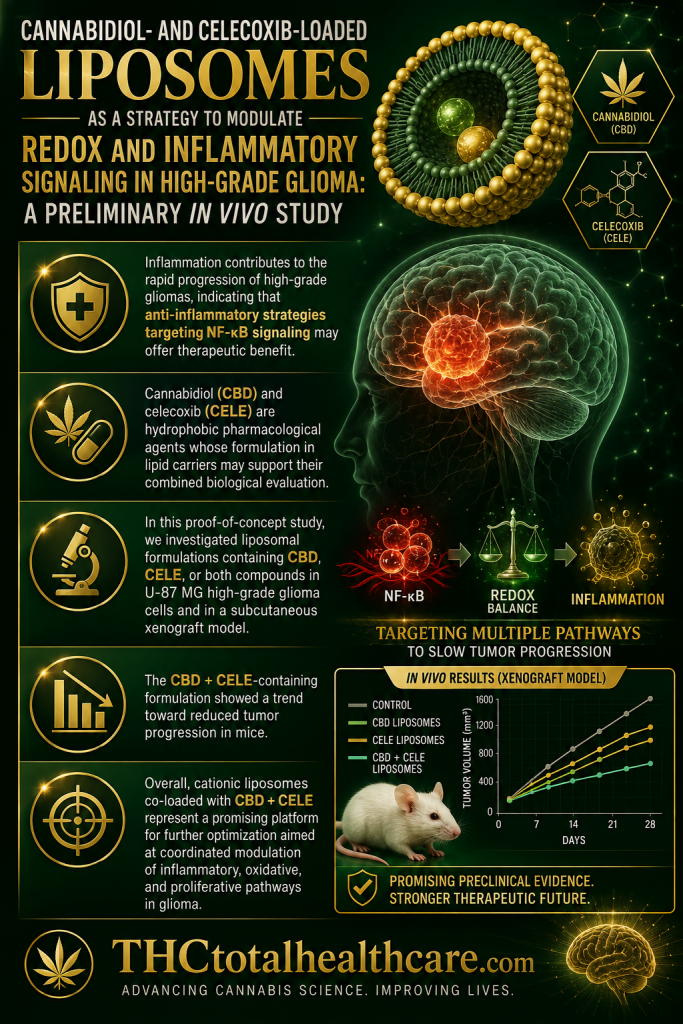
Cannabidiol- and Celecoxib-Loaded Liposomes as a Strategy to Modulate Redox and Inflammatory Signaling in High-Grade Glioma: A Preliminary In Vivo Study

“Inflammation contributes to the rapid progression of high-grade gliomas, indicating that anti-inflammatory strategies targeting NF-κB signaling may offer therapeutic benefit.

Cannabidiol (CBD) and celecoxib (CELE) are hydrophobic pharmacological agents whose formulation in lipid carriers may support their combined biological evaluation.

In this proof-of-concept study, we investigated liposomal formulations containing CBD, CELE, or both compounds in U-87 MG high-grade glioma cells and in a subcutaneous xenograft model.

We assessed cytotoxicity, apoptosis, oxidative stress, Nrf2-dependent responses, NF-κB-centered inflammatory networks, tumor cell invasive properties, and Wnt/β-catenin pathway activity. The nanoformulations induced reactive oxygen species generation by 1.8-fold, which was accompanied by Nrf2 activation. Cationic formulations loaded with the compounds produced more pronounced pro-apoptotic effects (up to 39%) than POPC liposomes, although both types reduced the nuclear translocation of the NF-κB p65 subunit.

The CBD + CELE-containing formulation showed a trend toward reduced tumor progression in mice. It is important to note that the in vitro and in vivo nanoformulations were physicochemically related, but not identical, and the in vivo experiment should be interpreted as a preliminary assessment after intratumoral administration.

Overall, cationic liposomes co-loaded with CBD + CELE represent a promising platform for further optimization aimed at coordinated modulation of inflammatory, oxidative, and proliferative pathways in glioma. However, additional studies, including tissue distribution, release kinetics, and efficacy in orthotopic glioma models, are needed to fully verify their translational potential.”

https://pubmed.ncbi.nlm.nih.gov/42511566

“In summary, this study shows that liposomal formulations containing CBD and CELE, particularly DOTAP:POPC formulations prepared with both compounds, modulate apoptosis, cell cycle distribution, oxidative stress, Nrf2/NF-κB/Wnt-related pathways, and glioma-associated inflammatory mediators in U-87 MG-based models. In the subcutaneous xenograft model, intratumoral administration of the CBD + CELE-containing formulation was associated with a trend toward reduced tumor progression and modulation of selected tumor-associated proteins.”
https://www.mdpi.com/1422-0067/27/14/6220

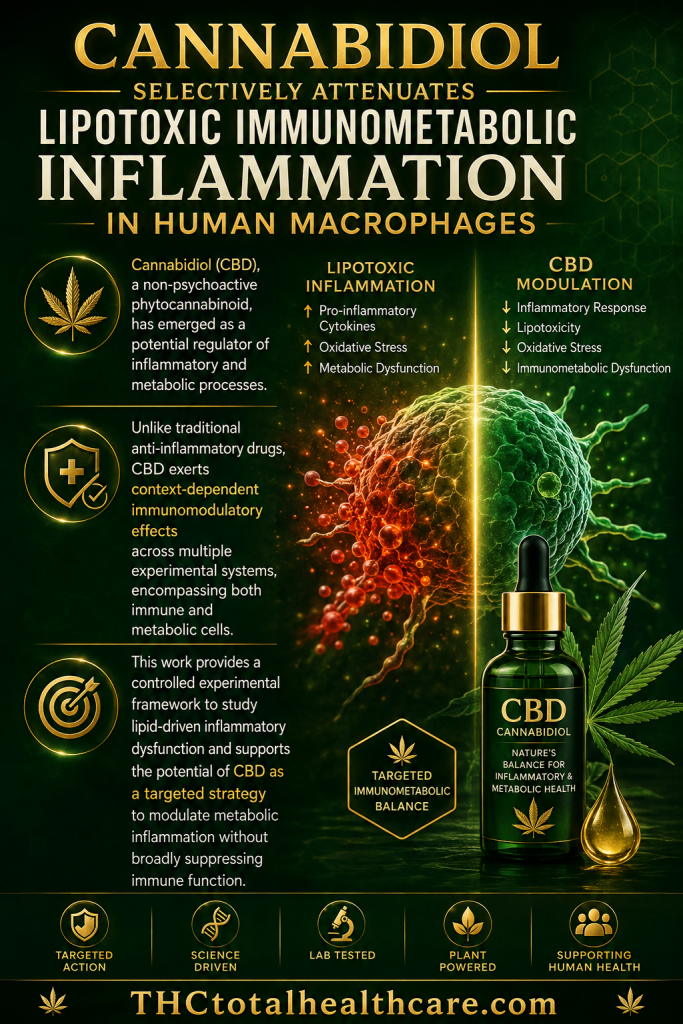
Cannabidiol selectively attenuates lipotoxic immunometabolic inflammation in human macrophages

“The role of saturated fatty acid-induced immunometabolic stress in macrophage dysfunction during metabolic disease remains incompletely understood, particularly the interplay between inflammatory signaling and intracellular lipid handling.

We employed a tightly controlled palmitic acid (PA)-based lipotoxicity model in PMA-differentiated U937-derived human macrophage-like cells to investigate how lipid excess reshapes inflammatory responses and to evaluate the modulatory effects of cannabidiol (CBD).

PA exposure induced a metabolically stressed yet viable macrophage phenotype, characterized by a broad cytokine remodeling profile. This included induction of classical proinflammatory cytokines such as interleukin (IL)-6, together with activation of inflammasome-associated cytokines IL-1β and IL-18 and additional immunoregulatory mediators, while tumor necrosis factor alpha (TNF-α) contributed to the overall inflammatory profile in a multivariate analysis. These changes were accompanied by a significant, time-dependent storage of intracellular triglycerides (TG) consistent with lipid overload and altered lipid handling.

CBD co-treatment did not compromise cell viability but selectively attenuated PA-induced inflammatory response in a cytokine-dependent manner, with the most significant reduction observed at higher concentrations. In parallel, CBD significantly reduced intracellular TG accumulation under lipotoxic conditions.

Collectively, these findings define a lipotoxicity-associated macrophage phenotype driven by saturated fatty acids and identify CBD as a context-dependent modulator of immunometabolic inflammation.

This work provides a controlled experimental framework to study lipid-driven inflammatory dysfunction and supports the potential of CBD as a targeted strategy to modulate metabolic inflammation without broadly suppressing immune function.”

https://pubmed.ncbi.nlm.nih.gov/42534637

“Cannabidiol (CBD), a non-psychoactive phytocannabinoid, has emerged as a potential regulator of inflammatory and metabolic processes. Unlike traditional anti-inflammatory drugs, CBD exerts context-dependent immunomodulatory effects across multiple experimental systems, encompassing both immune and metabolic cells.”

“Overall, this work supports CBD as a context-dependent modulator of immunometabolism response in PMA-differentiated U937-derived macrophages and provides a controlled experimental framework for studying lipid-driven inflammatory dysfunction in U937-derived macrophages.”

https://www.frontiersin.org/journals/immunology/articles/10.3389/fimmu.2026.1873494/full

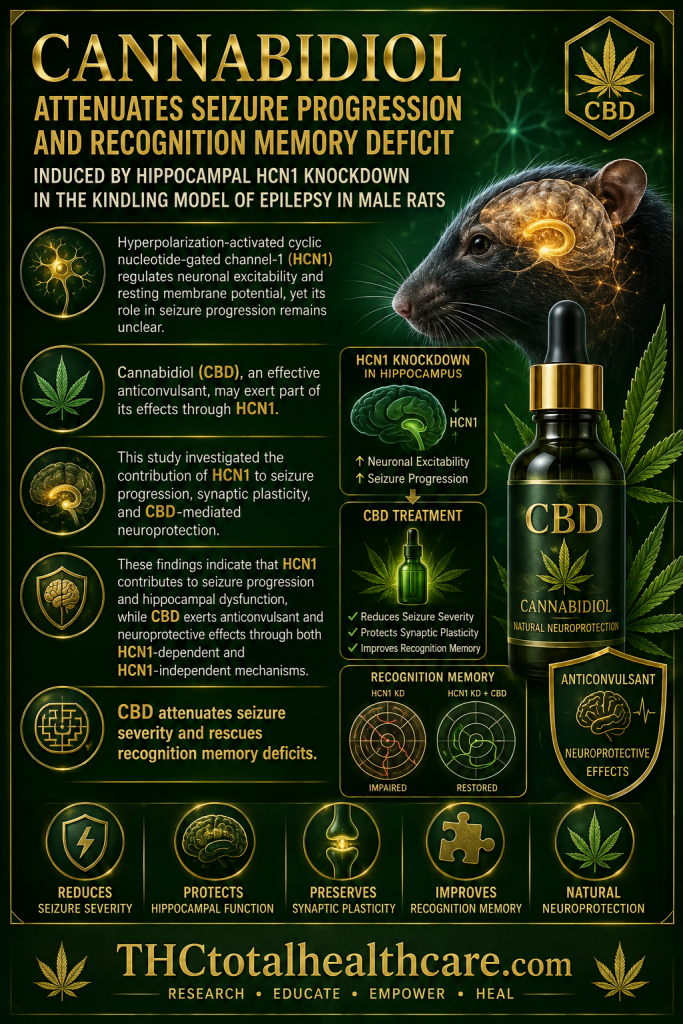
Cannabidiol Attenuates Seizure Progression and Recognition Memory Deficit Induced by Hippocampal HCN1 Knockdown in the Kindling Model of Epilepsy in Male Rats

“Epilepsy is a neurological disorder characterized by excessive neuronal firing, frequently originating in the hippocampus. Hyperpolarization-activated cyclic nucleotide-gated channel-1 (HCN1) regulates neuronal excitability and resting membrane potential, yet its role in seizure progression remains unclear.

Cannabidiol (CBD), an effective anticonvulsant, may exert part of its effects through HCN1.

This study investigated the contribution of HCN1 to seizure progression, synaptic plasticity, and CBD-mediated neuroprotection.

Rats were implanted with stimulation electrodes in the perforant path (PP) and recording electrodes with a guide cannula in the dentate gyrus (DG). One week later, lentiviral shRNA-HCN1 was injected into the DG, followed by PP electrical kindling. CBD (100 ng/2 μL) was administered every other day in shRNA-HCN1-treated or non-manipulated animals. Seizure severity was assessed using Racine’s scale. Synaptic transmission, paired-pulse plasticity, and long-term potentiation (LTP) were evaluated by extracellular field recordings, HCN1 function by whole-cell patch-clamp recordings of Ih (Hyperpolarization-activated current), HCN1 expression by RT-qPCR, and recognition memory using the novel object recognition (NOR) test.

Kindling reduced HCN1 mRNA expression, which was further decreased by shRNA-HCN1. HCN1 knockdown accelerated seizure progression, prolonged after-discharge duration, increased spike activity, reduced the sag ratio, and impaired synaptic transmission, paired-pulse plasticity, LTP, and object recognition memory in fully kindled rats.

CBD significantly attenuated these electrophysiological and recognition memory deficits, although its protective effects were partially reduced following HCN1 knockdown.

These findings indicate that HCN1 contributes to seizure progression and hippocampal dysfunction, while CBD exerts anticonvulsant and neuroprotective effects through both HCN1-dependent and HCN1-independent mechanisms.”

https://pubmed.ncbi.nlm.nih.gov/42532179

“CBD attenuates seizure severity and rescues recognition memory deficits.”

“This study provides direct experimental evidence that hippocampal HCN1 channels play a vital protective role against seizure progression and recognition memory disturbance in the kindling model. Furthermore, we found that the functional involvement of these channels in the DG is an essential and novel mechanism underlying the anticonvulsant and neuroprotective effects of CBD.”

https://www.sciencedirect.com/science/article/abs/pii/S0028390826002893?via%3Dihub