
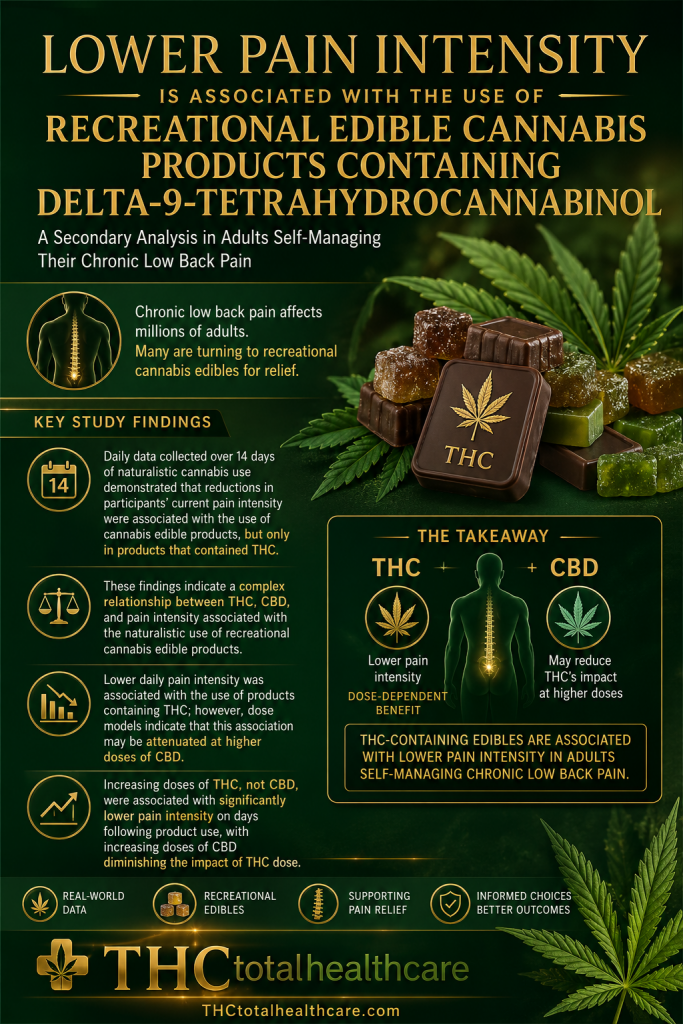
“Background/Objectives: Current literature regarding the efficacy of cannabis to reduce chronic pain intensity is mixed. Despite growing accessibility throughout the U.S., it is still unclear if the naturalistic use of recreational cannabis edible products is associated with decreases in pain intensity on days of use or longitudinally, and if these associations are dependent on the doses of delta-9-tetrahydrocannabinol (THC) and cannabidiol (CBD) being consumed.
Methods: The trial (NCT03522324) from which these data were pulled was pre-registered in April 2018. Participants (N = 243; 56% female; mean age = 46 ± 12 years) with self-reported chronic low-back pain selected a recreational edible cannabis product to use exclusively, ad libitum, for 14 days. Labeled THC and CBD potency were used to determine product group: CBD-dominant (n = 97), THC + CBD (n = 112), or THC-dominant (n = 34). Participants completed daily surveys indicating current pain intensity (PROMIS; 0-10 scale), use or non-use of their product, and cannabinoid dose (THC and CBD).
Results: Linear mixed effects showed a significant use × group interaction (p = 0.002), indicating that pain intensity was significantly lower on days of use in THC-dominant (b = -0.66, 95% CI [-0.94,-0.37]) and THC + CBD (b = -0.41, 95% CI [-0.57,-0.25]) groups compared to days when cannabis was not used. A significant group × time interaction (p = 0.02) indicated that pain intensity significantly decreased from day 1 to day 14 in those using THC + CBD products (b = -0.05, 95% CI [-0.07,-0.03]), with 36.6% of participants in the THC + CBD group experiencing ≥30% reduction in pain intensity from day 1 to day 14. Increasing doses of THC (b = -0.02, 95% CI [-0.04, -0.01]), not CBD (b = 0.003, 95% CI [-0.03, 0.01]), were associated with significantly lower pain intensity on days following product use, with increasing doses of CBD diminishing the impact of THC dose (b = 0.02, 95% CI [0.01, 0.04]).
Conclusions: These findings indicate a complex relationship between THC, CBD, and pain intensity associated with the naturalistic use of recreational cannabis edible products. Lower daily pain intensity was associated with the use of products containing THC; however, dose models indicate that this association may be attenuated at higher doses of CBD. Additionally, only products containing relatively equal amounts of THC and CBD were associated with lower pain intensity after 14 days of observation.”
https://pubmed.ncbi.nlm.nih.gov/42512114
“Daily data collected over 14 days of naturalistic cannabis use demonstrated that reductions in participants’ current pain intensity were associated with the use of cannabis edible products, but only in products that contained THC. More frequent use of these products in the previous 24 h was associated with improved reductions in pain intensity.”
https://www.mdpi.com/2227-9059/14/7/1642