
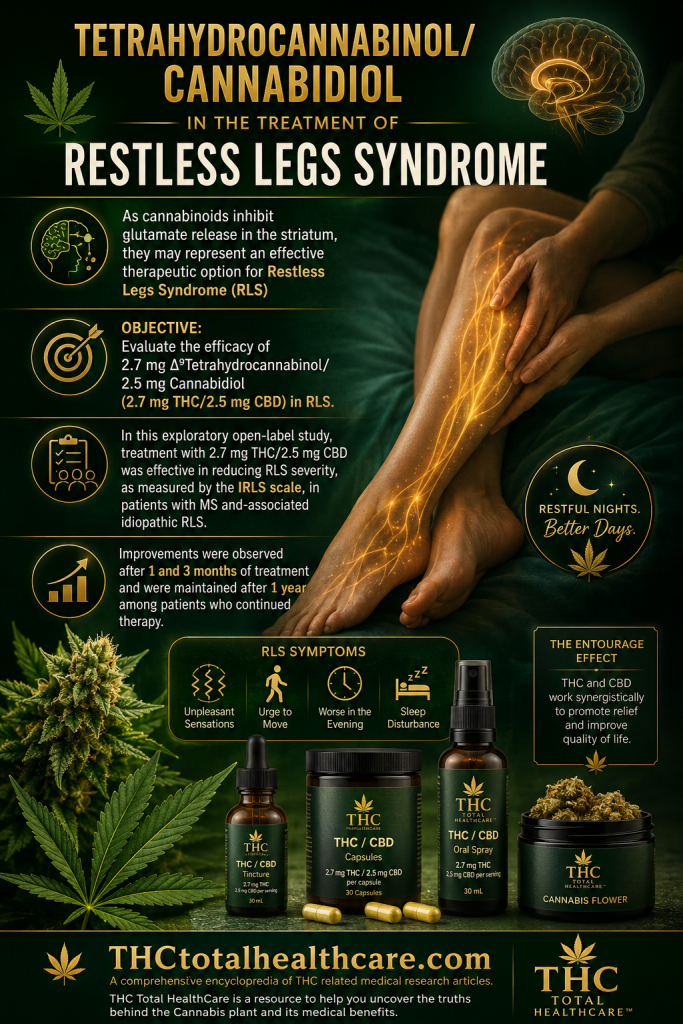
“Background: Dopamine agonists were previously considered the first-line treatment for Restless Legs Syndrome (RLS); however, α2δ ligands are now recommended to prevent augmentation. As cannabinoids inhibit glutamate release in the striatum, they may represent an effective therapeutic option for RLS.
Objective: Evaluate the efficacy of 2.7 mg Δ9Tetrahyedrocannabinol/2.5 mg Cannabidiol (2.7mgTHC/2.5mgCBD) in RLS.
Methods: This is an exploratory, prospective, 3-month open-label trial. At baseline, patients underwent blood testing, respiratory polygraphy, and a 14-day actigraphy. Treatment was initiated at baseline, with dose titration at week 4 if required. The Expanded Disability Status Scale (EDSS), Epworth Sleepiness Scale (ESS), International Restless Legs Syndrome Rating Scale (IRLS), Modified Ashworth Scale, and EQ-5D were assessed at baseline and at weeks 4 and 12. The 14-day actigraphy was repeated at week 12. The primary endpoint was improvement in IRLS scores. Sleep parameters were evaluated as secondary endpoints. Primary end point: improvement in IRLS. Sleep parameters were secondary end points.
Results: Eighteen patients with RLS were included, of whom 16 had multiple sclerosis (MS). The cohort comprised 55.5% women, with a mean age of 51.87 years, a median EDSS score of 2, and a mean Ashworth score of 1 ± 1.19. Median iron metabolism parameters were within the normal range. At baseline, patients exhibited low daytime sleepiness (ESS: 10.63 ± 3.46) and severe RLS (IRLS: 22.44 ± 8.77). Mean sleep efficiency (SE) was 83.64 ± 6.03%, sleep latency (SL) was 26.71 ± 18.64 min, and wake after sleep onset (WASO) was 40.29 ± 10.03 min. IRLS scores improved significantly after both 1 month and 3 months of treatment (p < 0.001). WASO was significantly reduced (p = 0.015), whereas no significant changes were observed in SL or SE. After 1 year, 66.66% of patients remained on treatment and continued to show sustained improvement in IRLS scores (p = 0.000).
Conclusions: In this exploratory open-label study, treatment with 2.7 mg THC/2.5 mg CBD was effective in reducing RLS severity, as measured by the IRLS scale, in patients with MS and-associated idiopathic RLS. Improvements were observed after 1 and 3 months of treatment and were maintained after 1 year among patients who continued therapy.”
https://pubmed.ncbi.nlm.nih.gov/42387200
https://link.springer.com/article/10.1007/s00415-026-13975-y
 “Restless legs syndrome (RLS) is one of the most disabling and sometimes painful sensorimotor ailment of the nervous system that has only in recent years become more widely accepted as a clinical disorder with its own distinct features. Usually, symptoms respond well to dopamine agonists, anticonvulsants, or opiates, but still a subset of patients remains refractory to medical therapy and/or reports serious side effects.