
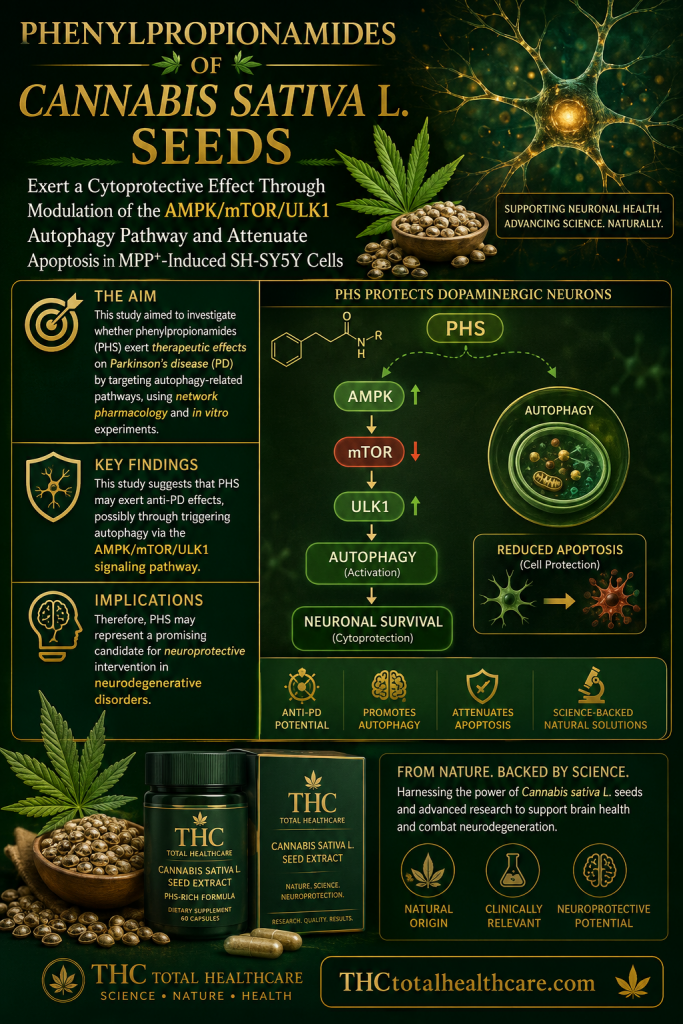
“Objective: This study aimed to investigate whether phenylpropionamides (PHS) exert therapeutic effects on Parkinson’s disease (PD) by targeting autophagy-related pathways, using network pharmacology and in vitro experiments.
Methods: Network pharmacology (NP) analysis and molecular dynamics simulation (MDS) were applied to elucidate the potential mechanisms by which PHS treats PD. Subsequently, SH-SY5Y cells were treated with MPP+ to establish a neurotoxin model. Cell viability was assessed using the CCK-8 assay. Mitochondrial membrane potential (MMP) in SH-SY5Y cells was measured using JC-1 staining. Western blot (WB) was used to detect the expression of Bax, cleaved caspase-3, caspase-3, LC3-II, p62, Beclin-1, AMPK, mTOR, and ULK1 signaling proteins in SH-SY5Y cells.
Results: NP analysis suggested that the potential anti-PD effects of PHS were associated with cleaved caspase-3, Bcl-2, mTOR, and Beclin-1. Furthermore, KEGG and PPI analyses demonstrated that PHS may exert anti-PD effects by modulating the AMPK/mTOR/ULK1 autophagy signaling pathway. Molecular docking (MolD) and MDS showed that the key PHS component (Cannabisin I) had a stable interaction with caspase-3, Bcl-2, AMPK, mTOR, ULK1, and Beclin-1. The in vitro experiments showed that PHS suppressed the expression of cleaved caspase-3 and Bax, promoted Bcl-2 expression, activated the autophagy pathway, increased the levels of LC3-II and Beclin-1, increased mitochondrial membrane potential and decreased the levels of p62. Notably, PHS promoted autophagy by increasing AMPK and ULK1 while inhibiting mTOR protein levels. Therefore, PHS may represent a promising candidate for neuroprotective intervention in neurodegenerative disorders.
Conclusion: This study suggests that PHS may exert anti-PD effects, possibly through triggering autophagy via the AMPK/mTOR/ULK1 signaling pathway.”
https://pubmed.ncbi.nlm.nih.gov/42456387
“Historically, the seeds of Cannabis sativa L. have been used in traditional Chinese medicine (TCM). They are frequently utilized in various dietary applications, including cannabis seed oil, bread, and yogurt. Because they are rich in unsaturated fatty acids (UFAs) and essential amino acids (EAAs), they have been sought after by people. In addition, they have been reported to exhibit neuroprotective and immunomodulatory effects, as well as benefits for gastrointestinal health.
Furthermore, UFAs and EAAs, the seeds of Cannabis sativa L., are abundant in a category of compounds known as phenylpropionamides (PHS). Research has demonstrated that PHS compounds possess the ability to inhibit apoptosis in the SH-SY5Y cell model of PD, which is triggered by 1-methyl−4-phenylpyridinium (MPP+), by modulating the autophagy pathway. Previous studies have identified 22 PHS in cannabis seeds and demonstrated that PHS ameliorated MPTP-induced PD symptoms by promoting autophagy.”
https://www.sciencedirect.com/science/article/abs/pii/S0040816626004490?via%3Dihub