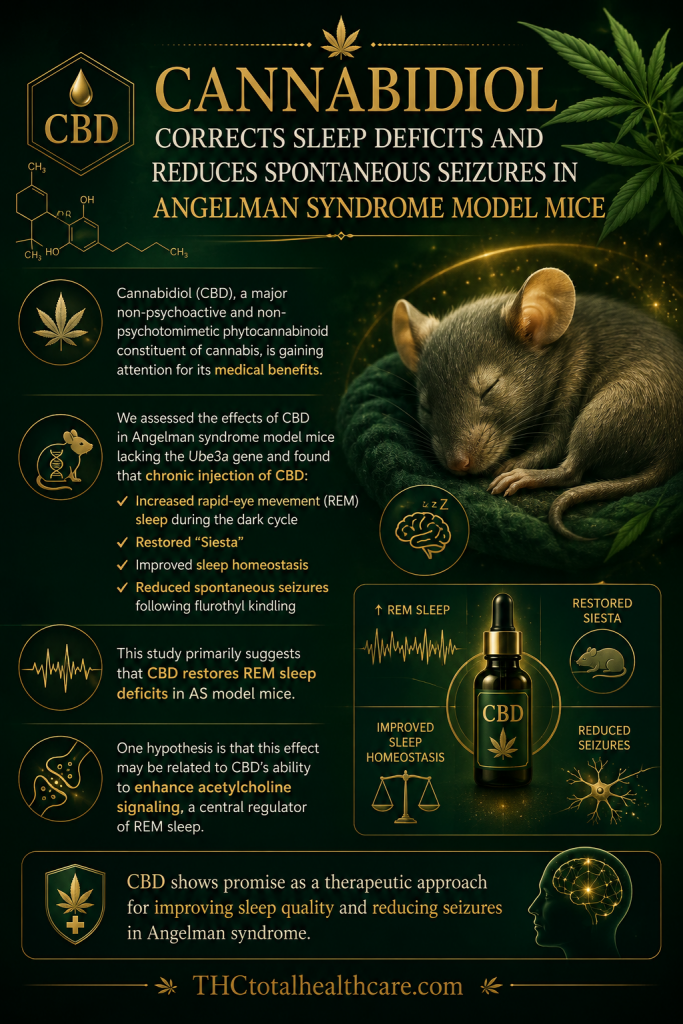
“The off-label use of cannabidiol (CBD) has outpaced investigation. We assessed the effects of CBD in Angelman syndrome model mice lacking the Ube3a gene and found that chronic injection of CBD increased rapid-eye movement sleep during the dark cycle, restored “Siesta”, improved sleep homeostasis, and reduced spontaneous seizures following flurothyl kindling.”
“Cannabidiol (CBD), a major non-psychoactive and non-psychotomimetic phytocannabinoid constituent of cannabis, is gaining attention for its medical benefits. The multitarget and complex pharmacological nature of CBD in the central nervous system makes it a unique candidate for treating a wide range of complex neurological and psychiatric conditions, including seizures and sleep deficits.”
“This study primarily suggests that CBD restores REM sleep deficits in AS model mice. One hypothesis is that this effect may be related to CBD’s ability to enhance acetylcholine signaling, a central regulator of REM sleep. CBD’s ability to reduce the frequency of SRS, beyond its effects on induced-seizure suppression, further strengthens the preclinical evidence supporting its potential for clinical translation.”
“Background: This study compared the efficacy and safety of integrative and conventional therapies for chronic insomnia.
Objective: To evaluate the effects of the Suk-Sai-Yat traditional Thai herbal remedy, Cannabis sativa oil (Deja formula) and lorazepam on sleep quality and quality of life in patients with chronic insomnia.
Methods: In a randomized controlled parallel-group trial, 60 adults with chronic insomnia received Suk-Sai-Yat, Cannabis sativa oil, or lorazepam for four weeks. Sleep quality was assessed using the Pittsburgh leep Quality Index (PSQI) and quality of life was evaluated using EQ-5D-5L and EQ-VAS. Safety was monitored throughout the study.
Results: After four weeks, PSQI scores significantly improved in all groups: Suk-Sai-Yat (12.3-6.6), Cannabis sativa oil (13.6-3.68) and lorazepam (14.4-5.8) (all p < 0.001), with no significant differences between groups. Quality-of-life scores improved significantly in the integrative therapy groups. Only mild adverse events were reported.
Conclusion: Suk-Sai-Yat and Cannabis sativa oil demonstrated comparable efficacy to lorazepam with favorable safety profiles, supporting their role as integrative, non-benzodiazepine options for chronic insomnia management.”
“Background: Poor sleep quality is a commonly reported reason for medical cannabis (MC) use, yet evidence regarding its long-term impact on sleep remains limited. This study evaluated changes in subjective sleep quality over a 12-month period among adults initiating MC treatment in Pennsylvania and explored whether preferred route of administration and referring condition were associated with observed changes.
Methods: A total of 137 adults newly referred for MC in PA completed the Pittsburgh Sleep Quality Index (PSQI) at baseline and at 3, 6, 9, and 12 months. Linear mixed effects models assessed changes in PSQI global and subscale scores over time. Additional models evaluated whether preferred administration route (oral vs. other) and referring condition (chronic pain, anxiety, PTSD) were associated with differences in observed outcomes.
Results: Global sleep quality scores, where higher values indicate poorer sleep quality, were significantly higher at baseline than at each follow-up point (p < .0001), with no significant differences among follow-up assessments, suggesting early and sustained improvements in self-reported sleep quality. Improvements were observed across all PSQI subscales. No significant relationships were found between sleep quality scores and either administration route or referring condition.
Conclusions: These findings suggest that MC may be associated with improvements in subjective sleep quality, though its impact did not vary as a function of administration route or primary referring condition. Additional research using objective sleep measures and controlled designs is needed to clarify MC’s role in sleep quality.”
“Background: Despite the Netherlands having one of the world’s oldest medical cannabis programs, the majority of people who use cannabis for medicinal purposes continue to rely on non-prescribed sources. This study investigates patterns of use, motives for use, perceived effectiveness, and barriers to accessing prescribed cannabis among individuals self-medicating with non-prescribed cannabis.
Methods: A cross-sectional online survey was conducted between January and April 2023, using convenience sampling primarily via social media. Participants (N = 1059) were adults (18 years or older) residing in the Netherlands who self-reported current use of non-prescribed cannabis-based products to manage physical or mental health symptoms.
Results: Cannabis was used to manage a wide range of conditions, most commonly chronic pain, sleep disorders, depression, and ADHD/ADD, with three out of four participants reporting use for multiple conditions. Most participants obtained cannabis from coffeeshops, although one in four also reported home cultivation as a source. Participants typically smoked cannabis with tobacco, reported (near-)daily use for therapeutic purposes, and indicated a monthly expenditure of €100. The majority was not aware of the THC and CBD content of their products. Perceived effectiveness was rated as high, and more than half of those with a history of prescription medication use reported substituting cannabis for these medications. Only a minority of participants had ever used, or were currently using, prescribed cannabis. Commonly cited barriers included perceived lower quality, higher cost, and lower ease of access compared with non-prescribed cannabis.
Conclusions: The widespread use of non-prescribed cannabis for medicinal purposes in the Netherlands reflects both unmet health needs and barriers within the regulated medical cannabis system. Risky use practices – such as smoking cannabis with tobacco and using products without knowing their cannabinoid content – raise public health concerns. The findings highlight the need for harm reduction strategies and policies that better align medical cannabis regulation with patients’ real-world behaviours and care needs.”
“Introduction: The endocannabinoid system plays a role in sleep-wake regulation. In clinical practice, people with central disorders of hypersomnolence (CDH) frequently report use of cannabis.
Methods: We compared lifetime and current use of cannabis of people with CDH to the Dutch general population. Additionally, we assessed cannabis use in relation to hypersomnolence symptoms.
Results: In total, 76 (out of 88) patients completed the online questionnaire. Lifetime cannabis use (42% vs. 23%, p < 0.001) and current use (18% vs. 4%, p < 0.001) were higher in people with CDH compared to the Dutch general population. For 57% of patients currently using cannabis, improvements of at least one CDH symptom were the motivation for use. Additionally, 79% of current cannabis users reported cannabis-related effects on a symptom, which were mostly positive (43%), some negative (7%), or mixed effects (29%). Patients that stopped using mostly started using cannabis before symptom onset and for recreational purposes. The most reported reasons to stop using were disadvantages of using or changes in the social environment.
Conclusion: This study provides a rationale for future research on the potential benefits of cannabis in CDH.”
“Medicinal cannabis has been the subject of extensive research, with recent studies demonstrating its potential in managing chronic pain and enhancing quality of life.
This case report examines the use of medicinal cannabis in a patient treated at the School of Dentistry of Araçatuba (FOA-UNESP). The patient, a 28-year-old female with no comorbidities, presented with chronic muscular TMD and reported poor sleep quality. Full-spectrum cannabis oil (1:1 ratio of THC to CBD), was prescribed for a period of 60 days, with a maximum dosage of 10 drops per day. Pain intensity was measured using the Visual Analog Scale (VAS), while sleep quality was assessed using the Pittsburgh Sleep Quality Index (PSQI). Evaluations were conducted at three intervals: baseline, day 30, and day 60. To ensure patient safety, pre- and post-treatment blood tests were performed, and dosage adjustments were made every three days under the supervision of the study’s medical team.
The results revealed significant improvements in pain management, with the patient’s orofacial pain score decreasing from 7 to 3 on the NRS. Additionally, sleep quality improved, as reflected by a lower PSQI score (global sleep quality at level 6 at the end), indicating more restorative sleep. Throughout the treatment period, the patient experienced mild side effects, including drowsiness and gastrointestinal discomfort, which were effectively managed through dosage modifications.
In conclusion, full-spectrum cannabis oil shows promise as a therapeutic strategy for managing orofacial pain and improving sleep quality, providing significant relief in conditions where other interventions are ineffective or poorly tolerated. Further research is warranted to better understand the therapeutic mechanisms and potential side effects of medicinal cannabis in the management of chronic pain and related conditions.”
“In conclusion, the use of Full Spectrum Cannabis Oil in this case was associated with a clinically meaningful reduction in chronic orofacial pain and improvement in sleep quality, with no adverse effects or laboratory abnormalities observed during the treatment period. These outcomes suggest that individualized cannabinoid-based therapy may be a safe and effective approach for selected patients with temporomandibular disorders and comorbid sleep disturbances.”
“Study objectives: This systematic review and meta-analysis assessed the efficacy of cannabinoids compared to placebo for improving sleep quality.
Methods: Searches were conducted in MEDLINE, Embase, and Cochrane databases for randomised controlled trials comparing cannabinoids vs. placebo for improving sleep quality in adults with or without insomnia or poor sleep. The primary outcome was self-reported sleep quality (PROMIS, PSQI, LSEQ, Sleep Diary). Secondary outcomes included actigraphy parameters, anxiety (GAD-7, STAI-T), well-being (WHO-5 index), and insomnia severity (ISI). Additional analyses focused on sleep quality in (1) participants with insomnia or poor sleep, and (2) cannabidiol (CBD) vs. non-CBD interventions. Statistical analysis was performed using RevMan 5.4.1, with p < 0.05 considered significant.
Results: Six trials (1077 patients) were included. Cannabinoids significantly improved sleep quality compared to placebo [SMD 0.53; 95 % CI 0.03-1.02; p = 0.04; I2 = 88 %], particularly in those with insomnia or poor sleep [SMD 0.60; 95 % CI 0.09-1.11; p = 0.02; I2 = 89 %]. Non-CBD cannabinoids demonstrated greater efficacy [SMD 0.82; 95 % CI 0.24-1.40; p = 0.005], whereas CBD-only therapies showed no significant effect [SMD 0.13; 95 % CI -0.38-0.65; p = 0.61].
Conclusion: Cannabinoids, particularly non-CBD formulations, improve sleep quality, justifying further investigation as therapeutic options for insomnia or poor sleep.”
“Insomnia affects approximately 10% of adults globally. Current treatments have their limitations, and there is growing evidence on the therapeutic potential of cannabis-based medicinal products for insomnia.
This study aimed to assess changes in sleep-specific and general patient-reported outcome measures (PROMs) in individuals prescribed cannabis-based medicinal products for insomnia and to assess the incidence of adverse events.
A case series was analysed with patients diagnosed with primary insomnia from the UK Medical Cannabis Registry (UKMCR). The primary outcome examined changes in the Single-Item Sleep Quality Scale (SQS), Generalised Anxiety Disorder-7 (GAD-7), and EuroQol-5 Dimension-5 Level (EQ-5D-5L). Changes in PROMs were assessed from baseline to 1-, 3-, 6-, 12- and 18-months. Adverse events were classified according to the CTCAE version 4.0. The inclusion criteria were met by 124 participants.
SQS scores showed improvement from baseline (2.66 ± 2.41) to 1- (5.67 ± 2.65; p < 0.001), 3- (5.41 ± 2.69; p < 0.001), 6- (4.80 ± 2.89; p < 0.001), 12- (4.24 ± 3.01; p < 0.001) and 18-months (3.81 ± 2.90; p < 0.001). GAD-7 scores improved from baseline to 1-, 3-, 6-, 12- and 18-months (p < 0.050). There were also improvements in EQ-5D-5L dimensions of usual activities, pain/discomfort, anxiety/depression, and index values (p < 0.001). Eleven (8.87%) participants reported a total of 112 (90.32%) adverse events, but none were disabling or life-threatening.
The study demonstrated improvements in subjective sleep quality and other captured PROMs in insomnia patients treated with cannabis-based medicinal products. Although the treatment was generally well-tolerated, randomised controlled trials are needed to confirm the effectiveness and safety of cannabis-based medicinal products.”
“Background: Cannabidiol (CBD) has demonstrated potential as a therapeutic agent for muscle tension, pain, and sleep bruxism, yet its broader impact on comorbid conditions such as sleep disturbance and migraine disability remains underexplored. This study aimed to assess the effects of topical CBD on sleep quality and migraine-related disability in patients with bruxism-associated muscular pain.
Methods: In a randomized, double-blind clinical trial, 60 participants with bruxism were allocated equally into three groups: control (placebo gel), 5% CBD gel, and 10% CBD gel. Participants applied the gel intraorally to the masseter muscles nightly for 30 days. Sleep quality and migraine-related disability were assessed using the Pittsburgh Sleep Quality Index (PSQI) and the Migraine Disability Assessment Scale (MIDAS), respectively. Surface electromyography (sEMG) and the Bruxoff® device were used for objective evaluation of muscle tension and bruxism intensity.
Results: Both CBD treatment groups demonstrated statistically significant improvements in PSQI and MIDAS scores compared to the control group (p < 0.001). No significant differences were observed between the 5% and 10% CBD groups, suggesting comparable efficacy. The sEMG findings corroborated a reduction in muscle tension. Improvements in sleep and migraine outcomes were positively correlated with reductions in muscle activity and pain.
Conclusions: Topical CBD gel significantly improved sleep quality and reduced migraine-related disability in patients with bruxism-associated muscular pain, supporting its role as a multifaceted therapeutic option in the management of TMD and related comorbidities. Further research is needed to confirm long-term benefits and determine optimal dosing strategies.”
“This study demonstrates that topical application of cannabidiol (CBD) gel, at both 5% and 10% concentrations, significantly improves sleep quality and reduces migraine-related disability in patients with bruxism-associated muscular pain. These effects were observed alongside reductions in muscle tension and pain, suggesting a broader therapeutic impact of CBD beyond localized symptom relief. Notably, no substantial differences were found between the two concentrations, indicating that lower doses may achieve comparable clinical outcomes.
The findings support the use of topical CBD as a well-tolerated, non-invasive adjunct in the multimodal management of temporomandibular disorders (TMD), especially in patients experiencing comorbid sleep and headache disturbances. Future research should explore long-term efficacy, optimal dosing, and underlying mechanisms through objective neurophysiological and sleep assessments”
“Cannabinoids, particularly Δ9-tetrahydrocannabinol (THC) and cannabidiol (CBD), have gained popularity as alternative sleep aids; however, their effects on sleep architecture and next-day function remain poorly understood.
Here, in a pilot trial, we examined the effects of a single oral dose containing 10 mg THC and 200 mg CBD (THC/CBD) on objective sleep outcomes and next-day alertness using 256-channel high-density EEG in 20 patients with DSM-5 diagnosed insomnia disorder (16 female; mean (SD) age, 46.1 (8.6) years).
We showed that THC/CBD decreased total sleep time (-24.5 min, p = 0.05, d = -0.5) with no change in wake after sleep onset (+10.7 min, p > 0.05) compared to placebo. THC/CBD also significantly decreased time spent in REM sleep (-33.9 min, p < 0.001, d = -1.5) and increased latency to REM sleep (+65.6 min, p = 0.008, d = 0.7). High-density EEG analysis revealed regional decreases in gamma activity during N2 sleep, and in delta activity during N3 sleep, and a regional increase in beta and alpha activity during REM sleep. While there was no observed change in next-day objective alertness, a small but significant increase in self-reported sleepiness was noted with THC/CBD (+0.42 points, p = 0.02, d = 0.22). No changes in subjective sleep quality, cognitive performance, or simulated driving performance were observed.
These findings suggest that a single dose of cannabinoids, particularly THC, may acutely influence sleep, primarily by suppressing REM sleep, without noticeable next-day impairment (≥ 9 h post-treatment).”
“This study is the first to use high-density EEG to explore the acute effects of oral THC/CBD on objective sleep outcomes in individuals with insomnia. A single oral dose significantly reduced total sleep time and REM sleep, without impairing next-day alertness.”