
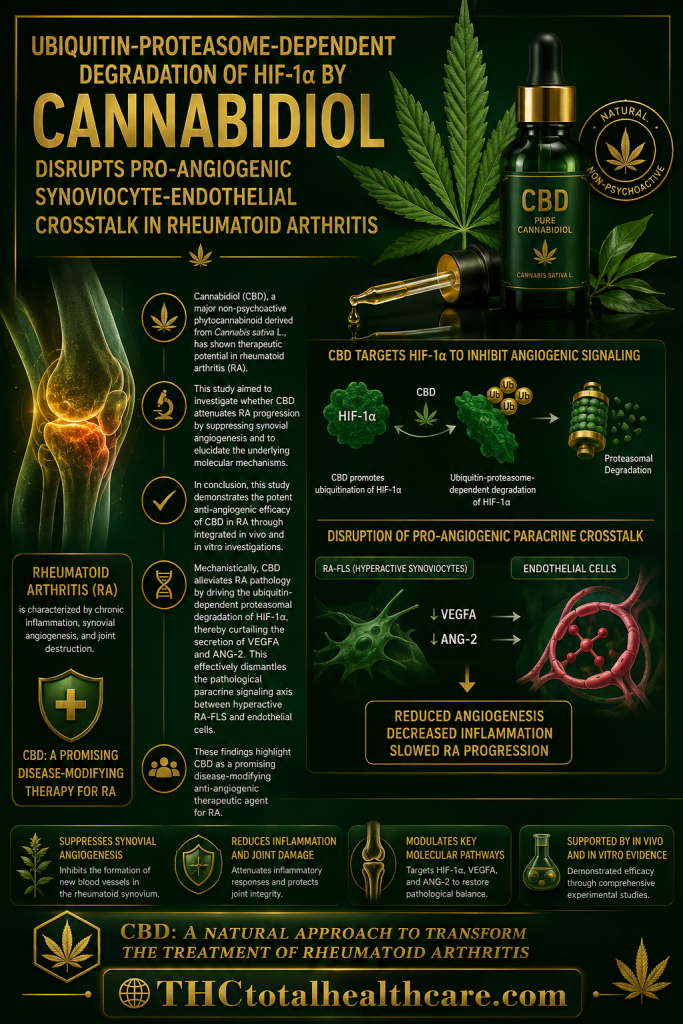
Rheumatoid arthritis is driven in part by abnormal synovial inflammation and the formation of new blood vessels that sustain diseased tissue. In this study, cannabidiol (CBD) reduced joint inflammation, synovial angiogenesis, and bone destruction while suppressing abnormal fibroblast activity. The researchers concluded that CBD disrupts pro-angiogenic signaling through HIF-1α degradation and may represent a promising disease-modifying anti-angiogenic therapeutic agent for rheumatoid arthritis.
“Background: Cannabidiol (CBD), a major non-psychoactive phytocannabinoid derived from Cannabis sativa L., has shown therapeutic potential in rheumatoid arthritis (RA). However, the mechanisms by which CBD modulates synovial angiogenesis remain unclear.
Purpose: This study aimed to investigate whether CBD attenuates RA progression by suppressing synovial angiogenesis and to elucidate the underlying molecular mechanisms.
Methods: An adjuvant-induced arthritis (AIA) rat model was established to evaluate the therapeutic effects of CBD in vivo using arthritis scoring, micro-CT, and histopathological, immunohistochemical, and immunofluorescence analyses. In vitro, cytotoxicity was determined using the CCK-8 assay, followed by evaluations of CBD’s direct effects on the proliferation, migration, invasion, and inflammatory responses of RA fibroblast-like synoviocytes (RA-FLS) were evaluated, alongside Cell Counting Kit-8 (CCK-8) for cytotoxicity screening. Furthermore, the paracrine regulation of angiogenesis was assessed using a conditioned medium (CM) transfer system from hypoxia-stimulated RA-FLS applied to human umbilical vein endothelial cells (HUVECs). Molecular mechanisms were analyzed via Western blotting, RT-qPCR, ELISA, co-immunoprecipitation (Co-IP), molecular docking, and targeted proteasome inhibition (MG132).
Results: In vivo, CBD (5 and 10 mg/kg) treatment markedly alleviated joint inflammation, synovial angiogenesis, and structural bone destruction in AIA rats. In vitro, non-cytotoxic concentrations of CBD (2.4-4.8 μM) significantly suppressed aberrant RA-FLS proliferation, migration, invasion, and pro-inflammatory cytokine secretion. Mechanistically, CBD abrogated the hypoxia-induced accumulation of hypoxia-inducible factor-1α (HIF-1α) protein in RA-FLS without significantly altering HIF1A mRNA expression. This reduction was effectively reversed by MG132. Co-IP and molecular docking analyses revealed that CBD directly enhances the polyubiquitination of HIF-1α through stable structural interactions, driving a ubiquitin-proteasome-dependent degradation mechanism. Consequently, CBD dose-dependently decreased the extracellular secretion of vascular endothelial growth factor A (VEGFA) and angiopoietin-2 (ANG-2) from RA-FLS. Functionally, CM from CBD-treated RA-FLS disrupted the pro-angiogenic paracrine crosstalk-independent of direct CBD carryover-significantly impairing HUVEC migration, capillary-like tube formation, and downstream VEGFR2 (Tyr1175) phosphorylation.
Conclusion: CBD attenuates RA pathogenesis not only by directly suppressing RA-FLS hyperactivity but also by severing the pro-angiogenic paracrine crosstalk between RA-FLS and endothelial cells. These effects are driven by the ubiquitin-proteasome-dependent degradation of HIF-1α in RA-FLS via direct structural engagement, which depletes VEGFA/ANG-2 production and subsequent endothelial VEGFR2 activation. These findings highlight CBD as a promising disease-modifying anti-angiogenic therapeutic agent for RA.”
https://pubmed.ncbi.nlm.nih.gov/42542056
“In conclusion, this study demonstrates the potent anti-angiogenic efficacy of CBD in RA through integrated in vivo and in vitro investigations. Mechanistically, CBD alleviates RA pathology by driving the ubiquitin-dependent proteasomal degradation of HIF-1α, thereby curtailing the secretion of VEGFA and ANG-2. This effectively dismantles the pathological paracrine signaling axis between hyperactive RA-FLS and endothelial cells.”
https://www.sciencedirect.com/science/article/abs/pii/S0944711326008925?via%3Dihub