
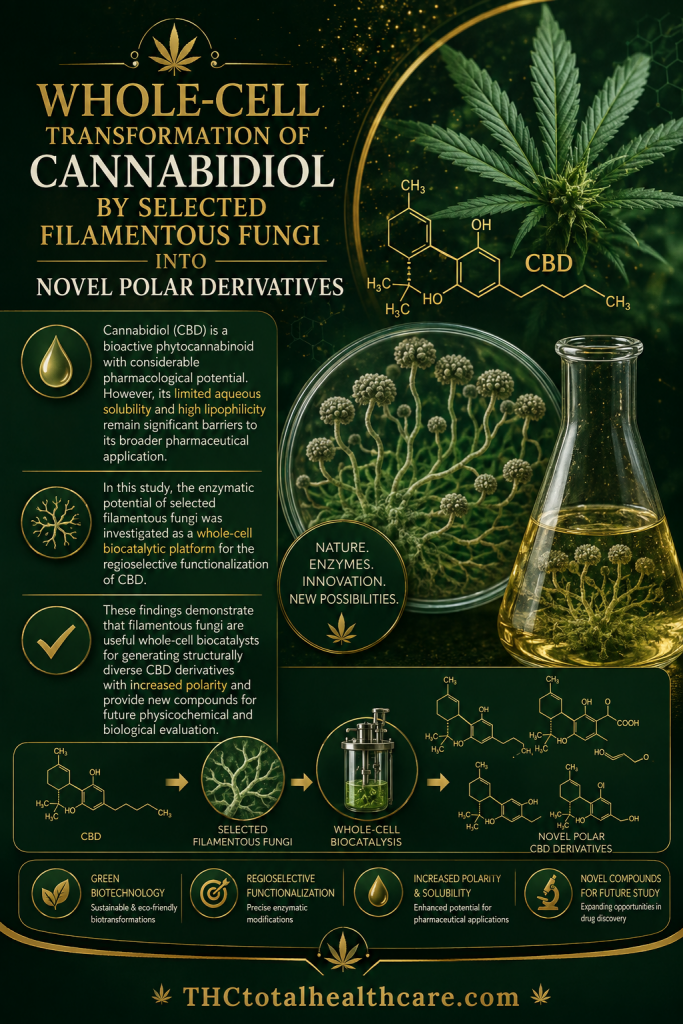
Researchers are using fungi as biological tools to transform cannabidiol (CBD) into new chemical derivatives that may have different properties from the original cannabinoid. In this study, selected filamentous fungi converted CBD into several more polar metabolites, expanding the range of cannabinoid compounds that could be explored for future pharmaceutical and biomedical applications.
“Cannabidiol (CBD) is a bioactive phytocannabinoid with considerable pharmacological potential. However, its limited aqueous solubility and high lipophilicity remain significant barriers to its broader pharmaceutical application.
In this study, the enzymatic potential of selected filamentous fungi was investigated as a whole-cell biocatalytic platform for the regioselective functionalization of CBD.
Sixteen fungal strains were screened, and thirteen microorganisms successfully transformed CBD into more polar derivatives. Four strains showing distinct and promising chromatographic profiles were selected for scale-up biotransformation and product isolation: Mucor hiemalis KCh W2, M. hiemalis AM 450, Isaria fumosorosea KCh J2, and Metarhizium robertsii MU4. Eight CBD derivatives were isolated and identified by UHPLC-DAD, NMR spectroscopy, and HRESI-MS, including hydroxylated, glycosylated, and methylglycosylated products.
Among them, two metabolites, 2′-O-(4‴-O-methyl-β-D-glucopyranosyl)-cannabidiol and 2′-O-(4‴-O-methyl-β-D-glucopyranosyl)-5″-hydroxycannabidiol, are reported here as previously undescribed CBD derivatives.
I. fumosorosea KCh J2 and M. robertsii MU4 demonstrated the ability to catalyse 4-O-methylglycosylation. An additional experiment using 2′-O-(β-D-glucopyranosyl)-cannabidiol as an intermediate supported a sequential pathway involving initial phenolic O-glycosylation followed by methylation of the sugar moiety. In silico analysis predicted reduced lipophilicity for the newly obtained derivatives compared with CBD; however, these computational results require experimental verification and should not be interpreted as evidence of improved aqueous solubility, bioavailability, or biological activity.
These findings demonstrate that filamentous fungi are useful whole-cell biocatalysts for generating structurally diverse CBD derivatives with increased polarity and provide new compounds for future physicochemical and biological evaluation.”