
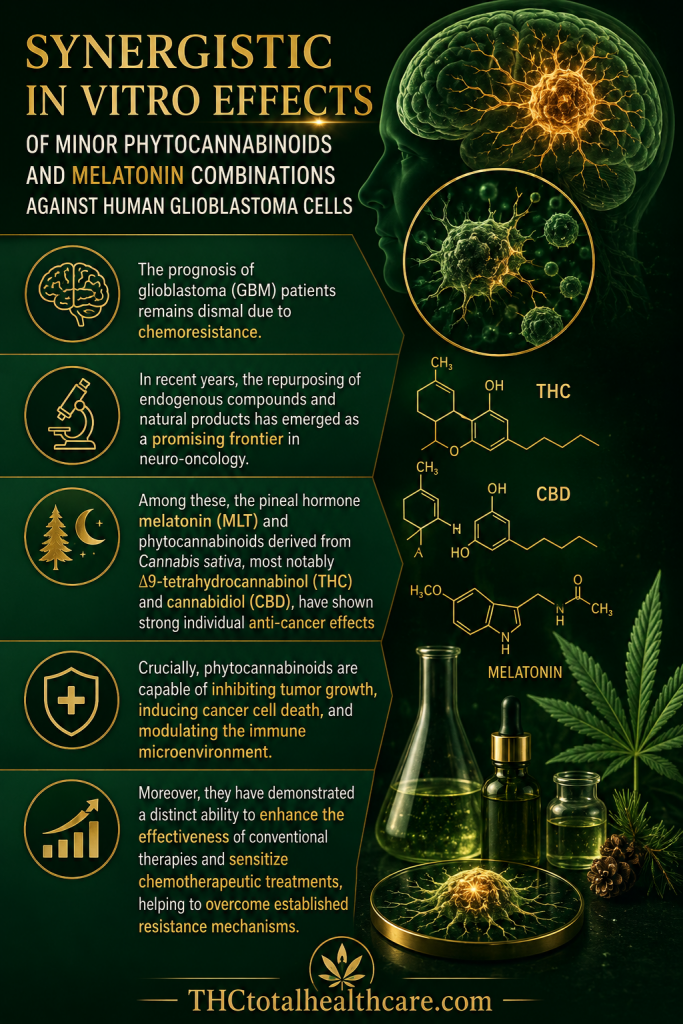
Glioblastoma remains one of the most difficult brain cancers to treat, in part because tumor cells can develop resistance to chemotherapy. In laboratory testing, combinations of the minor cannabinoids CBN or CBG with melatonin produced synergistic anticancer effects against human glioblastoma cells while sparing healthy astrocytes, and significantly enhanced the effectiveness of temozolomide.
“The prognosis of glioblastoma (GBM) patients remains dismal due to chemoresistance.
Repurposing of natural and endogenous compounds, such as the pineal hormone melatonin (MLT) and minor phytocannabinoids like cannabinol (CBN) or cannabigerol (CBG), represents a promising strategy.
This study investigates the cytotoxic potential of combining these phytocannabinoids with MLT, evaluating their efficacy both alone and synergistically with temozolomide (TMZ) to overcome drug resistance.
To achieve this, cytotoxicity, synergy (Bliss model), and selectivity were evaluated in U87, T98, and U251 GBM lines and normal astrocytes. Mechanisms of damage were characterized via Western blot (γH2AX and PARP-1), flow cytometry using fluorescent dyes/probes (DCFDA, JC-1, MitoBright, BODIPY, PI, and Annexin-V), or the protein marker COX IV and confocal analysis.
The results demonstrated that CBN-MLT and CBG-MLT regimens exerted synergistic cytotoxicity while sparing healthy astrocytes. Notably, combining these regimens (U87: MLT 0.3 mg/mL + CBN 25 µM; MLT 0.2 mg/mL + CBG 15 µM. T98: MLT 0.7 mg/mL + CBN 25 µM; MLT 0.6 mg/mL + CBG 30 µM. U251: MLT 0.4 mg/mL + CBN 20 µM; MLT 0.5 mg/mL + CBG 35 µM) with TMZ significantly enhanced chemotherapeutic efficacy, overcoming baseline effects of TMZ in these cell lines.
The combinations induced necrotic cell death characterized by severe double-strand DNA damage. This was driven by an early accumulation of intracellular ROS, which triggered mitochondrial depolarization, loss of organelle mass, and lipid peroxidation. CBN combinations consistently triggered more robust biochemical alterations than CBG-based treatments.
Taken together, this study provides a strong preclinical basis for utilizing minor cannabinoids combined with MLT in GBM management.
Crucially, this co-treatment emerges as a promising approach to potentiate TMZ efficacy, offering a novel and potentially effective therapeutic strategy to counter GBM resilience.”
https://pubmed.ncbi.nlm.nih.gov/42589431
“In recent years, the repurposing of endogenous compounds and natural products has emerged as a promising frontier in neuro-oncology. Among these, the pineal hormone melatonin (MLT) and phytocannabinoids derived from Cannabis sativa, most notably Δ9-tetrahydrocannabinol (THC) and cannabidiol (CBD), have shown strong individual anti-cancer effects “
“Crucially, phytocannabinoids are capable of inhibiting tumor growth, inducing cancer cell death, and modulating the immune microenvironment. Moreover, they have demonstrated a distinct ability to enhance the effectiveness of conventional therapies and sensitize chemotherapeutic treatments, helping to overcome established resistance mechanisms.”
https://www.mdpi.com/1422-0067/27/15/6774