
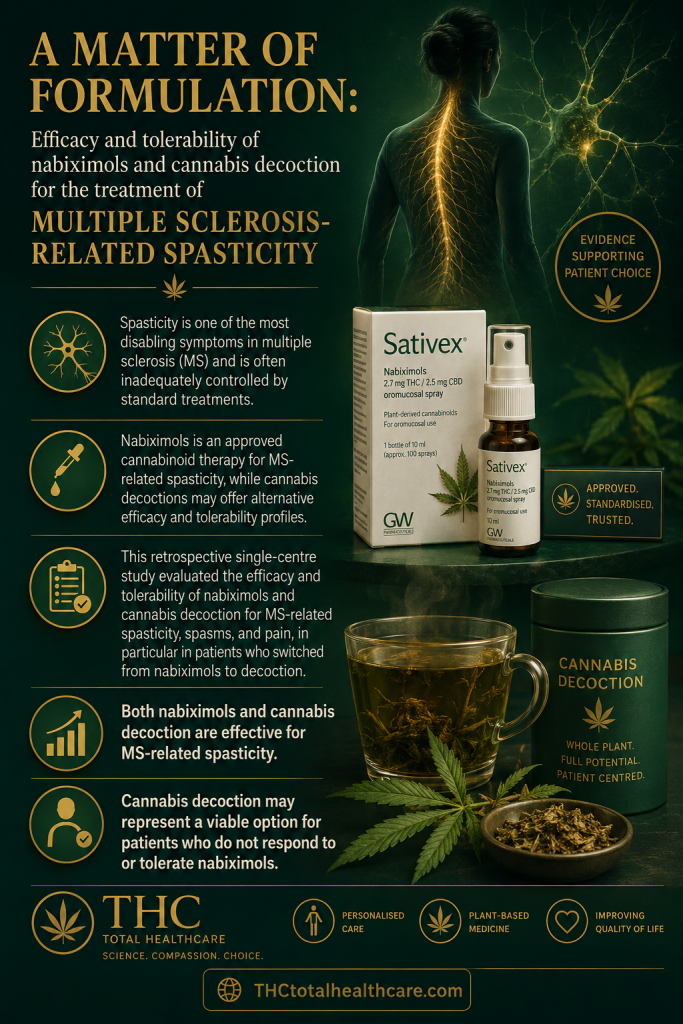
Cannabinoid medicines are used to help manage multiple sclerosis-related spasticity, but formulation can influence both effectiveness and tolerability. In this study, both nabiximols and cannabis decoction were effective for MS-related spasticity, while cannabis decoction may represent a viable option for patients who do not respond to or tolerate nabiximols.
“Background: Spasticity is one of the most disabling symptoms in multiple sclerosis (MS) and is often inadequately controlled by standard treatments. Nabiximols is an approved cannabinoid therapy for MS-related spasticity, while cannabis decoctions may offer alternative efficacy and tolerability profiles.
Methods: This retrospective single-centre study evaluated the efficacy and tolerability of nabiximols and cannabis decoction for MS-related spasticity, spasms, and pain, in particular in patients who switched from nabiximols to decoction. Patients initiating nabiximols between 2013 and 2024 were included. Modified Ashworth Scale (mAS), Numerical Rating Scale (NRS) for spasticity and pain, and Penn Spasm Frequency Scale (PSFS) were assessed at baseline and follow-up. Efficacy was analysed using within-group and mixed-model approaches, and Cox regression evaluated discontinuation risk.
Results: Sixty-three patients were included; 39 (61.9%) discontinued nabiximols and 14 switched to cannabis decoction. Both treatments significantly improved spasticity, spasms, and pain. In switchers, cannabis decoction led to significant improvements across all outcomes. Nabiximols showed a higher, though not statistically significant, discontinuation rate, with adverse effects reported in 27.0% versus 14.3% for cannabis decoction. Longer disease duration was associated with discontinuation due to inefficacy, while tetraspasticity predicted switching to cannabis decoction.
Conclusions: Both nabiximols and cannabis decoction are effective for MS-related spasticity. Cannabis decoction may represent a viable option for patients who do not respond to or tolerate nabiximols. Differences in cannabinoid composition and pharmacokinetics may explain variations in outcomes. Prospective studies are needed to confirm these findings and optimize treatment strategies.”
https://pubmed.ncbi.nlm.nih.gov/42594706
https://www.msard-journal.com/article/S2211-0348(26)00463-3/abstract