
Hemp seed is increasingly being incorporated into everyday foods as a way to improve nutritional value while creating new plant-based products.
In this study, researchers added hemp seed ingredients to pasta and evaluated how the enrichment affected its nutritional composition, texture, cooking characteristics and overall quality.
The findings show how hemp seed can be used to enhance conventional foods while maintaining properties important for consumer acceptance.
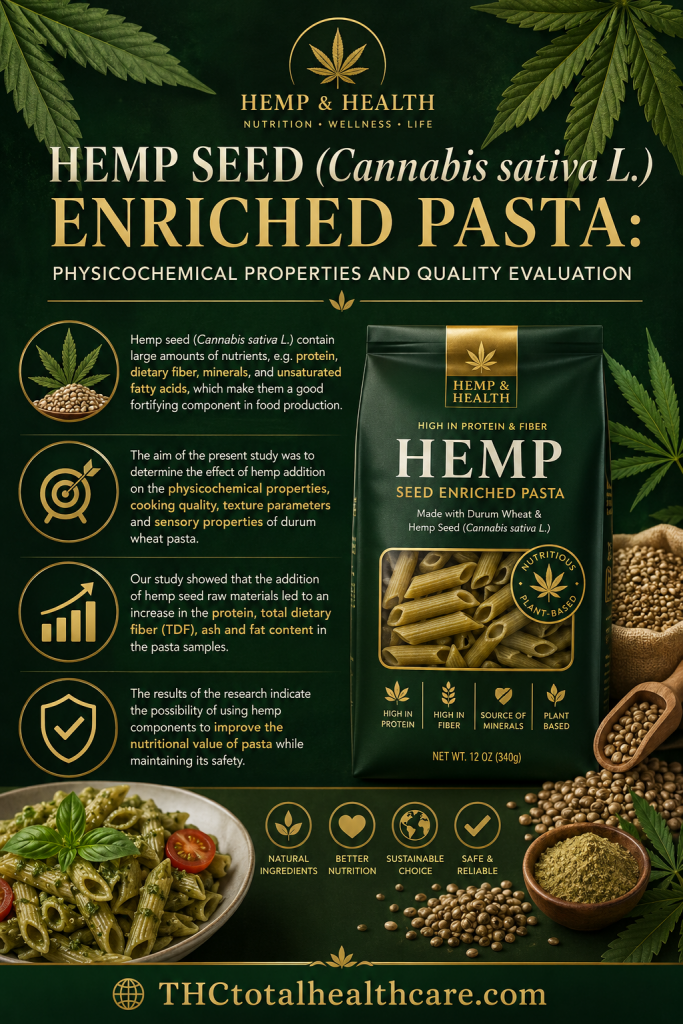
“Hemp seed (Cannabis sativa L.) contain large amounts of nutrients, e.g. protein, dietary fiber, minerals, and unsaturated fatty acids, which make them a good fortifying component in food production.
The aim of the present study was to determine the effect of hemp addition on the physicochemical properties, cooking quality, texture parameters and sensory properties of durum wheat pasta. The samples were fortified with 5-40% of commercially available hemp flour or 2.5-10% of hemp cake obtained from hemp seed oil pressing.
Our study showed that the addition of hemp seed raw materials led to an increase in the protein, total dietary fiber (TDF), ash and fat content in the pasta samples.
Due to its lower granulation and higher nutritional value, hemp flour was found to be a better raw material for the fortification of pasta than hemp cake. Pasta enriched with hemp flour at the level of 30-40% contains 19.53-28.87% d.m. of protein and 17.02-21.49% d.m. of TDF and according to the EU, a definition can be described as a high-protein and high-fiber products.
All enriched pasta samples were also characterized by safe Δ-9-tetrahydrocannabinol (THC) and cannabidiol (CBD) content, and their sensory properties were accepted by consumers.”
https://pubmed.ncbi.nlm.nih.gov/33735229
“Consumers are looking for new plant-based raw materials that could be a good source of protein. One of the high-protein raw materials, which is increasingly becoming part of a healthy balanced human diet is hemp (Cannabis sativa L.).”
“Hemp seeds are a rich source of nutrients.”
“The results of the research indicate the possibility of using hemp components to improve the nutritional value of pasta while maintaining its safety.
Both hemp raw materials allow enriching pasta with protein, dietary fiber, mainly its insoluble fraction and minerals.
Pasta with 30% addition of hemp flour can be described as a high-protein and high-fiber product and at the same time characterized by satisfactory organoleptic properties and good cooking qualities.”
https://journals.plos.org/plosone/article?id=10.1371/journal.pone.0248790