
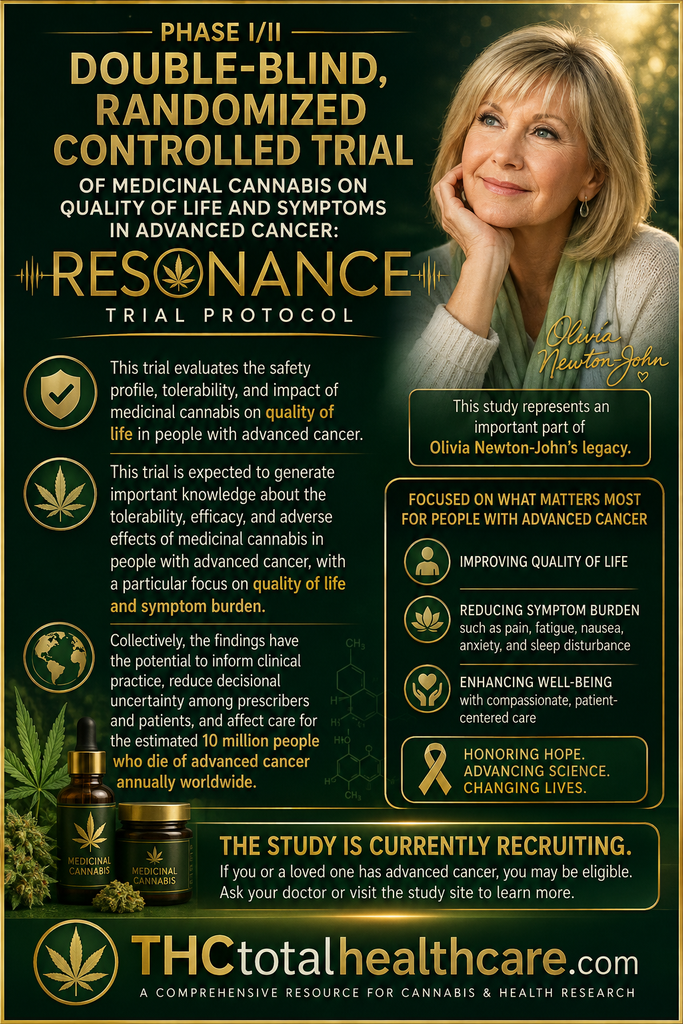
This study represents an important part of Olivia Newton-John’s legacy.
After experiencing medicinal cannabis personally during her long cancer journey, Olivia became an outspoken advocate not only for patient access, but for the scientific research needed to determine what cannabis could—and could not—do for people living with cancer.
The Olivia Newton-John Cancer Research Institute later stated that Olivia’s own experience with medicinal cannabis and her interest in pursuing the science behind its use in cancer helped lead the Institute to undertake its first medicinal-cannabis clinical trial.
That work developed into the RESONANCE trial, a Phase I/II double-blind, randomized controlled study examining medicinal cannabis in people with advanced cancer. The study is investigating its effects on quality of life and symptoms including pain, nausea, appetite loss, anxiety and sleep problems, as well as safety and how cannabinoids are metabolized by the body. The study protocol was published in Clinical Therapeutics in 2026.
Olivia repeatedly made clear that her personal experience was not enough. She wanted the science. She wanted researchers to investigate the benefits she believed she had experienced and determine whether other cancer patients could benefit as well.
The study is currently recruiting
As of August 2026, the RESONANCE trial is listed as open and recruiting in Victoria, Australia.
Potential participants may be eligible if they:
- are 18 years of age or older;
- have advanced cancer; and
- have an estimated life expectancy of at least two months.
Additional inclusion and exclusion requirements apply, and final eligibility must be determined by the study team.
Two-thirds of participants receive medicinal cannabis and one-third receive placebo. Both are administered as an oral oil, beginning once daily and increasing, when appropriate, to a maximum of three times per day. Dosing is increased until symptoms are adequately controlled and is then maintained for up to one month. Participants provide blood samples and complete questionnaires, and researchers may also invite a participant’s caregiver to take part in aspects of the study.
After completion of the trial period, participants may be able to obtain medicinal cannabis through compassionate access.
Clinical trial registration: ACTRN12619001534178.
Interested in participating?
People interested in the trial should discuss participation with their doctor and contact the research center to determine whether they meet the complete eligibility requirements. Peter MacCallum Cancer Centre currently lists the study as open and recruiting and directs prospective participants to the full Australian clinical-trial registry criteria.
Dr. Jodie Palmer
Olivia Newton-John Cancer Research Institute
Level 5, ONJWRC
145 Studley Road
Heidelberg, Victoria 3084, Australia
Phone: +61 3 9496 3573
Email: trials@onjcri.org.au
Olivia spent the final years of her life asking that medicinal cannabis be taken seriously enough to study scientifically. She believed her own experience raised questions worth answering.
This study is part of the scientific legacy she helped set in motion.
“Purpose: Medicinal cannabis is increasingly used in cancer care despite limited high-quality evidence to inform practice. It is increasingly legalized around the world; however, this has outpaced high-quality research on cancer symptom outcomes, leading to patient and prescriber uncertainty. This trial evaluates the safety profile, tolerability, and impact of medicinal cannabis on quality of life in advanced cancer.
Methods: This is a Phase I/II multicenter clinical trial. The Phase I component is open-label and aims to determine the safety profile and tolerability of medicinal cannabis use by evaluating clinical outcomes and pharmacokinetic profile. The Phase II component is a double-blind, randomized clinical trial that aims to determine the impact of medicinal cannabis on quality of life and symptom control (pain, anorexia, anxiety, sleep, nausea, treatment satisfaction, toxicity, and caregiver burden) using validated instruments in people with advanced cancer.
Findings & implications: This trial is expected to generate important knowledge about the tolerability, efficacy, and adverse effects of medicinal cannabis in people with advanced cancer, with a particular focus on quality of life and symptom burden. Protocol adaptations aimed at enhancing inclusivity may be worth noting in future studies. Collectively, the findings have the potential to inform clinical practice, reduce decisional uncertainty among prescribers and patients, and affect care for the estimated 10 million people who die of advanced cancer annually worldwide. Australian New Zealand Clinical Trials Registry identifier: ACTRN12619001534178.”
https://pubmed.ncbi.nlm.nih.gov/42476829
https://www.clinicaltherapeutics.com/article/S0149-2918(26)00233-X/fulltext