
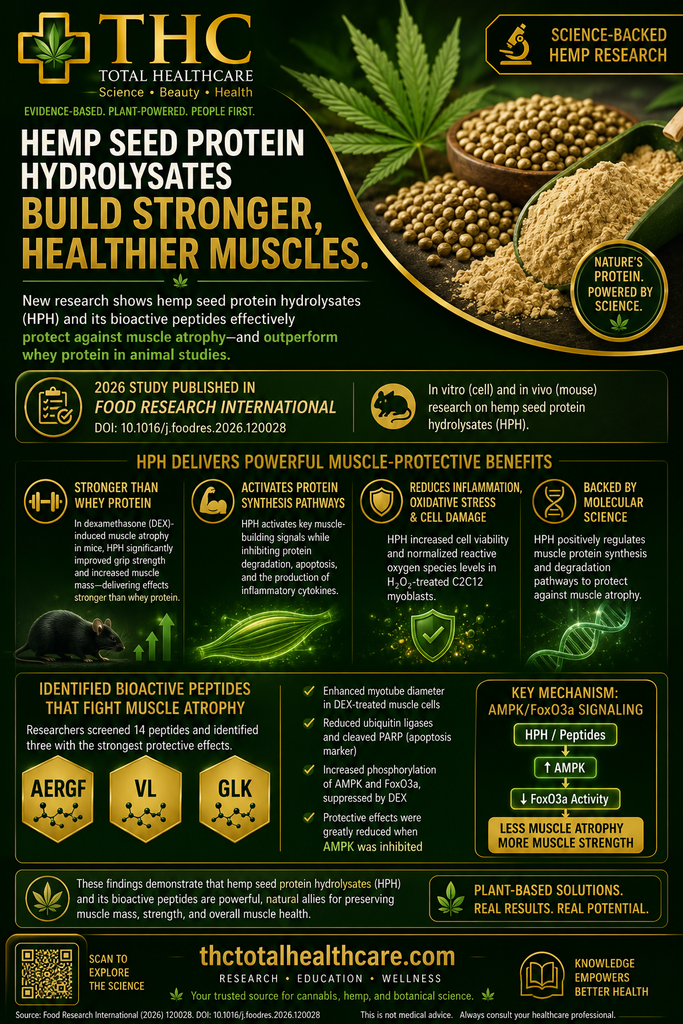
Hemp is increasingly being studied not just as a source of plant protein, but as a source of biologically active compounds that may influence muscle health. In this new study, researchers found that hemp seed protein hydrolysates helped protect against muscle atrophy in both cell and animal models, improving grip strength and muscle mass while also influencing pathways involved in protein synthesis, degradation, inflammation, and apoptosis.
The researchers also identified three bioactive peptides—AERGF, VL, and GLK—that showed particularly strong anti-atrophy effects, with evidence pointing to AMPK/FoxO3a signaling as an important part of their activity. Notably, the hemp protein hydrolysates produced stronger effects than whey protein in the mouse model, highlighting hemp seed as a potentially valuable source of functional proteins and bioactive peptides for future muscle-health research.
“We recently demonstrated that hemp seed protein hydrolysates (HPH), produced through enzymatic hydrolysis, protect against muscle atrophy in both in vitro and in vivo models.
This study aimed to optimize the HPH production method and elucidate its mechanism of action in preventing muscle atrophy, including the identification of bioactive peptides within HPH.
To optimize HPH production, we compared the degree of protein hydrolysis using alcalase and flavourzyme, both individually and in combination. Ultimately, we produced HPH by treating it with 2% flavourzyme for 2 h.
Our results showed that HPH increased cell viability and normalized reactive oxygen species levels in H2O2-treated C2C12 myoblasts. In a mouse model of muscle atrophy induced by dexamethasone (DEX), HPH improved grip strength and increased muscle mass, demonstrating effects stronger than those of whey protein. Immunoblotting analysis indicated that HPH activates protein synthesis pathways while inhibiting protein degradation, apoptosis, and the production of inflammatory cytokines in skeletal muscle. Additionally, we analyzed the peptide composition of HPH and investigated the anti-atrophic effects of specific peptides in C2C12 myotubes.
Among fourteen peptide candidates, peptides AERGF, VL, and GLK showed the most significant effects on enhancing myotube diameter and reducing the expression of ubiquitin ligases and cleaved PARP in DEX-treated C2C12 myotubes. These peptides also increased the phosphorylation of AMPK and FoxO3a, which were reduced by DEX. Notably, their protective effects against myotube atrophy diminished when the cells were co-treated with an AMPK inhibitor.
These findings demonstrate that HPH and its bioactive peptides effectively mitigate DEX-induced muscle atrophy by positively regulating muscle protein synthesis and degradation pathways.”
https://pubmed.ncbi.nlm.nih.gov/42680322
https://www.sciencedirect.com/science/article/abs/pii/S0963996926017126?via%3Dihub