
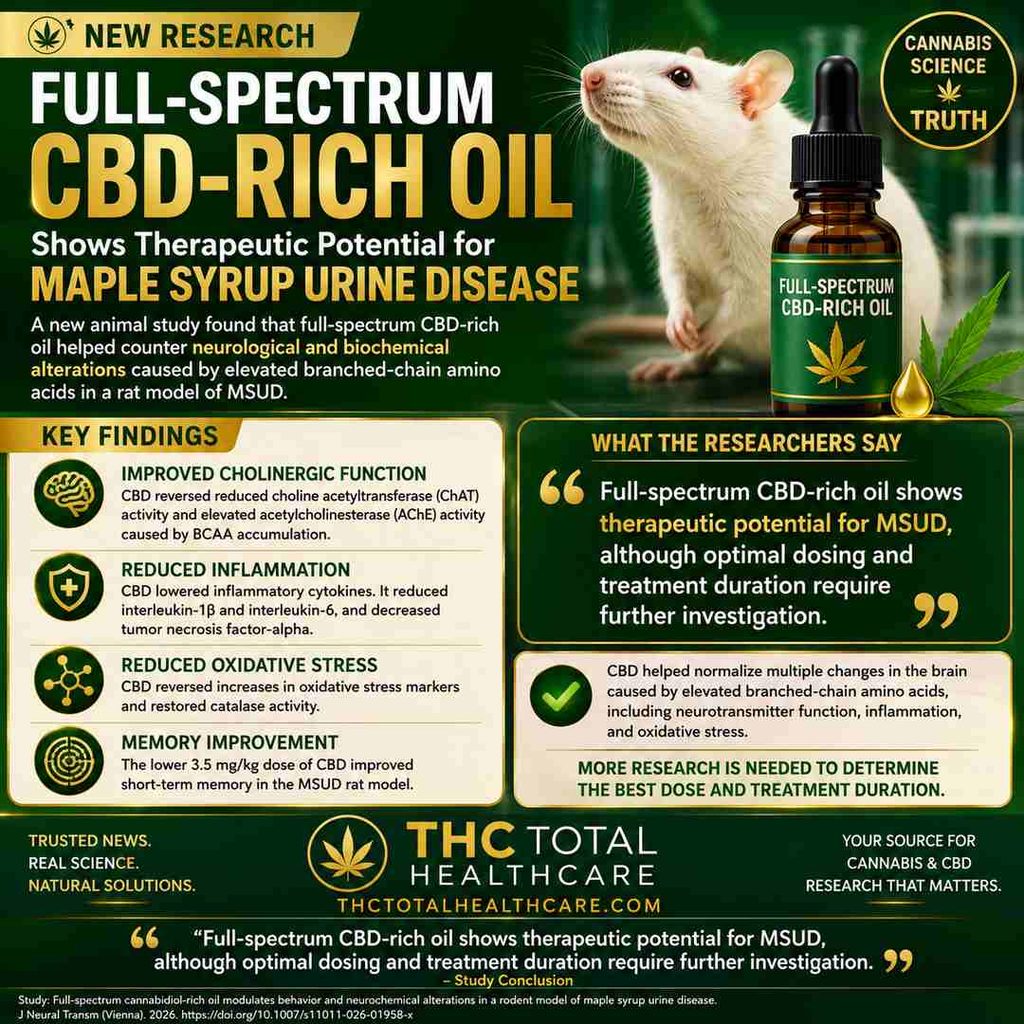
A new animal study suggests that full-spectrum CBD-rich oil may help protect the brain from some of the neurological effects associated with Maple Syrup Urine Disease. In rats, CBD treatment reduced inflammation and oxidative stress, improved cholinergic function, and at the lower dose improved short-term memory.
The researchers concluded that full-spectrum CBD-rich oil shows therapeutic potential for MSUD, although more research is needed to determine the best dose and treatment duration.
“Maple Syrup Urine Disease (MSUD) is caused by a genetic mutation in the branched-chain α-ketoacid dehydrogenase complex, resulting to accumulation of branched-chain amino acids (BCAAs) that affect the central nervous system and cause neurochemical alterations and behavioral changes.
In this line, full-spectrum cannabidiol (CBD)-rich oil has emerged as a potential therapeutic strategy. Therefore, this study aims to evaluate the effects of two doses of the compound full-spectrum CBD-rich oil in a BCAA-induced MSUD rat model, against behavioral, cholinergic, inflammatory, and oxidative stress parameters.
For this, animals were divided into six groups: control group, CBD 3.5 mg/kg group, CBD 7.5 mg/kg group, BCAA group, BCAA + CBD 3.5 mg/kg group, and BCAA + CBD 7.5 mg/kg group. The treatment was administered over 21 days; after that, the animals were subjected to open-field and object recognition tests. Next, we extracted the cerebral cortex to analyze cholinergic function, inflammation, and oxidative stress.
The results show that the open-field test revealed no differences in crossings and rearings across all groups. In object recognition test, control and CBD 3.5 groups showed improved short- and long-term memory compared to training. The CBD 7.5 and BCAA + CBD 3.5 groups showed improvement only in short-term memory. BCAA control and BCAA + 7.5 did not present differences.
In the cholinergic system, BCAA control showed decreased choline acetyltransferase (ChAT) activity, which was reversed by CBD treatment at both doses. The BCAA + CBD 7.5 shows increased ChAT activity compared to control group. While acetylcholinesterase (AChE) was reduced in the CBD 7.5 groups and increased in the BCAA control group, both CBDs reversed this increase in BCAA control group.
Inflammatory cytokines show increased interleukin-1β in BCAA control group, and the CBD treatment decreases its levels compared to BCAA and saline control groups. Interleukin-6 increases in BCAA control group, and CBD 3.5 reverses it. Tumoral necrosis factor-alpha was reduced in BCAA + CBD 3.5 and BCAA + CBD 7.5 compared to control and BCAA control groups.
Further, under oxidative stress, BCAA control increases 2,7-dichlorofluorescein oxidation and thiobarbituric acid levels, which were reversed by CBD treatment. Sulfhydryl content was decreased in CBD 7.5, BCAA control group, BCAA + CBD 3.5, and BCAA + CBD 7.5 compared to control group. Superoxide dismutase activity increased across all groups, whereas catalase activity decreased in the BCAA control group; treatment with CBD 7.5 reversed this reduction.
Overall, we conclude that full-spectrum CBD-rich oil shows therapeutic potential for MSUD, although optimal dosing and treatment duration require further investigation.”
https://pubmed.ncbi.nlm.nih.gov/42690466
“Cannabis-based products have emerged as a new class of drugs with potential therapeutic effects across a broad range of neurodegenerative and psychiatric disorders.”
“In summary, full-spectrum CBD-rich oil produced significant neurochemical benefits in neonatal MSUD model, including modulation of cholinergic enzymes, reduction of oxidative stress, and attenuation of inflammatory cytokines.”
https://link.springer.com/article/10.1007/s11011-026-01958-x