
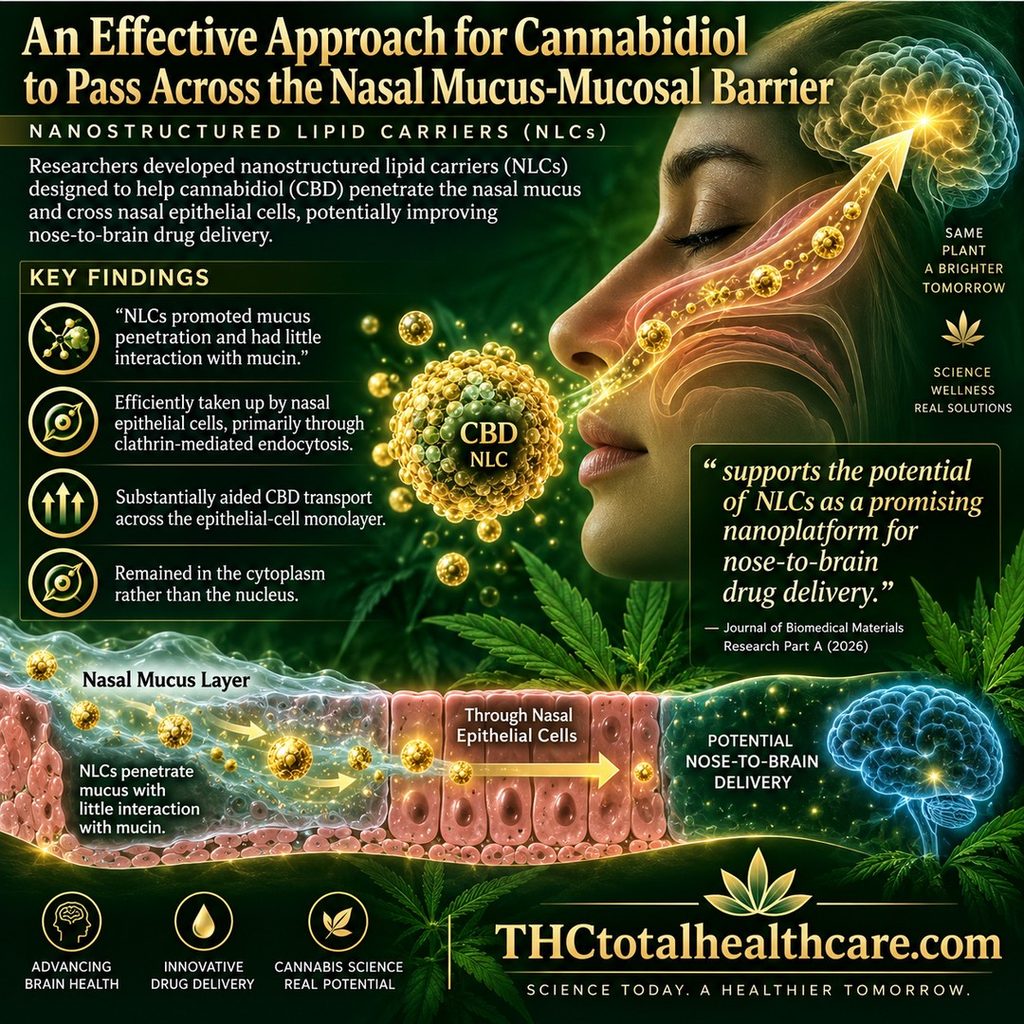
Researchers developed nanostructured lipid carriers designed to help cannabidiol (CBD) penetrate the nasal mucus and cross nasal epithelial cells, potentially improving nose-to-brain drug delivery. In laboratory experiments using rat nasal mucosal epithelial cells, the carriers showed little interaction with mucin, promoted mucus penetration, were efficiently taken up by cells, and improved CBD transport across the cell layer. The findings support mucus-penetrating lipid nanoparticles as a promising delivery platform for getting CBD across the nasal mucus-mucosal barrier and potentially toward the brain.
“Effective nose-to-brain delivery is limited by the mucus-mucosal barrier, which severely hinders drug transport after nasal administration. Although nanostructured lipid carriers (NLCs) offer promising solutions by improving their retention duration in the mucosal layer or promoting mucosal permeation and intracellular uptake, the nanoparticle-mucus interactions, epithelial uptake, and mechanisms supporting transcellular transport in the nasal cavity remain poorly learned.
This study was developed to assess the interactions between mucin and NLCs, the absorption and transport capabilities of Cannabidiol (CBD) nanostructured lipid carriers (CBD-NLCs) in rat nasal mucosal epithelial (RNME) cells.
Molecular docking (MD) was used to evaluate the interactions between the human mucin protein MUC5AC (hMUC5AC) and some main components of CBD-NLCs. In vitro experiments were conducted to assess the mucus penetration of CBD-NLCs. Cellular uptake, localization, and transport mechanisms of coumarin-6-labeled NLCs (C6-NLCs) in RNME cells were examined by confocal laser scanning microscopy, endocytosis inhibition assays, and transcellular transport assays.
Our results show that there were no interactions between the main components of NLCs and hMUC5AC according to MD simulations. In vitro experiments, NLCs promoted mucus penetration and had little interaction with mucin. Cellular studies confirmed cytoplasmic (non-nuclear) localization of C6-NLCs in RNME cells, and transport assays showed that the clathrin-mediated endocytic route was a predominant pathway for their internalization. When across the RNME cell monolayer, NLCs had a great benefit on CBD transportation across monolayers of RNME cells.
Our results clarify the mechanism by which NLCs enhance mucosal penetration and facilitate cellular trafficking in RNME cells. Their little interaction with mucin, combined with efficient cellular uptake and transcellular transport, supports the potential of NLCs as a promising nanoplatform for nose-to-brain drug delivery.”