
Severe traumatic brain injury can sometimes lead to paroxysmal sympathetic hyperactivity, a difficult-to-control syndrome marked by episodes of rapid heart rate, high blood pressure, fever, sweating, and abnormal muscle activity. This case report describes the use of cannabidiol as an adjunct treatment in a patient whose symptoms remained refractory to conventional therapy. Following CBD administration, the authors reported improvement in the frequency and severity of sympathetic episodes, suggesting a possible role for cannabinoid-based therapy in managing this serious complication of brain injury. Because the evidence comes from a single patient, the finding is preliminary, but it provides a basis for further clinical investigation.
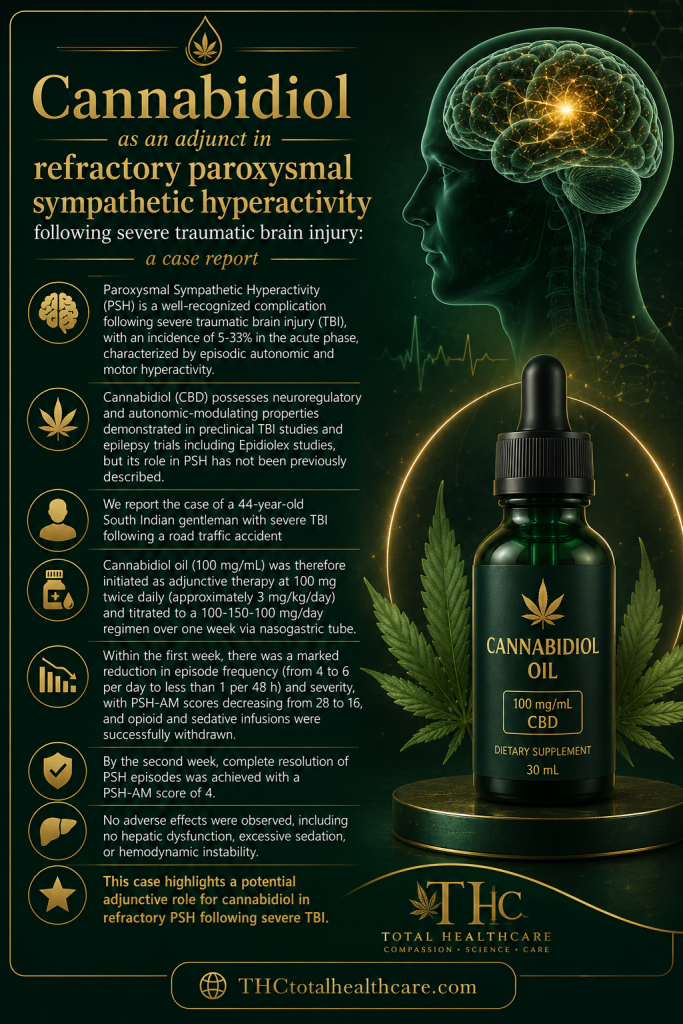
“Background: Paroxysmal Sympathetic Hyperactivity (PSH) is a well-recognized complication following severe traumatic brain injury (TBI), with an incidence of 5-33% in the acute phase, characterized by episodic autonomic and motor hyperactivity. Management is often challenging, and a subset of patients develop refractory PSH despite optimized first- and second-line therapies. Cannabidiol (CBD) possesses neuroregulatory and autonomic-modulating properties demonstrated in preclinical TBI studies and epilepsy trials including Epidiolex studies, but its role in PSH has not been previously described.
Case presentation: We report the case of a 44-year-old South Indian gentleman with severe TBI following a road traffic accident (GCS 5: E1V1M3) with CT brain showing bilateral frontotemporo-parietal acute subdural hematoma with mass effect. He underwent emergency bilateral decompressive craniectomy and required mechanical ventilation with tracheostomy. Three weeks post-injury, he developed recurrent PSH episodes (4-6 episodes per day) characterized by severe tachycardia (heart rate 140-180 bpm), hypertension (systolic blood pressure > 180 mmHg), hyperthermia (up to 40 °C), diaphoresis, and dystonic posturing. The diagnosis of PSH was established using the Paroxysmal Sympathetic Hyperactivity Assessment Measure (PSH-AM), with a total score of 28 (Clinical Feature Scale: 18, Diagnosis Likelihood Tool: 10), indicating probable PSH. Infective, metabolic, epileptic, and structural causes were excluded. Despite treatment with multiple conventional agents at maximum tolerated doses-including bromocriptine (titrated from 1.25 mg twice daily to 40 mg/day), baclofen (10 mg/day), gabapentin (titrated from 150 mg/day to 300 mg/day), propranolol (15 mg three times daily), clonidine (0.2 mg/day), dexmedetomidine infusion (72-h infusion), and fentanyl (infusion followed by patches)-the autonomic storms persisted, fulfilling criteria for refractory PSH.
Cannabidiol oil (100 mg/mL) was therefore initiated as adjunctive therapy at 100 mg twice daily (approximately 3 mg/kg/day) and titrated to a 100-150-100 mg/day regimen over one week via nasogastric tube. Within the first week, there was a marked reduction in episode frequency (from 4 to 6 per day to less than 1 per 48 h) and severity, with PSH-AM scores decreasing from 28 (CFS: 18, DLT: 10) to 16 (CFS: 6, DLT: 10), and opioid and sedative infusions were successfully withdrawn. By the second week, complete resolution of PSH episodes was achieved with a PSH-AM score of 4. No adverse effects were observed, including no hepatic dysfunction, excessive sedation, or hemodynamic instability.
Conclusions: This case highlights a potential adjunctive role for cannabidiol in refractory PSH following severe TBI. While causality cannot be inferred from a single observation, the sustained clinical improvement after failure of conventional therapies warrants further prospective investigation.”
https://pubmed.ncbi.nlm.nih.gov/42366387
https://link.springer.com/article/10.1186/s13256-026-06284-5