
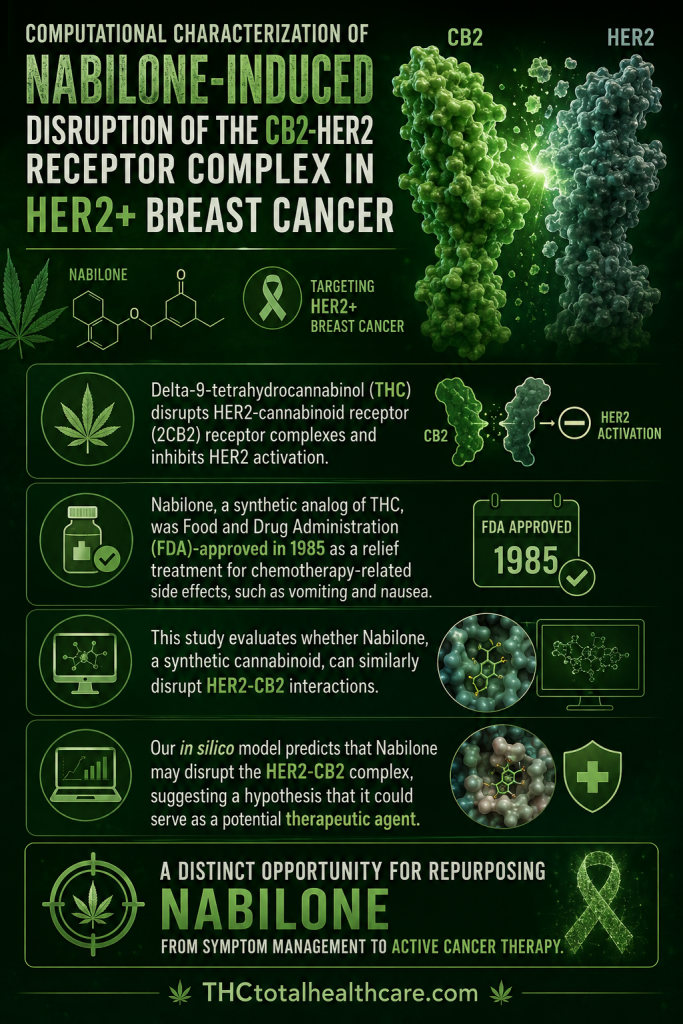
“Human epidermal growth factor receptor 2-positive (HER2+) breast cancer, accounting for 15% to 20% of cases, is often resistant to treatment.
Delta-9-tetrahydrocannabinol (THC) disrupts HER2-cannabinoid receptor (2CB2) receptor complexes and inhibits HER2 activation.
This study evaluates whether Nabilone, a synthetic cannabinoid, can similarly disrupt HER2-CB2 interactions.
A CB2-HER2 complex model was generated via protein-protein docking. Three 1-µs molecular dynamics simulations (CB2-HER2, CB2-HER2-THC, CB2-HER2-Nabilone) were performed using the Schrodinger Desmond with membrane embedding and solvent. Structural stability (root mean square deviation [RMSD] and root mean square fluctuation [RMSF]), binding free energy (molecular mechanics/generalized born surface area [MM/GBSA]), and intracellular/extracellular distances between receptors were analyzed. Intermolecular interactions were assessed using the MAPIYA server.
Nabilone induced comparable structural instability to THC, with increased RMSD and RMSF. The MM/GBSA analysis showed Nabilone increased the binding free energy between CB2 and HER2, indicating stronger disruption. Intracellular and extracellular distances between CB2 and HER2 increased, especially intracellularly, with Nabilone. Intermolecular interaction analysis revealed that Nabilone decreased the number of contacts, particularly hydrophobic interactions, between CB2 and HER2.
Our in silico model predicts that Nabilone may disrupt the HER2-CB2 complex, suggesting a hypothesis that it could serve as a potential therapeutic agent. These computational findings warrant urgent experimental validation.”
https://pubmed.ncbi.nlm.nih.gov/42164472
“Cannabinoids have produced antitumor responses in preclinical models of cancer, including HER2+ BC, via binding and activating cannabinoid receptors, CB1 and CB2, both G-protein coupled receptors (GPCRs).”
“Nabilone, a synthetic analog of THC, was Food and Drug Administration (FDA)-approved in 1985 as a relief treatment for chemotherapy-related side effects, such as vomiting and nausea.”
“Our results indicate that Nabilone effectively disrupts the oncogenic CB2-HER2 complex, weakening the heterodimer interface through a mechanism of structural instability similar to THC but with superior binding affinity to CB2. While these findings rely on in silico predictions, limited by simulation timescales and simplified membrane models, they highlight a distinct opportunity for repurposing Nabilone from symptom management to active cancer therapy. We conclude that these data provide a robust theoretical framework that justifies urgent experimental validation in living systems to confirm the therapeutic potential of disrupting CB2-HER2 signaling.”