
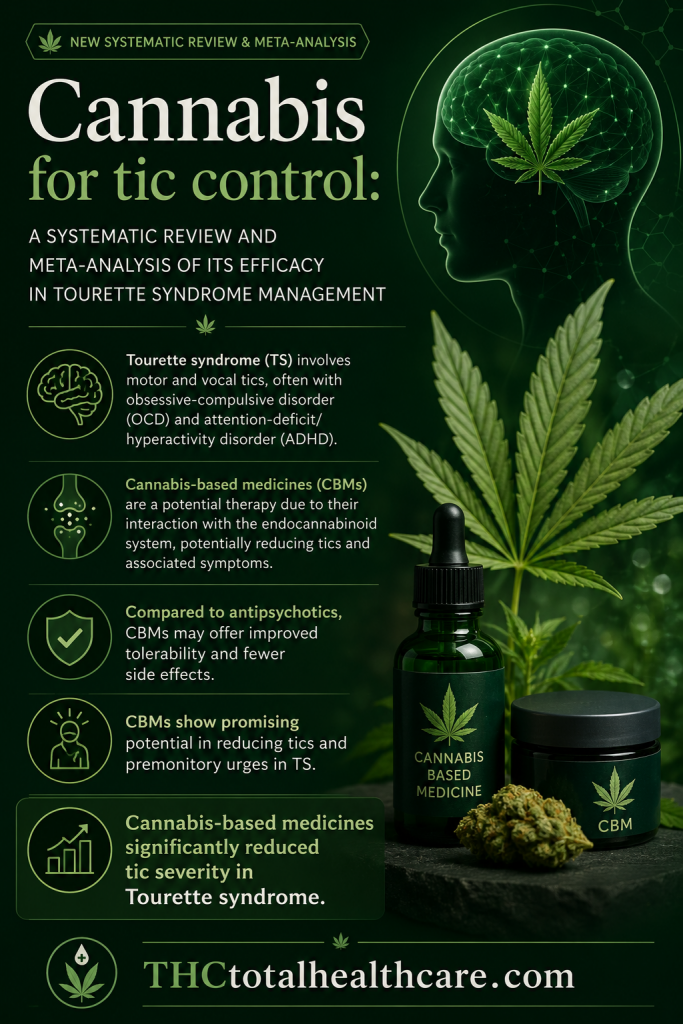
“Background: Tourette syndrome (TS) involves motor and vocal tics, often with obsessive-compulsive disorder (OCD) and attention-deficit/hyperactivity disorder (ADHD). Cannabis-based medicines (CBMs) are a potential therapy due to their interaction with the endocannabinoid system, potentially reducing tics and associated symptoms. Compared to antipsychotics, CBMs may offer improved tolerability and fewer side effects. Although evidence is limited, emerging studies suggest their potential to improve quality of life in TS. This review was registered with PROSPERO (CRD420251088633).
Aim: To evaluate the effectiveness of CBMs in treating TS.
Methods: We systematically searched PubMed, Google Scholar, ScienceDirect, and the Cochrane Collaboration Database for cohort studies and randomized controlled trials (RCTs) up to July 2, 2025. Data extraction included study characteristics and efficacy outcomes measured by the Yale Global Tic Severity Scale (YGTSS) and Premonitory Urge for Tics Scale (PUTS). Meta-analysis using Review Manager 5.4 compared pre- and post-treatment scores using mean difference (MD) and 95% confidence intervals (CI).
Results: From 1,105 screened articles, eight studies met inclusion criteria for the review, and seven were included in the meta-analysis, involving 306 adult TS patients. CBMs significantly reduced YGTSS scores (MD = – 13.29, 95% CI [-21.67 to – 4.91], P = 0.002) and PUTS scores (MD = – 4.09, 95% CI [-7.24 to – 0.93], P = 0.01).
Conclusion: CBMs show promising potential in reducing tics and premonitory urges in TS. Larger, placebo-controlled trials are needed to confirm efficacy, ensure safety, and optimize dosing.”
https://pubmed.ncbi.nlm.nih.gov/42229830
“Cannabis-based medicines significantly reduced tic severity in Tourette syndrome.”
https://www.ibroneuroscience.org/article/S0306-4522(26)00367-2/abstract