
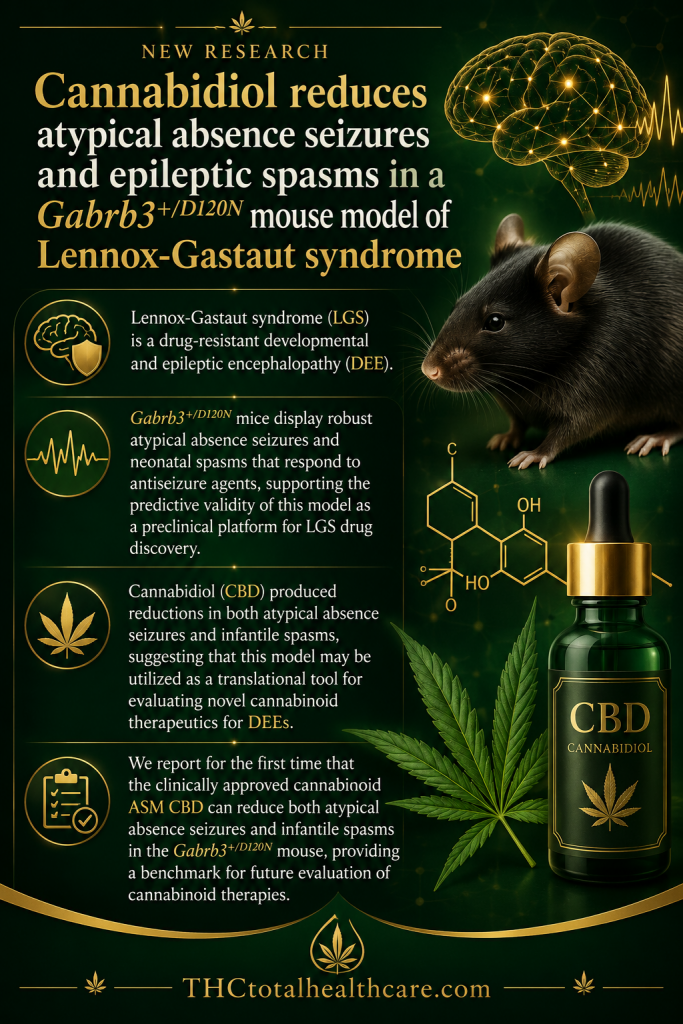
“Objective: Lennox-Gastaut syndrome (LGS) is a drug-resistant developmental and epileptic encephalopathy (DEE). Preclinical drug development for LGS is constrained by a lack of syndrome-relevant animal models. We aimed to evaluate a Gabrb3+/D120N knock-in (KI) mouse model of LGS by quantifying atypical absence seizures and epileptic spasms and assessing their sensitivity to antiseizure agents.
Methods: Video-EEG recordings of adult (10-week-old) KI and wild-type (WT) littermates were scored for atypical absence seizures, and the acute effects of ethosuximide (200 mg/kg), ulixacaltamide (60 mg/kg), and cannabidiol (CBD, 100 mg/kg) on seizure incidence and duration were evaluated using a within-subjects, crossover design. Video recordings of postnatal day 16 (P16) KI and WT littermates were scored for epileptic spasms, and the effects of once-daily dosing with vigabatrin (100 mg/kg) and CBD (100 mg/kg) from P13 to P15 were evaluated against vehicle.
Results: Adult KI but not WT mice exhibited spontaneous atypical absence seizures. CBD, ethosuximide, and ulixacaltamide reduced seizure incidence and duration. Epileptic spasms were more frequent in KI than in WT mice at P16. CBD and vigabatrin significantly reduced spasm frequency compared to the vehicle.
Significance: Gabrb3+/D120N mice display robust atypical absence seizures and neonatal spasms that respond to antiseizure agents, supporting the predictive validity of this model as a preclinical platform for LGS drug discovery. CBD produced reductions in both atypical absence seizures and infantile spasms, suggesting that this model may be utilized as a translational tool for evaluating novel cannabinoid therapeutics for DEEs.
Plain language summary: Lennox-Gastaut syndrome (LGS) is a rare type of epilepsy that’s hard to treat and poses a challenge for developing new drugs. Finding suitable animal models that accurately represent LGS is crucial. This article describes the development of a mouse model of LGS with a genetic mutation that increases seizures and epileptic spasms. We tested how different antiseizure drugs affect the mice. CBD, ethosuximide, and ulixacaltamide reduced seizure incidence and duration. CBD and vigabatrin also reduced spasm frequency in young mice. These promising results suggest the mouse model could be a valuable tool for drug discovery in LGS.”
https://pubmed.ncbi.nlm.nih.gov/42274296
“We report for the first time that the clinically approved cannabinoid ASM CBD can reduce both atypical absence seizures and infantile spasms in the Gabrb3+/D120N mouse, providing a benchmark for future evaluation of cannabinoid therapies.”