
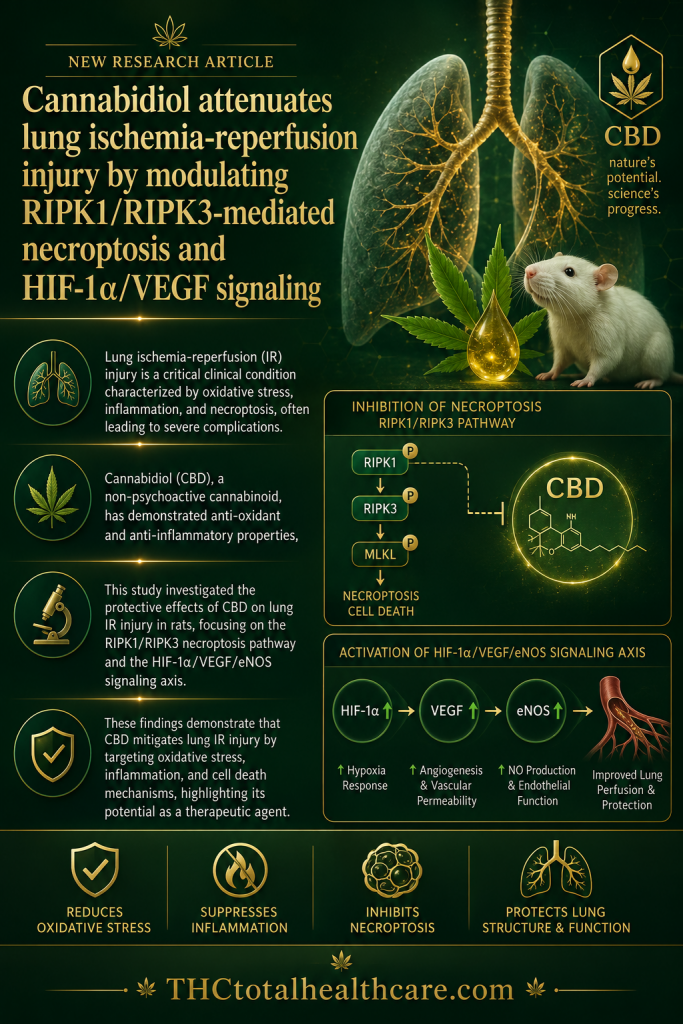
“Objectives: Lung ischemia-reperfusion (IR) injury is a critical clinical condition characterized by oxidative stress, inflammation, and necroptosis, often leading to severe complications. Cannabidiol (CBD), a non-psychoactive cannabinoid, has demonstrated anti-oxidant and anti-inflammatory properties, but its role in modulating lung IR injury remains incompletely understood. This study investigated the protective effects of CBD on lung IR injury in rats, focusing on the RIPK1/RIPK3 necroptosis pathway and the HIF-1α/VEGF/eNOS signaling axis.
Materials and methods: Forty male Wistar albino rats were randomized into four groups: control, IR, IR+CBD (5 mg/kg), and CBD-only. Histopathological, immunohistochemical (TNF-α, Caspase-3), biochemical (TOS, TAS, OSI), and gene expression (RIPK1, RIPK3, HIF-1α, VEGF, eNOS) analyses were performed. The IR group exhibited significant oxidative stress, inflammation, and tissue damage, with elevated TNF-α, caspase-3, TOS, OSI, and necroptosis/apoptosis markers.
Results: CBD treatment markedly attenuated these effects, reducing oxidative stress (↑TAS, ↓TOS/OSI), suppressing inflammation (↓TNF-α), and inhibiting both apoptotic (↓Caspase-3) and necroptotic (↓RIPK1/RIPK3) pathways. Additionally, CBD down-regulated HIF-1α/VEGF/eNOS expression, suggesting modulation of hypoxia-responsive signaling.
Conclusion: These findings demonstrate that CBD mitigates lung IR injury by targeting oxidative stress, inflammation, and cell death mechanisms, highlighting its potential as a therapeutic agent. Further preclinical and clinical studies are warranted to validate these results.”