
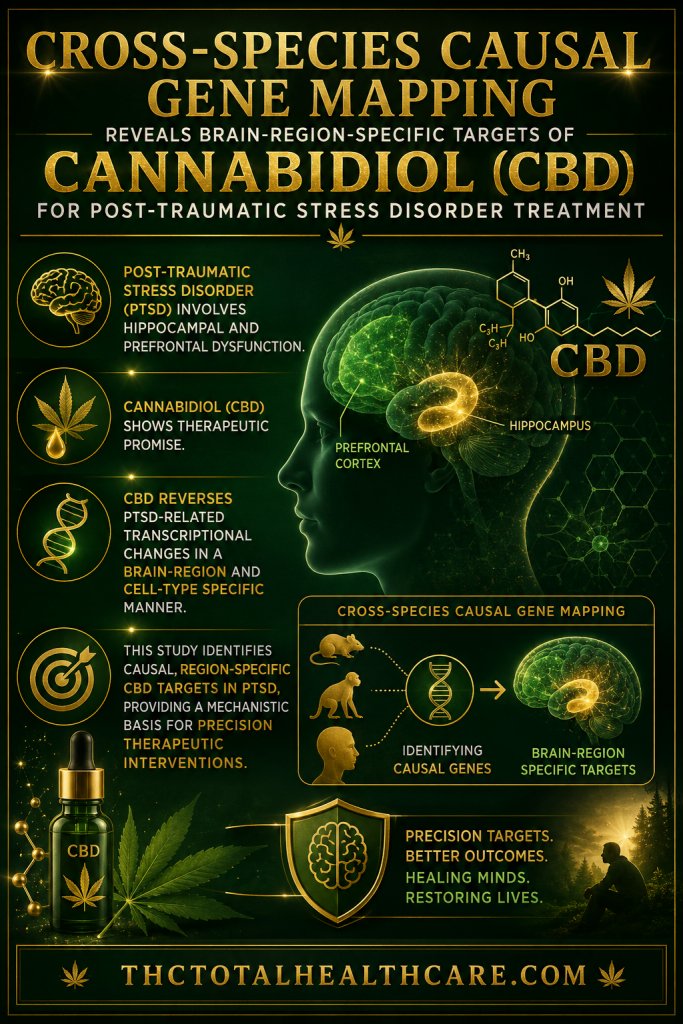
“Purpose: Post-traumatic stress disorder (PTSD) involves hippocampal and prefrontal dysfunction. Cannabidiol (CBD) shows therapeutic promise, but its cell-type-specific and causal mechanisms remain unclear.
Methods: We performed single-cell RNA sequencing of hippocampal and prefrontal cortices from PTSD mice, healthy controls, and CBD-treated PTSD mice. Genes dysregulated in PTSD and reversed by CBD were integrated with human PTSD GWAS and brain eQTL datasets using summary-data-based Mendelian randomization (SMR) to identify causal risk targets. Molecular docking assessed direct CBD-protein interactions.
Results: PTSD induced extensive transcriptional alterations, most prominent in excitatory neurons. SMR analysis identified 15 potential causal risk genes linked to PTSD. Among these, 7 high-confidence targets were confirmed to be transcriptionally responsive to CBD treatment. In the hippocampus, key causal targets included LYNX1 (OR = 0.75, 95% CI: 0.57-0.98, P = 0.038), RAB3C (OR = 1.291, 95% CI: 1.052-1.584, P = 0.015), MAGI2 (OR = 1.15, 95% CI: 1.00-1.31, P = 0.048), LINGO2 (OR = 1.48, 95% CI: 1.07-2.03, P = 0.017), and UNC5D (OR = 1.41, 95% CI: 1.03-1.93, P = 0.032). In the prefrontal cortex, identified targets were CNTN3 (OR = 0.78, 95% CI: 0.62-0.98, P = 0.036), IGSF21 (OR = 1.22, 95% CI: 1.04-1.42, P = 0.012). While SEPTIN3 (OR = 1.25, 95% CI: 1.01-1.56, P = 0.043) was identified as a causal risk gene, its expression was not reversed by CBD. Molecular docking indicated that all 15 SMR-identified candidates possess strong binding affinity to CBD, including RAB3C (-8.636 kcal/mol), CNTN3 (-7.216 kcal/mol), and LINGO2 (-6.222 kcal/mol), which suggests a direct pharmacological interaction.
Conclusion: This study identifies causal, region-specific CBD targets in PTSD, providing a mechanistic basis for precision therapeutic interventions.”
https://pubmed.ncbi.nlm.nih.gov/42542041
“CBD reverses PTSD-related transcriptional changes in a brain-region and cell-type specific manner.”
https://www.sciencedirect.com/science/article/abs/pii/S0006291X26011113?via%3Dihub