
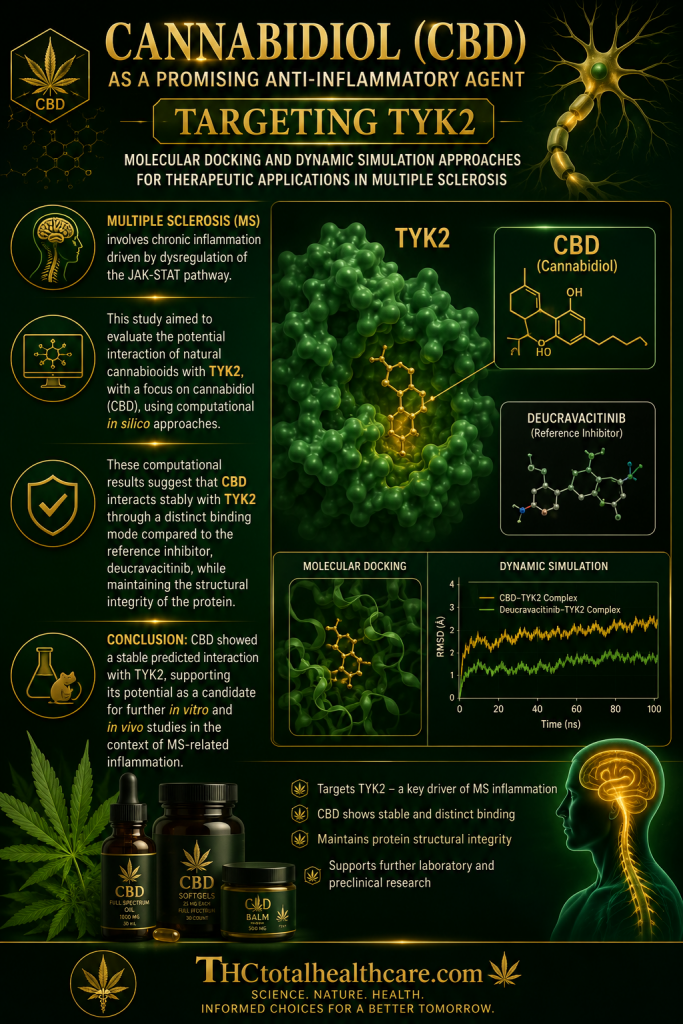
“Introduction: Multiple sclerosis (MS) involves chronic inflammation driven by dysregulation of the JAK-STAT pathway. This study aimed to evaluate the potential interaction of natural cannabinoids with TYK2, with a focus on cannabidiol (CBD), using computational in silico approaches.
Methods: A combined molecular docking and molecular dynamics (MD) workflow was used. Cannabinoid ligands and the TYK2 structure (JH2 domain) were prepared and docked in MOE, followed by 20 ns MD simulations under NVT and NPT conditions in GROMACS. Complex stability and ligand-protein interactions were analysed.
Results: CBD showed a competitive docking score (-7.31 kcal/mol) and a refined RMSD of 0.9198 Å. MD simulations revealed a stable CBD-TYK2 complex, with RMSD fluctuations of 0.15-0.20 nm, which were lower than those observed for the reference inhibitor, deucravacitinib. RMSF analysis revealed a slight increase in local flexibility in specific regions without affecting the overall stability of the protein. The radius of gyration remained stable throughout the simulation, indicating that the protein’s compactness was preserved. Hydrogen bond analysis showed fewer but transient interactions for CBD, consistent with a binding mode dominated by hydrophobic interactions.
Discussion: These computational results suggest that CBD interacts stably with TYK2 through a distinct binding mode compared to the reference inhibitor, deucravacitinib, while maintaining the structural integrity of the protein.
Conclusion: CBD showed a stable predicted interaction with TYK2, supporting its potential as a candidate for further in vitro and in vivo studies in the context of MS-related inflammation.”