
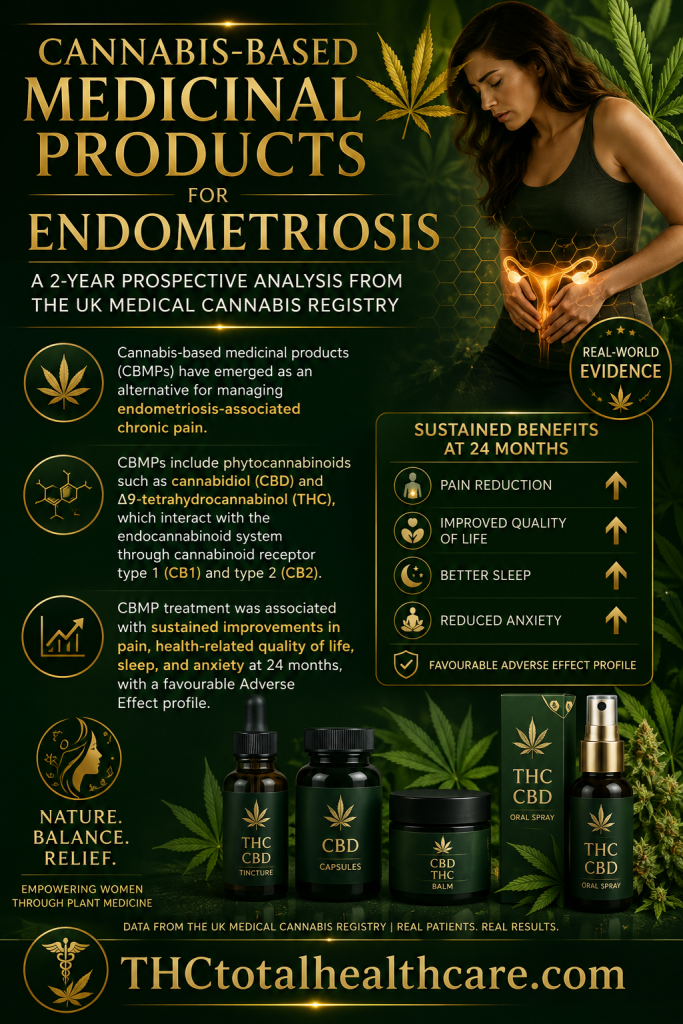
“Background: Endometriosis affects up to 10% of biological females of reproductive age. Current treatment options are limited and often unsuitable for prolonged use. Cannabis-based medicinal products (CBMPs) have emerged as an alternative for pain management.
Aims: To analyse changes in patient-reported outcome measures (PrOMs), prescribed opioid burden, and the prevalence of adverse events (AEs) in patients prescribed CBMPs for endometriosis-associated pain.
Materials and methods: This was an observational analysis of prospectively collected data from the UK Medical Cannabis Registry. Biological females (≥ 18 years) with a primary diagnosis of endometriosis, enrolled ≥ 2 years prior to data extraction on 06/01/2025, were included. PrOMs and prescribed oral morphine equivalents (OME) were assessed between baseline and 1, 3, 6, 12, 18, and 24 months. Changes from baseline were assessed by repeated-measures ANOVA and Bonferroni-adjusted post hoc pairwise t-tests. p < 0.050 was considered statistically significant.
Results: One hundred and one patients were included. Improvements from baseline were observed in BPI Severity, BPI Interference, SF-MPQ-2 Total, Pain VAS, EQ-5D-5L Index, GAD-7, and SQS at all follow-ups (p < 0.001). Mean prescribed OME decreased from 19.9 ± 17.2 mg/day at baseline to 14.8 ± 15.9 mg/day at 24 months. Eighteen participants (17.8%) reported 165 AEs, of which 84 (50.9%) were mild. The most frequent were fatigue (n = 16; 15.8%), lethargy (n = 15; 14.9%), and headache (n = 13; 12.9%).
Conclusion: CBMP treatment was associated with sustained improvements in pain, health-related quality of life, sleep, and anxiety at 24 months, with a favourable AE profile. Randomised controlled trials are required to establish efficacy and safety.”
https://pubmed.ncbi.nlm.nih.gov/42576801
“Cannabis-based medicinal products (CBMPs) have emerged as an alternative for managing endometriosis-associated chronic pain.
CBMPs include phytocannabinoids such as cannabidiol (CBD) and Δ9-tetrahydrocannabinol (THC), which interact with the endocannabinoid system through cannabinoid receptor type 1 (CB1) and type 2 (CB2).
Anandamide, an endogenous cannabinoid, binds to these receptors to modulate pain. THC is a partial agonist of CB1 and CB2, while CBD increases anandamide by inhibiting its breakdown.”