
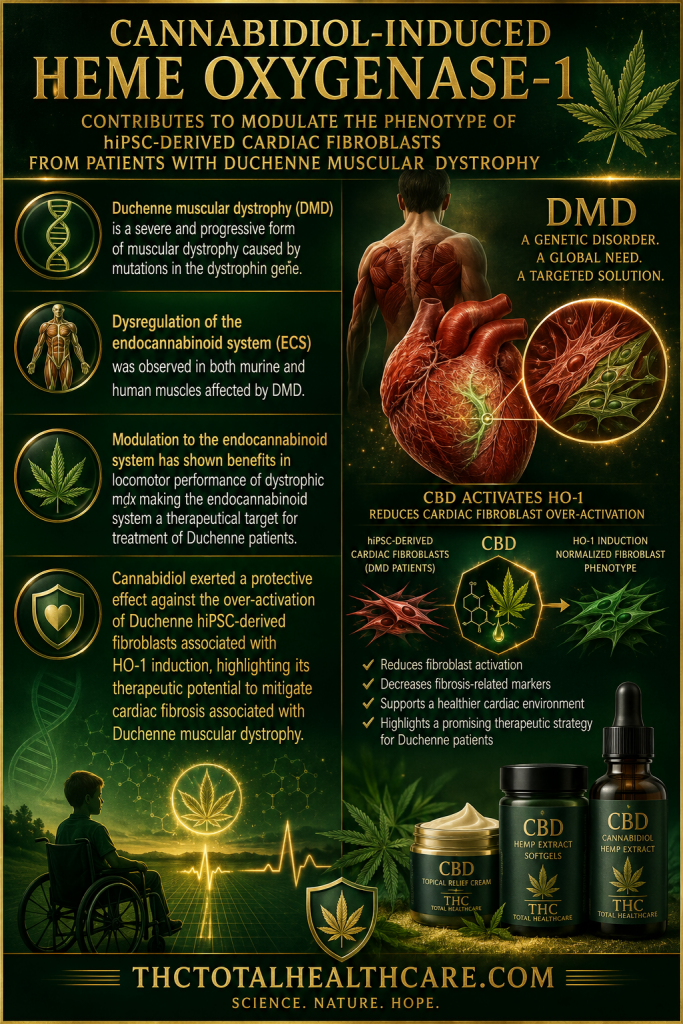
“Duchenne muscular dystrophy (DMD) is a severe and progressive form of muscular dystrophy caused by mutations in the dystrophin gene. We previously observed that loss of dystrophin in human induced pluripotent stem cell-derived cardiac fibroblasts (hiPSC-cFib) dysregulated the actin network and induced a metabolic remodeling associated with an exacerbated myofibroblast phenotype.
The endocannabinoid signaling (ECS) system plays an important role in chronic inflammatory and fibrotic conditions and is dysregulated in skeletal muscle of DMD patients. Here, we investigated the effects of cannabidiol (CBD) on hiPSC-cFib from healthy controls and DMD patients.
CBD failed to modify metabolic responses in DMD hiPSC-cFib, while significantly promoting glycolysis and cell proliferation in control hiPSC-cFib. Despite these distinct metabolic responses, CBD significantly attenuated TGF-β-induced myofibroblast activation in both DMD and control hiPSC-cFib by lowering α-smooth muscle actin and collagen type I levels suggesting a metabolism-independent mechanism.
Additionally, CBD exerted strong antioxidant effects on both DMD and control hiPSC-cFib, markedly reducing intracellular reactive oxygen species (ROS) levels, increasing GSH levels and robustly inducing heme oxygenase-1 (HO-1) expression in a time- and dose-dependent manner which could not be mimicked by CB1R or CB2R agonists and blocked by their antagonists.
Pharmacological inhibition of HO-1 blunted CBD’s ability to suppress TGF-β-induced activation of DMD and control hiPSC-cFib, demonstrating that HO-1 is a key mediator of CBD’s anti-fibrotic action.
Together, these findings showed stimulation of glycolytic metabolism by CBD, regulation which is lost in DMD hiPSC-cFib. We uncovered a previously unrecognized HO-1-dependent pathway by which CBD dampens profibrotic activation in human DMD and control hiPSC-cFib, highlighting its potential as a therapeutic approach to limit cardiac fibrosis in Duchenne muscular dystrophy.”
https://pubmed.ncbi.nlm.nih.gov/42579928
“Dysregulation of the endocannabinoid system (ECS) was observed in both murine and human muscles affected by DMD.”
“Modulation to the endocannabinoid system has shown benefits in locomotor performance of dystrophic mdx making the endocannabinoid system a therapeutical target for treatment of Duchenne patients.”
“Cannabidiol exerted a protective effect against the over-activation of Duchenne hiPSC-derived fibroblasts associated with HO-1 induction, highlighting its therapeutic potential to mitigate cardiac fibrosis associated with Duchenne muscular dystrophy.”
https://www.sciencedirect.com/science/article/pii/S2213231726003320?via%3Dihub