
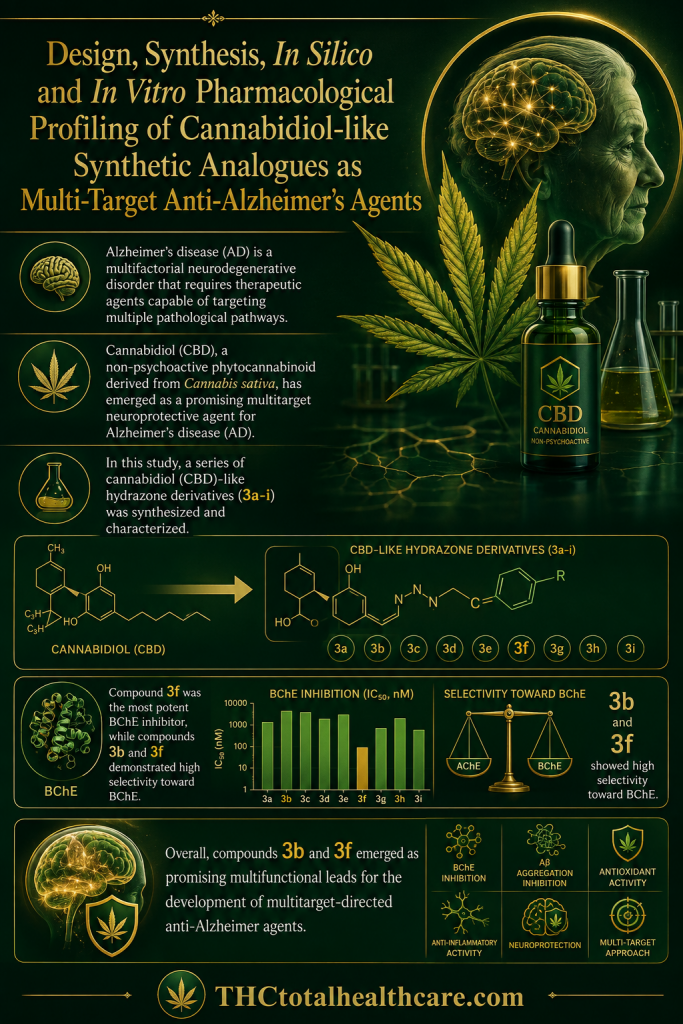
“Alzheimer’s disease (AD) is a multifactorial neurodegenerative disorder that requires therapeutic agents capable of targeting multiple pathological pathways.
In this study, a series of cannabidiol (CBD)-like hydrazone derivatives (3a–i) was synthesized and characterized by NMR, HRMS, and single-crystal X-ray diffraction for compound 3i.
In silico ADME analysis predicted favorable drug-like properties, including compliance with Lipinski’s Rule of Five, oral bioavailability, and blood-brain barrier permeability. The compounds were evaluated for cholinesterase inhibition, antioxidant activity, cytotoxicity in neuronal cell lines, and binding interactions with human butyrylcholinesterase (hBChE) by molecular docking. Biological evaluation revealed a marked preference for BChE over acetylcholinesterase (AChE).
Compound 3f was the most potent BChE inhibitor (IC50 = 1.67 ± 0.11 μM), while compounds 3b and 3f demonstrated high selectivity toward BChE. Antioxidant assays (DPPH, ABTS, FRAP, and FTC) indicated moderate, mechanism-dependent activity. Compounds 3b and 3e showed the strongest ABTS radical-scavenging effects, whereas compounds 3b and 3f provided the greatest protection against lipid peroxidation, surpassing CBD under the tested conditions. Several derivatives, particularly 3a, 3b, 3f, 3h, and 3i, exhibited favorable safety profiles in SH-SY5Y and Neuro-2a cells. Molecular docking supported the experimental findings.
Overall, compounds 3b and 3f emerged as promising multifunctional leads for the development of multitarget-directed anti-Alzheimer agents.”
https://pubmed.ncbi.nlm.nih.gov/42588505
“Cannabidiol (CBD), a non-psychoactive phytocannabinoid derived from Cannabis sativa, has emerged as a promising multitarget neuroprotective agent for Alzheimer’s disease (AD).”