
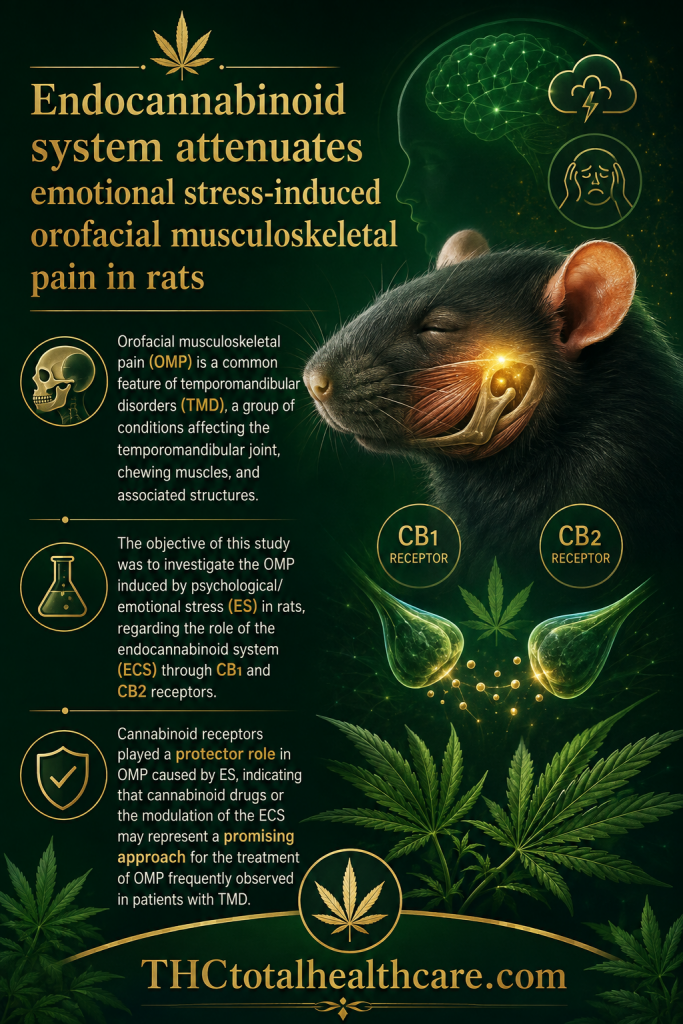
“Orofacial musculoskeletal pain (OMP) is a common feature of temporomandibular disorders (TMD), a group of conditions affecting the temporomandibular joint, chewing muscles, and associated structures.
The etiology of muscular TMD is currently understood within a biopsychosocial model of pain, highlighting the complexity related to OMP. In this context, the objective of this study was to investigate the OMP induced by psychological/emotional stress (ES) in rats, regarding the role of the endocannabinoid system (ECS) through CB1 and CB2 receptors.
Male Wistar rats were divided into Control and ES groups. OMP was induced by ES using the communication box model and evaluated through the mechanical threshold in masticatory muscles. c-Fos, CB1, and CB2 immunostaining was evaluated in the trigeminal ganglion (TG) and in the trigeminal nucleus caudalis (Sp5C). The selective CB1 or CB2 antagonist (AM251 or AM630, respectively) or the cannabinoid receptor non-selective agonist (WIN55,212-2) were administered to both groups, and the OMP was evaluated. The mechanical sensitivity of the masticatory muscles increased in the ES group, accompanied by increased c-Fos expression in the TG and Sp5C. AM251 and AM630 increased mechanical sensitivity, while WIN55,212-2 decreased the OMP. Furthermore, ES increased CB1 density in the TG and elevated both CB1 and CB2 in the Sp5C. Additionally, CB2 was increased in the masseter muscle.
Thus, cannabinoid receptors played a protector role in OMP caused by ES, indicating that cannabinoid drugs or the modulation of the ECS may represent a promising approach for the treatment of OMP frequently observed in patients with TMD.”
https://pubmed.ncbi.nlm.nih.gov/42585375
https://www.scielo.br/j/bjmbr/a/DHTkCSCk5bcNGJrbWcb67Jz/?lang=en