
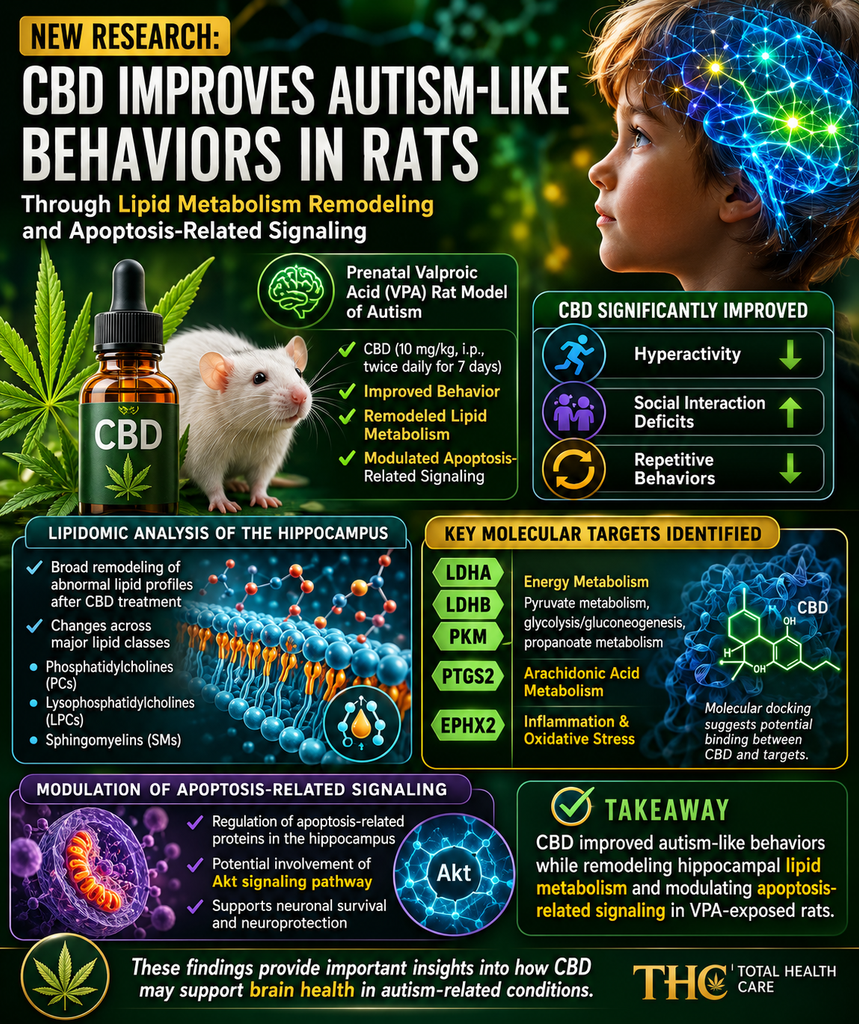
“Background: Cannabidiol (CBD) has shown potential benefits in managing symptoms associated with autism spectrum disorder (ASD), although its underlying mechanisms of action remain unclear. This study investigated whether CBD improves ASD-like behavior in association with changes in lipid metabolic disturbances and apoptosis-related signaling in a prenatal valproic acid (VPA) rat model.
Methods: Male offspring from VPA-exposed rats received CBD (10 mg/kg, intraperitoneal, twice daily) for 7 days starting on postnatal day 21. Behavioral testing evaluated hyperactivity, social interaction, and repetitive behaviors. Hippocampal lipid profiles were quantified by UPLC-MS/MS. Candidate mechanisms were examined through a joint pathway analysis integrating lipidomics with curated target information, followed by targeted gene/protein validation (qPCR, Western blotting) and molecular docking.
Results: CBD treatment improved VPA-induced hyperactivity and repetitive behaviors and social interaction deficits. Lipidomics demonstrated remodeling of hippocampal lipid abnormalities after CBD treatment, with changes across major classes, including phosphatidylcholines, lysophosphatidylcholines, and sphingomyelins. Joint pathway analysis pinpointed potential targets-LDHA, LDHB, PKM, PTGS2, and EPHX2-linked to energy-related pathways (pyruvate metabolism, glycolysis/gluconeogenesis, propanoate metabolism) and arachidonic acid metabolism. CBD also modulated apoptosis-related protein dysregulation, with potential involvement of Akt-related signaling. Docking results suggested possible binding between CBD and the selected targets.
Conclusion: These results suggest that CBD improves ASD-like behaviors alongside hippocampal lipid metabolism remodeling and modulation of apoptosis-related signaling in VPA-exposed rats, providing preliminary insights into potential mechanisms underlying the effects of CBD in ASD models.”
https://pubmed.ncbi.nlm.nih.gov/42632396
“CBD improved ASD-like behaviors in VPA-induced rats.”
https://www.sciencedirect.com/science/article/abs/pii/S0165178126004658?via%3Dihub