
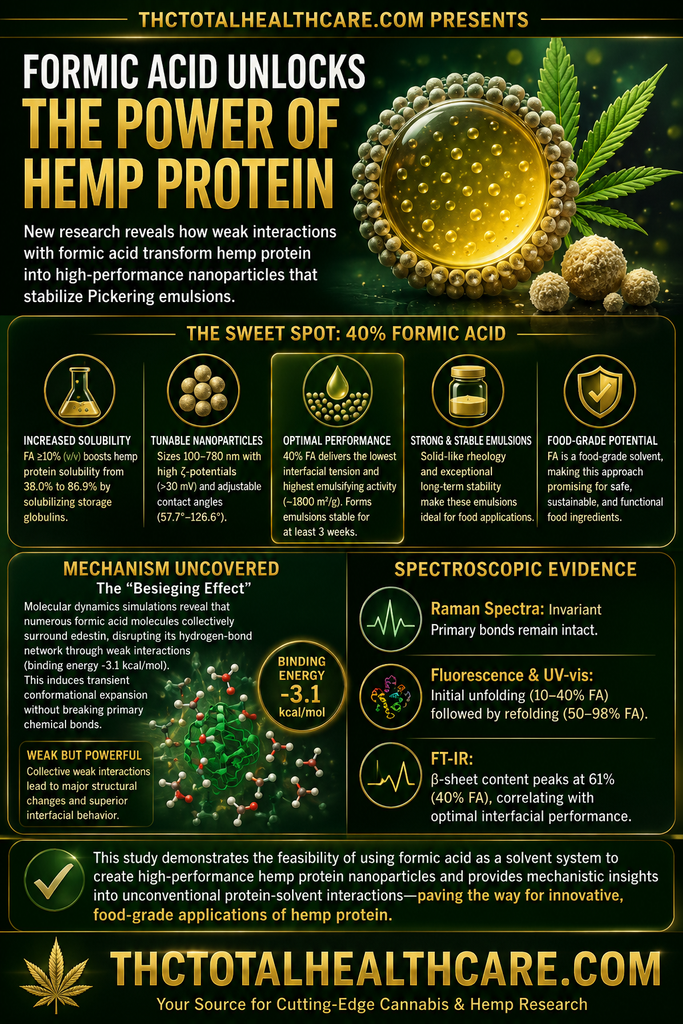
“Anti-solvent precipitation using formic acid (FA, 0-98%, v/v) was developed to fabricate hemp protein nanoparticles (HPNs) for Pickering emulsion stabilization.
FA ≥10% (v/v) increased hemp protein solubility from 38.0% to 86.9% by solubilizing storage globulins, yielding HPNs with tunable sizes (100-780 nm), high ζ-potentials (>30 mV), and adjustable contact angles (57.7°-126.6°).
HPNs prepared at 40% FA exhibited optimal interfacial properties, including the lowest interfacial tension and highest emulsifying activity index (∼1800 m2/g), forming Pickering emulsions with 3-week stability and solid-like rheology.
Spectroscopic analysis revealed concentration-dependent conformational changes: invariant Raman spectra confirmed intact primary bonds, while fluorescence and UV-vis indicated initial unfolding (10-40%) followed by refolding (50-98%), and FT-IR showed that β-sheet content peaked at 61% (40% FA), which correlated with optimal interfacial performance.
Molecular dynamics simulations elucidated a dynamic “besieging effect” where numerous FA molecules collectively disrupted edestin’s hydrogen-bond network via weak interactions (binding energy -3.1 kcal/mol), inducing transient conformational expansion.
This work demonstrates the feasibility of FA as a solvent system for hemp protein nanoparticle fabrication and provides mechanistic insights into unconventional protein-solvent interactions, offering a foundation for future food-grade applications.”
https://pubmed.ncbi.nlm.nih.gov/42637338
“Tunable hemp protein nanoparticles with adjustable wettability are fabricated for Pickering emulsion stabilization.”
https://www.sciencedirect.com/science/article/abs/pii/S096399692601865X?via%3Dihub