
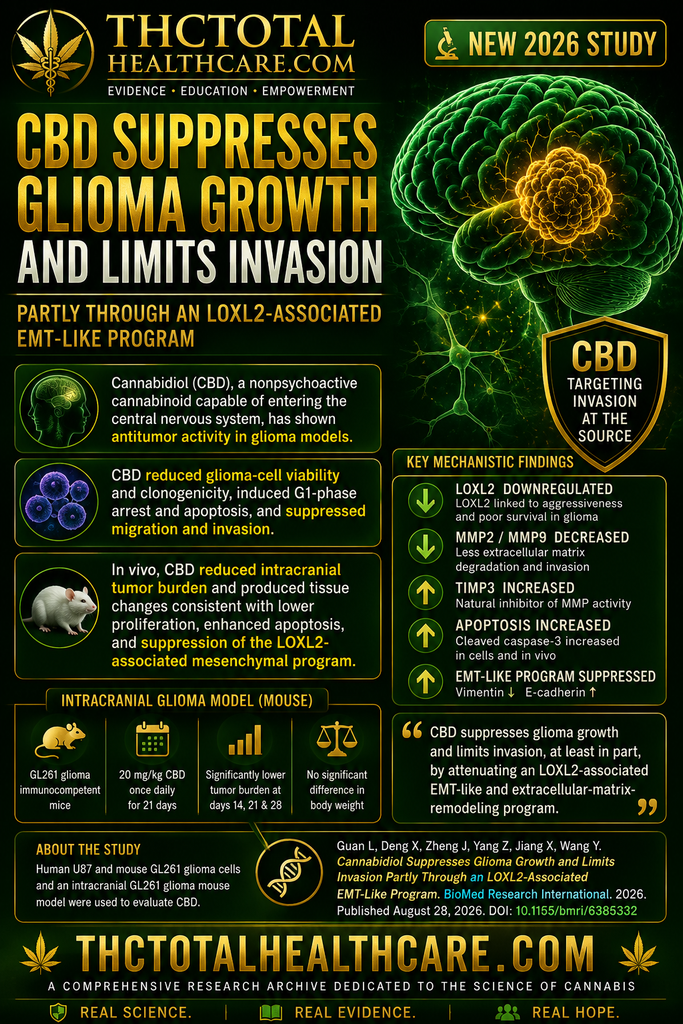
A new 2026 study found that cannabidiol (CBD) suppressed glioma growth and reduced tumor-cell migration and invasion in laboratory and animal models. The researchers linked part of this effect to reduced LOXL2 activity, suggesting CBD may interfere with molecular programs that help glioma cells spread into surrounding brain tissue.
The study adds new mechanistic evidence to the growing body of research examining CBD as a potential therapeutic compound in glioma and glioblastoma.
“Background: Gliomas, particularly glioblastoma, remain difficult to control because diffuse infiltration into surrounding brain tissue limits complete resection and contributes to recurrence. Cannabidiol (CBD), a nonpsychoactive cannabinoid capable of entering the central nervous system, has shown antitumor activity in glioma models, but the mechanisms underlying its anti-invasive effects remain unclear. Lysyl oxidase-like 2 (LOXL2) regulates extracellular-matrix remodeling and mesenchymal phenotypes in several cancers. We therefore tested the hypothesis that CBD limits glioma growth and invasion partly by suppressing an LOXL2-associated extracellular-matrix and EMT-like program.
Methods: Human U87 and murine GL261 glioma cells were used to examine CBD effects on tetrazolium-based cell viability, clonogenic growth, cell-cycle progression, apoptosis, migration, and invasion. The two cell lines provided complementary human and murine models, and the immunocompetent intracranial GL261 model enabled syngeneic in vivo validation. RNA sequencing and public glioma datasets were used to identify and contextualize CBD-responsive molecules. Mechanistic involvement was tested by determining whether LOXL2 knockdown phenocopied and LOXL2 overexpression attenuated the anti-invasive effects of CBD.
Results: CBD reduced glioma-cell viability and clonogenicity, induced G1-phase arrest and apoptosis, and suppressed migration and invasion. C CCK-8-derived IC50 values (mean ± SD, n = 3) at 24, 48, and 72 h were 36.5 ± 0.3, 26.7 ± 0.3, and 21.4 ± 0.3 μM in U87 cells and 33.3 ± 0.2, 29.3 ± 0.2, and 25.5 ± 0.4 μM in GL261 cells, respectively. CBD treatment was accompanied by reduced MMP2 and MMP9 expression and increased TIMP3 expression. Transcriptomic profiling identified LOXL2 as a prominent CBD-downregulated molecule, and public datasets associated higher LOXL2 expression with aggressive molecular features and shorter overall survival. LOXL2 silencing reproduced the antimigratory and anti-invasive phenotype, whereas LOXL2 overexpression enhanced cell motility and partially attenuated the effects of CBD. The partial rescue involved vimentin, MMP9/TIMP3, EMT-related transcription factors, and F-actin-rich protrusions. In vivo, CBD reduced intracranial tumor burden and produced tissue changes consistent with lower proliferation, enhanced apoptosis, and suppression of the LOXL2-associated mesenchymal program.
Conclusions: CBD suppresses glioma growth and limits invasion, at least in part, by attenuating an LOXL2-associated EMT-like and extracellular-matrix-remodeling program. Because LOXL2 overexpression produced only a partial rescue and direct target engagement was not tested, LOXL2 should be interpreted as a functional mediator rather than the sole or direct molecular target of CBD. These findings support further validation in patient-derived and pharmacokinetically informed glioma models.”