
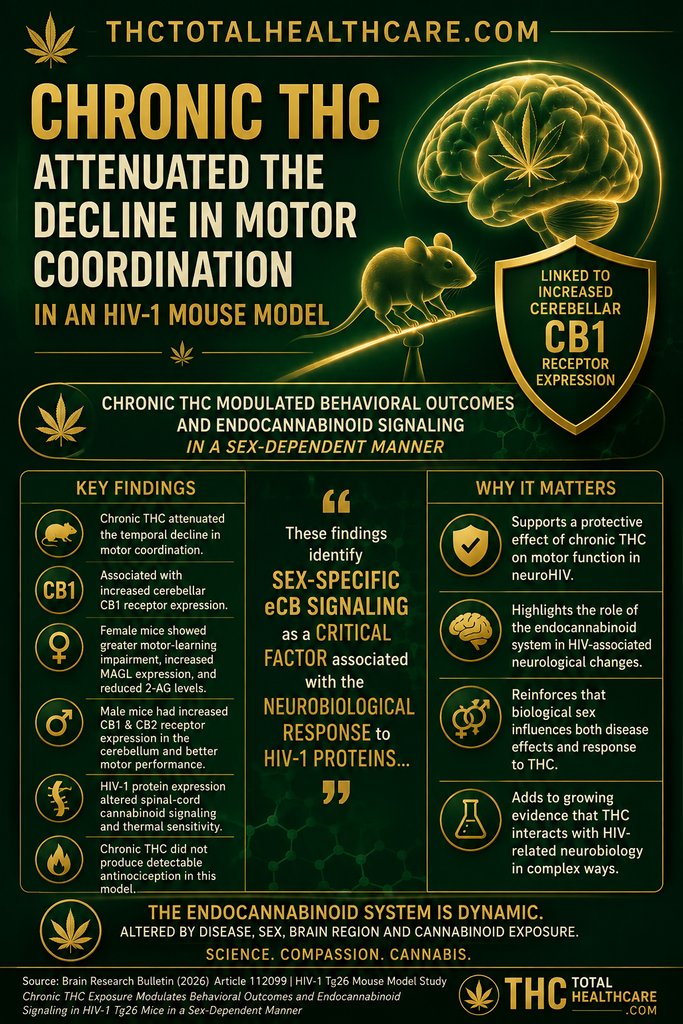
Researchers examined how chronic THC exposure affects behavior and endocannabinoid signaling in an HIV-1 mouse model.
Chronic THC helped attenuate the decline in motor coordination and was associated with increased CB1 receptor expression in the cerebellum. The study also found major sex-dependent differences, with female and male mice showing different patterns of motor impairment and endocannabinoid signaling.
THC did not produce detectable pain-relieving effects in this model, but the findings suggest that chronic THC can influence HIV-related neurological changes through the endocannabinoid system.
Overall, the study highlights the complex relationship between THC, HIV-associated neurological dysfunction, and biological sex.
“While combined antiretroviral therapy (cART) has transitioned HIV-1 into a manageable chronic condition, it fails to eradicate latent viral reservoirs in the central nervous system (CNS) that drive persistent neuroinflammation and synaptodendritic injury. Consequently, people living with human immunodeficiency virus type-1 (HIV-1) often utilize cannabis to manage neurological symptoms, yet the long-term impact of exogenous cannabinoids on the HIV-1-burdened brain remains poorly understood.
In this study, we utilized the HIV-1 Tg26 mouse model to evaluate how chronic Δ9-tetrahydrocannabinol (THC, 3mg/kg) exposure influences motor coordination, thermal nociception, and endocannabinoid (eCB) signaling in the context of constitutive viral protein expression.
Our results demonstrate that HIV-1 viral protein expression was associated with impaired acquisition of cerebellum-dependent motor learning in a sex-dependent manner. This deficit was primarily driven by females and coincided with altered markers of eCB plasticity, characterized by elevated monoacylglycerol lipase (MAGL) expression and a depletion of 2-arachidonoylglycerol (2-AG). Conversely, males exhibit increased cerebellar CB1R and CB2R expression, which paralleled preserved rotarod performance. In the spinal cord, viral protein expression was associated with thermal hyposensitivity and a reduction in 2-AG and cannabinoid receptor levels, a pattern consistent with HIV-1-associated alterations in sensory processing circuits.
While chronic THC failed to produce detectable antinociceptive effects, consistent with spinal CB1R downregulation, it successfully attenuated the temporal decline of motor coordination with upregulating cerebellar CB1R. Data from a separate acute THC cohort demonstrated detectable THC and metabolite concentrations in plasma and cortex, while also revealing sex- and genotype-dependent differences in these measures.
Together, these findings identify sex-specific eCB signaling as a critical factor associated with the neurobiological response to HIV-1 proteins and provide a biological framework for understanding sex-dependent variability in cannabinoid efficacy.”
https://pubmed.ncbi.nlm.nih.gov/42660238
“Collectively, these results provide a biological framework for understanding sex-dependent variability in cannabinoid responses and support the inclusion of sex as a key factor in the development of cannabinoid-based adjunct therapies for chronic neuroinflammatory conditions.”
https://www.sciencedirect.com/science/article/pii/S0361923026003862?via%3Dihub