
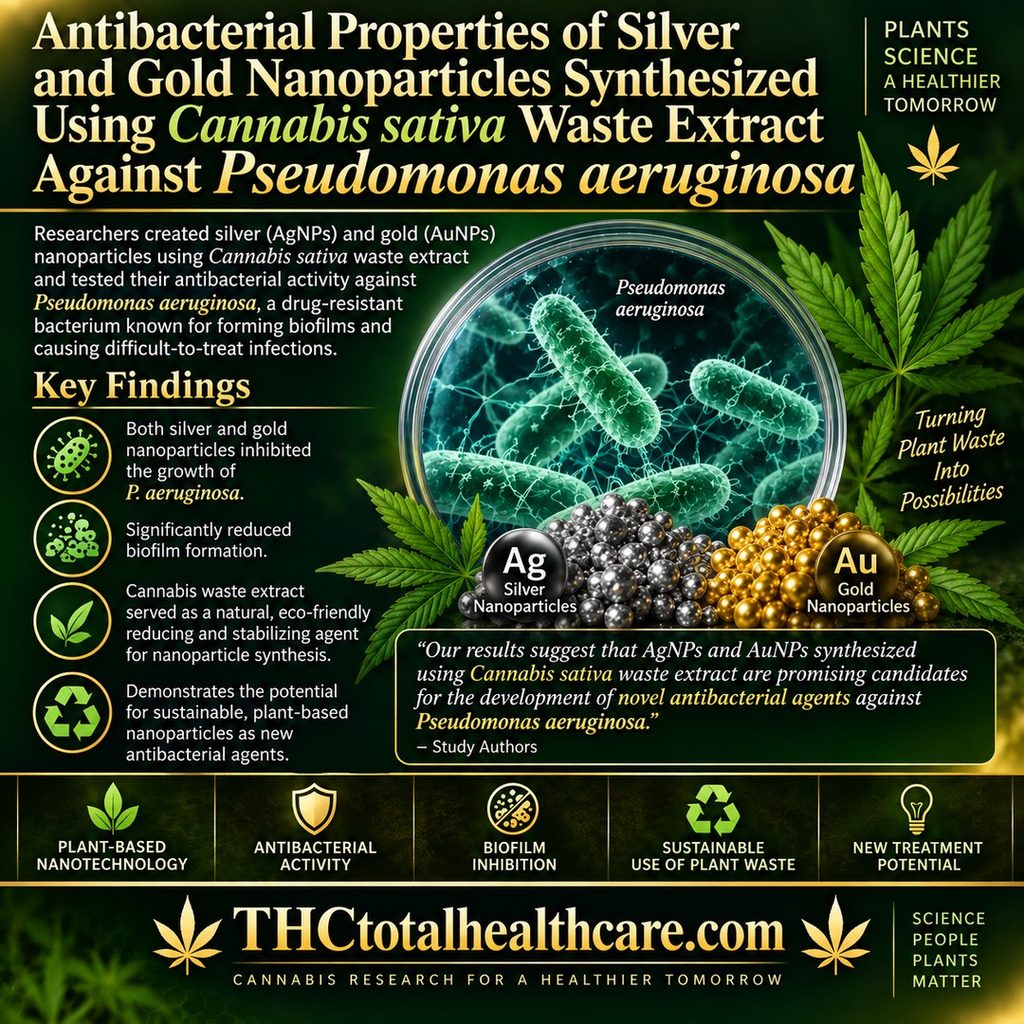
Researchers are finding new uses for Cannabis sativa that go far beyond cannabinoids themselves. In this study, scientists used Cannabis sativa waste extract to synthesize silver and gold nanoparticles and then tested them against Pseudomonas aeruginosa, a difficult-to-treat bacterium known for forming protective biofilms.
The Cannabis-derived silver nanoparticles showed significant antibacterial and anti-biofilm activity, highlighting the potential of plant waste as a sustainable tool for developing new antimicrobial materials. The findings also show how parts of the Cannabis plant that might otherwise be discarded can be repurposed for advanced medical and environmental research.
This study investigated the antimicrobial potential of Cannabis sativa extract, Henola variety, and systems with carriers. The extract showed antimicrobial activity against pathogenic microorganisms, suggesting its possible application as support in combating infections. Additionally, the system with hydroxypropyl-β-cyclodextrin may possess prebiotic properties, stimulating the growth of probiotic microorganisms. Furthermore, the investigated systems exhibit immunomodulatory and immunostimulatory effects, with potential therapeutic implications for modulating inflammatory responses. Overall, these findings underscore the multifaceted therapeutic potential of Cannabis sativa extracts. The delivery systems might be used as powder-based food additives, but they might also be subjected to formulation studies for the development of an oral dietary supplement.
This study investigated the antimicrobial potential of Cannabis sativa extract, Henola variety, and systems with carriers. The extract showed antimicrobial activity against pathogenic microorganisms, suggesting its possible application as support in combating infections. Additionally, the system with hydroxypropyl-β-cyclodextrin may possess prebiotic properties, stimulating the growth of probiotic microorganisms. Furthermore, the investigated systems exhibit immunomodulatory and immunostimulatory effects, with potential therapeutic implications for modulating inflammatory responses. Overall, these findings underscore the multifaceted therapeutic potential of Cannabis sativa extracts. The delivery systems might be used as powder-based food additives, but they might also be subjected to formulation studies for the development of an oral dietary supplement.
“Aims: The study aimed to explore the sustainable synthesis of metal nanoparticles using a green and eco-friendly resource. Specifically, it investigated the utilization of Cannabis sativa waste extract for the production of gold and silver nanoparticles, focusing on their antimicrobial activity against gram-negative bacteria, particularly Pseudomonas aeruginosa strains, which are significant in nosocomial infections.
Methods: Cannabis sativa waste extract was employed to synthesize gold and silver nanoparticles through a green synthesis approach. The produced nanoparticles were characterized using transmission electron microscopy (TEM), atomic absorption spectrometry (AAS), X-ray diffraction (XRD), and Fourier transform infrared spectroscopy (FTIR). The antimicrobial efficacy of the synthesized nanoparticles was assessed through their minimum inhibitory concentration (MIC), minimum bactericidal concentration (MBC), and minimal biofilm inhibitory concentration (MBIC) against Pseudomonas aeruginosa, utilizing a microcultivation device, solid medium cultivation, and a metabolic activity assay in a polystyrene microtiter plate, respectively.
Results: The TEM analysis revealed the size and morphology of the nanoparticles, while AAS confirmed their concentration. XRD provided insights into the crystalline structure, and FTIR analysis identified the molecular structure of the nanoparticle’s stabilizing layer. The synthesized nanoparticles showed significant antimicrobial activity against Pseudomonas aeruginosa, with determined MIC, MBC, and MBIC values of produced silver nanoparticles, showcasing their potential as effective antimicrobial agents.
Conclusions: This study successfully demonstrated the synthesis of silver and gold nanoparticles using Cannabis sativa waste extract and highlighted their potent antimicrobial properties. It underscores the potential of utilizing plant waste extracts in sustainable nanomaterial synthesis and contributes to the fields of green nanotechnology and waste valorization within the circular economy. The findings also offer valuable insights into developing natural waste source-based antimicrobial agents.”
https://pubmed.ncbi.nlm.nih.gov/40221737/
“This study investigated the antimicrobial potential of Cannabis sativa extract, Henola variety, and systems with carriers. The extract showed antimicrobial activity against pathogenic microorganisms, suggesting its possible application as support in combating infections. Additionally, the system with hydroxypropyl-β-cyclodextrin may possess prebiotic properties, stimulating the growth of probiotic microorganisms. Furthermore, the investigated systems exhibit immunomodulatory and immunostimulatory effects, with potential therapeutic implications for modulating inflammatory responses. Overall, these findings underscore the multifaceted therapeutic potential of Cannabis sativa extracts. The delivery systems might be used as powder-based food additives, but they might also be subjected to formulation studies for the development of an oral dietary supplement.”
https://pmc.ncbi.nlm.nih.gov/articles/PMC11047504
https://jcannabisresearch.biomedcentral.com/articles/10.1186/s42238-025-00272-0